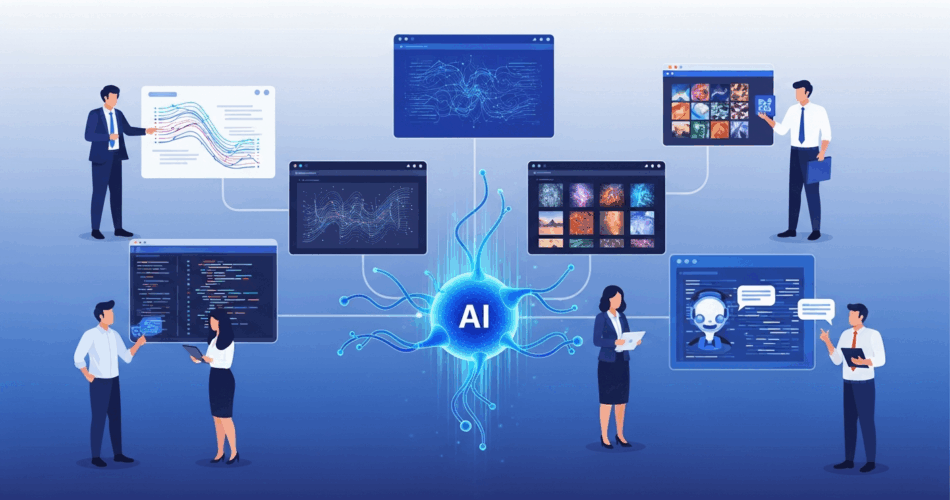
Generative AI isn’t just another tech buzzword—it’s the most transformative technology since the internet. In 2025, generative AI development services have evolved from experimental novelties into mission-critical business tools that are reshaping entire industries. From automating content creation and accelerating product design to revolutionizing customer experiences and enabling predictive decision-making, businesses that leverage generative AI are pulling ahead at an unprecedented pace.
The numbers tell a compelling story. According to McKinsey’s 2024 State of AI Report, generative AI adoption has nearly doubled in just one year, with 65% of organizations now regularly using generative AI in at least one business function. Gartner predicts the generative AI market will reach $137 billion by 2027, growing at a CAGR of over 45%. For businesses, this isn’t a trend to watch—it’s a wave to ride.
But what exactly are generative AI development services? How do they work? Which industries benefit most? And how can your business get started without costly mistakes? This comprehensive guide answers all these questions and more.
What Are Generative AI Development Services?
Generative AI development services encompass the end-to-end design, development, deployment, and optimization of AI systems that can create new, original content—text, images, code, audio, video, 3D models, and more—by learning patterns from existing data.
Unlike traditional AI that classifies, predicts, or recognizes patterns in data, generative AI produces entirely new outputs. Think of the difference between an AI that identifies a cat in a photo (traditional) versus an AI that creates a photorealistic image of a cat that never existed (generative).
Core Components of Generative AI Services
- Large Language Models (LLMs): GPT-4, Claude, Gemini, LLaMA—models that understand and generate human-like text for chatbots, content creation, code generation, and analysis
- Image and Video Generation: DALL-E 3, Midjourney, Stable Diffusion—models that create visual content from text descriptions
- Audio and Speech AI: Text-to-speech, voice cloning, music generation, and audio enhancement models
- Code Generation: AI-powered tools that write, review, debug, and optimize software code
- Multimodal AI: Advanced models that combine text, image, audio, and video understanding in a single system
Modern generative AI development services go far beyond simply plugging into an API. They include custom model fine-tuning, RAG (Retrieval Augmented Generation) pipeline development, enterprise integration, safety guardrails, and ongoing optimization—all tailored to your specific business needs.
Why Businesses Are Investing in Generative AI Development Services
The business case for generative AI has never been stronger. Here’s why enterprises across every industry are making significant investments:
1. Exponential Productivity Gains
Generative AI doesn’t just automate tasks—it multiplies human capability. According to Harvard Business Review, knowledge workers using generative AI tools complete tasks 25-40% faster with higher quality outputs. For software developers specifically, GitHub’s research shows a 55% improvement in coding speed.
2. Hyper-Personalized Customer Experiences
Generic, one-size-fits-all customer interactions are dead. Generative AI enables:
- Personalized product recommendations based on real-time behavior analysis
- Dynamic content generation tailored to individual customer preferences
- AI-powered chatbots that understand context and provide human-like responses
- Automated email campaigns with individually crafted messaging
A Salesforce study found that 73% of customers expect companies to understand their unique needs. Generative AI makes this level of personalization possible at scale.
3. Accelerated Innovation Cycles
From pharmaceutical drug discovery to architectural design, generative AI is compressing innovation timelines from years to months:
- Product Design: AI-generated prototypes reduce design cycles by 60-80%
- Drug Discovery: Generative models identify promising drug candidates 10x faster
- Marketing: Campaign creation that took weeks now happens in hours
- Software Development: AI-assisted coding cuts development time by 35-55%
4. Significant Cost Reduction
Automating repetitive cognitive tasks with generative AI delivers substantial cost savings. McKinsey estimates generative AI could add $2.6 to $4.4 trillion annually to the global economy across 63 use cases they analyzed. The biggest impact areas include customer operations (potential 30-45% cost reduction), marketing and sales (5-15% revenue increase), and software engineering (20-45% efficiency gains).
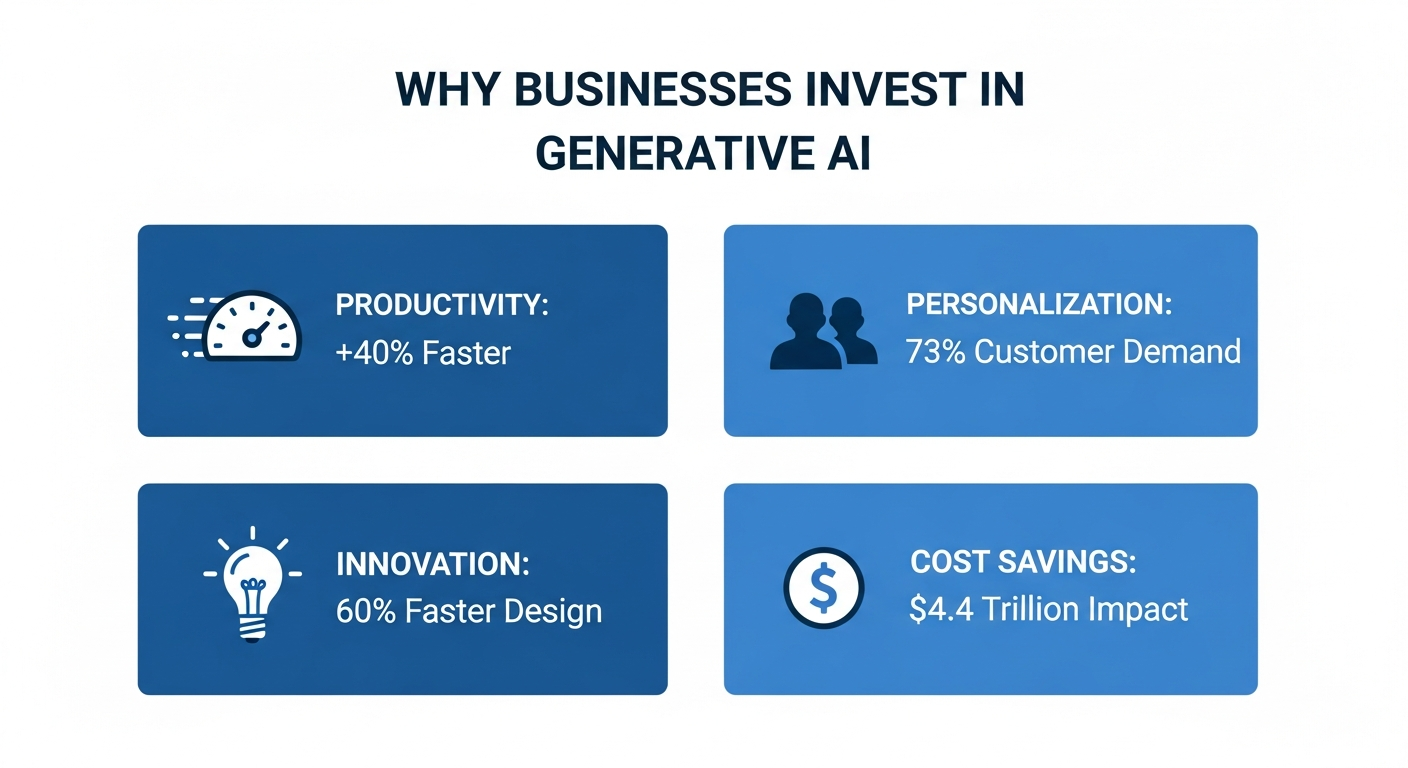
Key business drivers behind generative AI investment: productivity, personalization, innovation, and cost savings
Key Generative AI Services and Their Business Applications
Let’s explore the specific generative AI development services that are delivering the highest ROI for enterprises:
Custom LLM Development and Fine-Tuning
Off-the-shelf language models are powerful but generic. Custom LLM development involves fine-tuning foundation models on your proprietary data to create AI that understands your business domain deeply.
Business Applications:
- Internal knowledge assistants that answer employee questions using company-specific information
- Customer support chatbots trained on your product documentation and support history
- Document analysis and summarization for legal, financial, and compliance teams
- Code generation assistants trained on your codebase and coding standards
Real-World Impact: Organizations using fine-tuned LLMs report 70% fewer AI hallucinations compared to generic models, according to research published in arXiv.
RAG (Retrieval Augmented Generation) Systems
RAG combines the creative power of generative AI with the accuracy of real-time data retrieval. Instead of relying solely on training data, RAG systems pull relevant information from your knowledge base before generating responses.
Why RAG Matters:
- Always up-to-date responses based on current information
- Dramatically reduced hallucinations with source attribution
- No need to retrain models when information changes
- Enterprise-grade accuracy for mission-critical applications
AI-Powered Content Generation
Content creation at scale with brand consistency:
- Marketing Copy: Blog posts, social media content, email campaigns, ad copy
- Product Descriptions: E-commerce listings, catalogs, specifications
- Technical Documentation: API docs, user guides, release notes
- Creative Content: Brand storytelling, video scripts, presentations
Computer Vision and Image Generation
Visual AI services that transform business operations:
- Product Visualization: Generate photorealistic product images without physical photography
- Quality Inspection: AI-powered visual inspection for manufacturing defects
- Medical Imaging: Enhanced diagnostic imaging analysis and report generation
- Design Automation: Generative design for architecture, fashion, and product development
Conversational AI and Intelligent Chatbots
Next-generation chatbots powered by generative AI that go beyond scripted responses:
- Natural, human-like conversations with context understanding
- Multi-language support without separate model training
- Emotional intelligence and sentiment-aware responses
- Seamless integration with CRM, ERP, and business systems
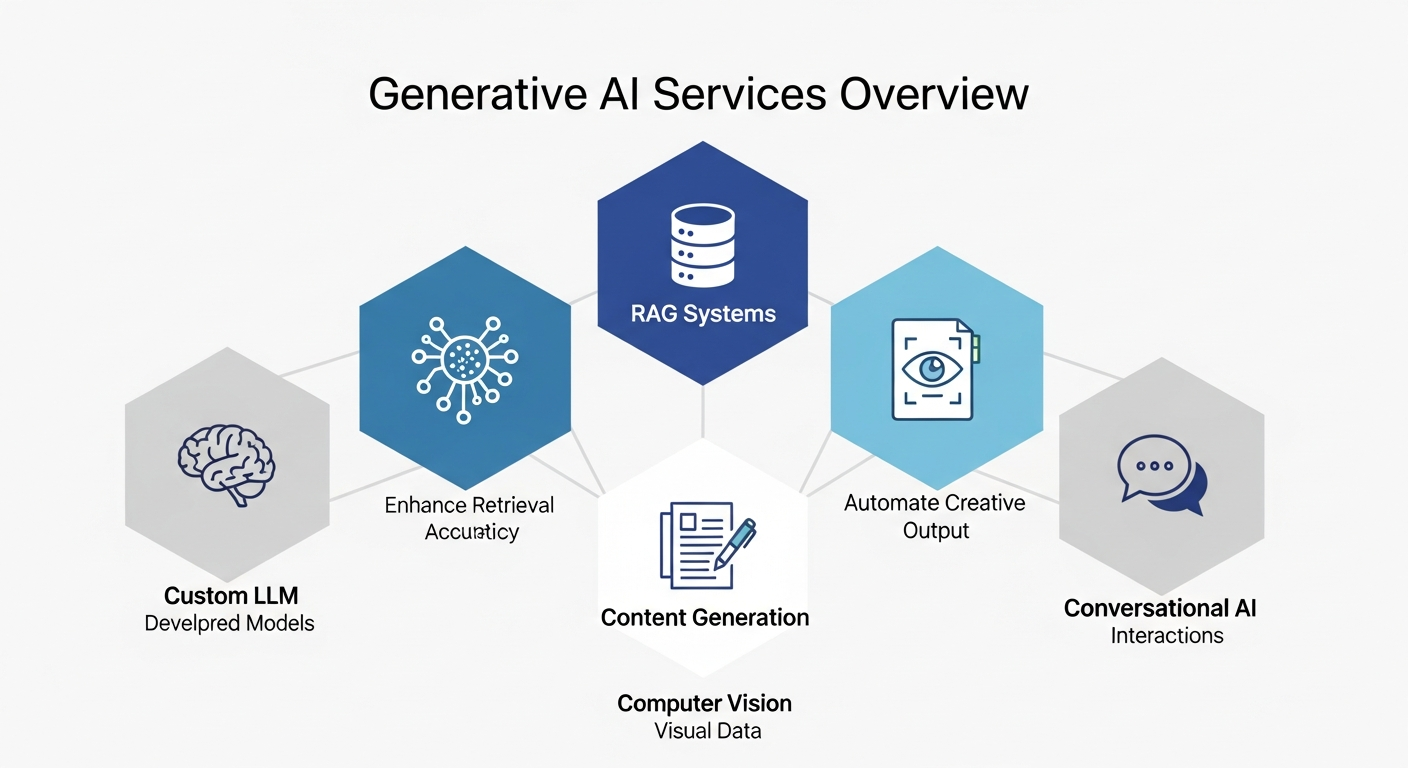
Overview of core generative AI service categories and their business applications
Industry-Specific Generative AI Applications
Generative AI development services are creating transformative impact across industries:
Healthcare and Life Sciences
- Drug molecule generation and virtual screening
- Clinical trial design optimization
- Automated medical report generation
- Patient communication and care coordination
Financial Services
- Automated financial report generation and analysis
- Fraud detection with synthetic data augmentation
- Personalized investment advisory content
- Regulatory compliance document processing
Manufacturing
- Generative design for product optimization
- Predictive maintenance documentation
- Supply chain scenario modeling
- Quality control automation
Retail and E-commerce
- Personalized product recommendations
- Dynamic pricing content
- AI-generated product descriptions at scale
- Virtual try-on and product visualization
The Generative AI Technology Stack
A robust generative AI implementation requires multiple technology layers working together:
Foundation Models
- Commercial APIs: OpenAI GPT-4, Anthropic Claude, Google Gemini
- Open-Source Models: Meta LLaMA 3, Mistral, Falcon, DeepSeek
- Specialized Models: Domain-specific models for healthcare, legal, finance
Data and Infrastructure Layer
- Vector Databases: Pinecone, Weaviate, Milvus, ChromaDB
- GPU Computing: NVIDIA A100/H100, cloud GPU instances
- MLOps Platforms: Model versioning, monitoring, and deployment
Application Layer
- Orchestration: LangChain, LlamaIndex, Semantic Kernel
- API Gateways: Rate limiting, authentication, load balancing
- Safety Systems: Content moderation, PII detection, prompt injection protection
How to Choose the Right Generative AI Development Partner
Selecting the right development partner is critical. Here’s what to evaluate:
Technical Expertise
- Proven experience with multiple AI frameworks and models
- Deep understanding of RAG, fine-tuning, and prompt engineering
- Track record of deploying AI in production environments
- Expertise in your specific industry vertical
End-to-End Capabilities
- From strategy and data preparation to deployment and maintenance
- Full-stack development team (ML engineers, data engineers, software engineers)
- Security and compliance expertise (SOC 2, HIPAA, GDPR)
- Ongoing optimization and support
Proven Results
- Case studies with measurable business outcomes
- Client testimonials and references
- Industry recognition and thought leadership
According to Stack Overflow’s 2024 Developer Survey, 76% of developers are using or planning to use AI tools in their development process. The demand for skilled AI development partners has never been higher.
Getting Started: Your Generative AI Roadmap
Here’s a proven framework for successfully adopting generative AI development services:
Phase 1: Discovery and Strategy (2-3 Weeks)
- Identify high-impact use cases with clear ROI potential
- Assess data readiness and quality
- Define success metrics and KPIs
- Evaluate build vs. buy options
Phase 2: Proof of Concept (4-6 Weeks)
- Build a focused MVP for the top use case
- Validate accuracy, performance, and user experience
- Gather feedback and iterate
- Quantify business impact
Phase 3: Production Deployment (6-12 Weeks)
- Scale the solution with production-grade infrastructure
- Implement security, monitoring, and governance
- Integrate with existing business systems
- Train end users and establish support processes
Phase 4: Continuous Optimization (Ongoing)
- Monitor model performance and accuracy
- Retrain and fine-tune based on new data
- Expand to additional use cases
- Stay current with evolving AI capabilities
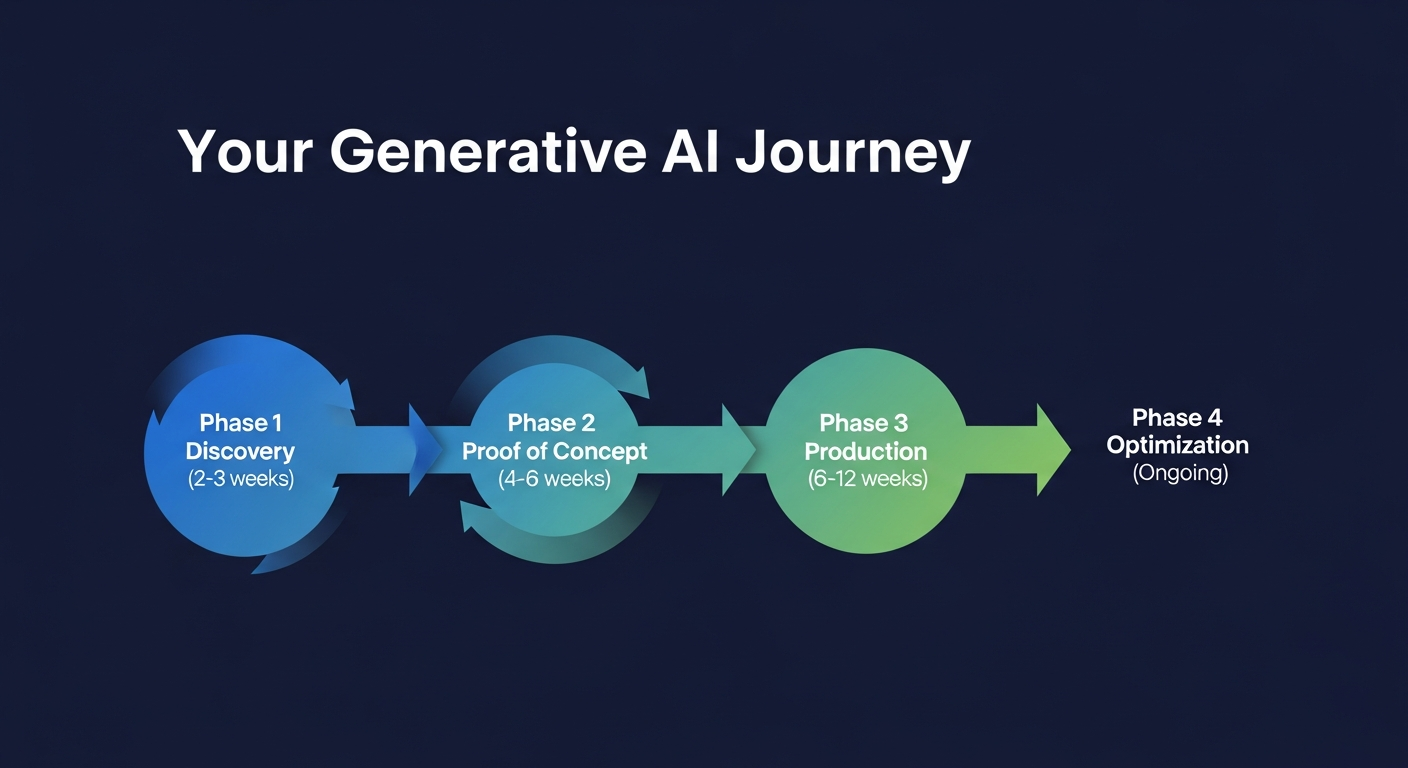
A proven four-phase roadmap for successfully adopting generative AI in your organization
The Future of Generative AI: What’s Coming Next
The generative AI landscape is evolving at breakneck speed. Here are the trends shaping the future:
- Multimodal AI: Models that seamlessly combine text, image, audio, and video understanding
- AI Agents: Autonomous systems that can plan, reason, and execute complex multi-step tasks
- Edge AI: Generative models running on devices without cloud connectivity
- Specialized Small Models: Efficient, domain-specific models that rival larger general-purpose ones
- Responsible AI: Built-in safety, bias detection, and ethical guardrails becoming standard
Gartner’s 2025 Technology Trends identifies generative AI as the most impactful technology for enterprise transformation in the next five years. Organizations that invest now will have a decisive competitive advantage.
Conclusion: The Time to Act Is Now
Generative AI development services represent the single biggest opportunity for business transformation in a generation. The technology has matured, the business cases are proven, and the competitive landscape is shifting rapidly. Companies that invest in generative AI today are building capabilities that will define their market position for years to come.
Whether you’re looking to automate customer service, accelerate product development, enhance content creation, or build entirely new AI-powered products, the right generative AI development partner can help you turn these ambitions into reality.
The question isn’t whether your business should adopt generative AI—it’s how quickly you can start.
About DreamzTech: We’re a leading Generative AI development company specializing in custom LLM development, RAG systems, and enterprise AI solutions. Our team combines deep technical expertise with practical business acumen to deliver AI systems that create measurable value.
Ready to unlock the power of generative AI? Contact us today for a no-obligation consultation about your generative AI project.