Hiring an AI consultant in 2026 is one of the highest-stakes decisions a CTO can make. Get it right, and you accelerate your organization’s competitive advantage by years. Get it wrong, and you waste six figures on a glossy strategy deck that never translates into production-ready AI.
According to McKinsey’s 2025 State of AI report, 72% of organizations have adopted AI in at least one business function—but only 26% have successfully scaled AI beyond pilot projects. The gap between AI adoption and AI success is where AI consulting services either prove their value or expose their limitations.
This guide is written specifically for CTOs, VPs of Engineering, and technology leaders evaluating AI consulting partners. We cover the critical questions you must ask, the cost ranges to expect, the red flags to watch for, and a practical framework for choosing the right AI consulting firm for your organization.
What Are AI Consulting Services?
AI consulting services encompass a broad range of advisory, strategy, and implementation support that helps organizations adopt artificial intelligence effectively. Unlike traditional IT consulting, AI consulting requires deep expertise in machine learning, data science, large language models (LLMs), MLOps, and the rapidly evolving AI technology landscape.
At a high level, AI consulting services fall into four categories:
- AI Strategy and Roadmap: Assessing AI readiness, identifying use cases, building a prioritized implementation roadmap, and defining success metrics
- AI Implementation and Development: Hands-on building of AI models, pipelines, integrations, and production systems
- AI Team Augmentation: Providing specialized AI/ML engineers to supplement your existing development team
- AI Training and Enablement: Upskilling your team to manage, maintain, and extend AI systems independently
The best AI consulting firms deliver all four. As Gartner emphasizes, the most successful AI engagements combine strategic advisory with hands-on implementation—consultants who only advise but never build often produce recommendations that are technically impractical.
7 Critical Questions CTOs Must Ask Before Hiring an AI Consultant
Before signing any engagement, use these seven questions to separate capable AI partners from overpromising vendors. Each question is designed to reveal whether a consulting firm has the depth, experience, and integrity to deliver real results.
1. What Is Your Track Record with Projects Like Ours?
This is the single most important question. Ask for:
- Specific case studies in your industry or with similar technical challenges
- Measurable outcomes—not “we built an AI model” but “we reduced customer churn by 32% within 6 months”
- Client references you can actually contact (not just logos on a slide deck)
- Production deployments—POCs and demos are easy; scaling to production is where most projects fail
According to Harvard Business Review, 80% of AI projects never make it past the pilot stage. A strong consulting partner should be able to demonstrate a track record of moving projects from concept to production.
2. Do They Understand Your Industry?
AI in healthcare looks nothing like AI in fintech or manufacturing. Industry-specific knowledge matters because:
- Regulatory requirements vary dramatically (HIPAA, SOC 2, PCI DSS, GDPR)
- Data types and formats are industry-specific
- Domain expertise accelerates model development and reduces costly iterations
- Integration patterns differ based on industry-standard platforms (Epic in healthcare, SAP in manufacturing)
A consultant with deep fintech experience will be 3–5x more efficient on a banking AI project than a generalist consultant learning the domain on your dime.
3. What Is Their Technical Depth?
AI consulting requires a breadth of technical capabilities. Evaluate whether the firm has hands-on expertise in:
- Large Language Models (LLMs): Fine-tuning, RAG architecture, prompt engineering, model evaluation
- Machine Learning: Classical ML, deep learning, computer vision, NLP
- Data Engineering: Data pipelines, ETL/ELT, data warehousing, feature engineering
- MLOps: Model deployment, monitoring, versioning, CI/CD for ML
- Cloud AI Platforms: AWS SageMaker, Azure AI, Google Vertex AI
- Generative AI: Custom GPT applications, image generation, code generation
Beware of firms that rebrand traditional software development as “AI consulting.” Ask to speak directly with their ML engineers, not just their sales team. A firm with genuine generative AI development capabilities will be transparent about their team’s qualifications and technical approach.
4. How Do They Handle Data Security and Compliance?
Your AI consultant will have access to some of your most sensitive data. Before engagement:
- Review their security certifications (SOC 2 Type II, ISO 27001)
- Understand their data handling policies—where is data stored, who has access, how is it encrypted?
- Verify compliance with regulations relevant to your industry
- Ensure clear data ownership agreements—your data and trained models should remain your intellectual property
- Check their incident response procedures
According to Cisco’s Data Privacy Benchmark Study, organizations that vet vendor security practices thoroughly experience 45% fewer data-related incidents during AI implementations.
5. What Does Their Engagement Model Look Like?
Different consulting models suit different needs:
- Fixed-Price Projects: Best for well-defined scope. Typical for strategy engagements or specific AI features. Risk: scope creep can lead to change orders.
- Time and Materials (T&M): Best for exploratory or evolving projects. You pay for actual hours worked. Risk: costs can exceed estimates without strong project management.
- Dedicated Teams: Best for long-term engagements. A full AI team works exclusively on your projects. Risk: requires clear internal leadership to direct the team effectively.
- Outcome-Based Pricing: Consultant compensation tied to specific business outcomes. Risk: misaligned incentives if metrics aren’t carefully defined.
For most CTOs, a phased approach works best: start with a fixed-price discovery phase (4–6 weeks, $15,000–$40,000), then transition to T&M or dedicated team for implementation.
6. Can They Scale Beyond the POC?
The graveyard of AI projects is littered with brilliant proof-of-concepts that never survived contact with production reality. Ask specifically about:
- Their production deployment methodology and infrastructure expertise
- How they handle model monitoring, retraining, and drift detection
- Their experience with enterprise-scale data volumes and real-time inference
- Post-deployment support and SLA commitments
- Knowledge transfer plans so your team can maintain the system
A capable AI software development partner treats production deployment as the beginning of the journey, not the end.
7. How Do They Measure ROI and Success?
Vague promises of “AI transformation” are worthless without concrete metrics. Insist on:
- Clearly defined KPIs agreed upon before the engagement begins
- Regular progress reporting against those KPIs
- A realistic timeline for when you should expect measurable results
- A framework for calculating total cost of ownership (TCO) including ongoing operations
According to Deloitte’s AI survey, organizations that define clear AI success metrics before starting a project are 3x more likely to report significant ROI from their AI investments.
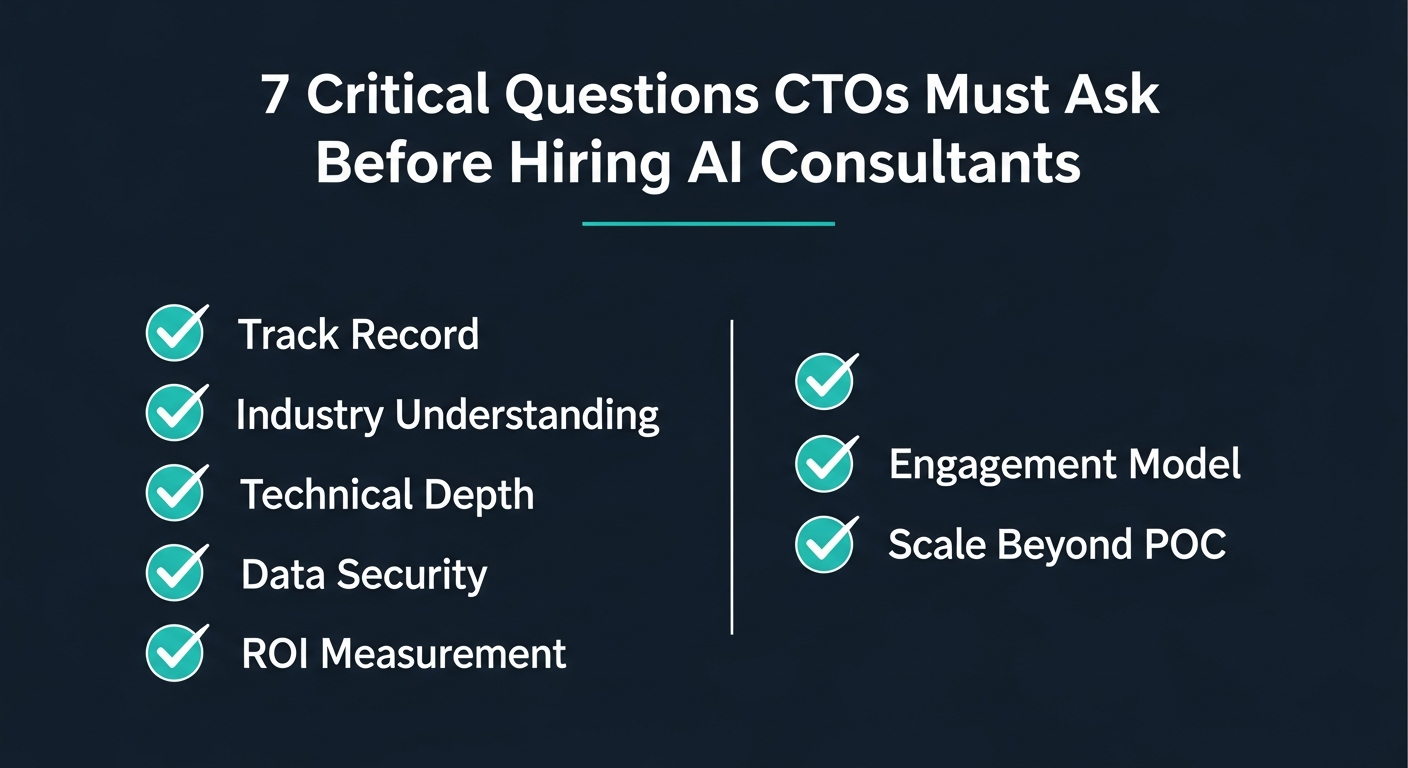
7 Critical Questions Every CTO Should Ask Before Hiring an AI Consulting Partner
Types of AI Consulting Engagements
Understanding the different engagement types helps you choose the right fit for your current needs and maturity level:
AI Strategy Consulting
Duration: 4–8 weeks | Cost: $15,000–$75,000
Strategy engagements are designed for organizations at the beginning of their AI journey. Deliverables typically include:
- AI readiness assessment across data, infrastructure, team skills, and organizational culture
- Use case identification and prioritization using impact-effort analysis
- Technology stack recommendations based on your existing infrastructure
- AI roadmap with phased milestones, resource requirements, and estimated costs
- Business case and ROI projections for executive stakeholders
AI Implementation Consulting
Duration: 3–12 months | Cost: $75,000–$500,000+
Implementation engagements involve hands-on development and deployment of AI solutions. This is where an experienced generative AI development company delivers the most value:
- Custom model development, training, and fine-tuning
- Data pipeline engineering and infrastructure setup
- Integration with existing enterprise systems (CRM, ERP, data warehouse)
- Production deployment with monitoring, alerting, and auto-scaling
- Documentation, testing, and knowledge transfer
Managed AI Services
Duration: Ongoing | Cost: $5,000–$50,000/month
For organizations that need continuous AI operations without building a full in-house AI team:
- Ongoing model monitoring and performance optimization
- Regular retraining cycles as data evolves
- Infrastructure management and cost optimization
- Feature development and enhancements
- 24/7 support and incident response
AI Team Augmentation
Duration: 3–12 months | Cost: $10,000–$30,000/month per engineer
When you need specialized AI talent without the overhead of permanent hires, hiring dedicated AI developers provides flexibility:
- Experienced ML engineers, data scientists, or MLOps specialists embedded in your team
- Work under your technical leadership and project management
- Faster onboarding than recruiting—typically 1–2 weeks vs. 2–4 months
- Scale up or down based on project needs without long-term commitments
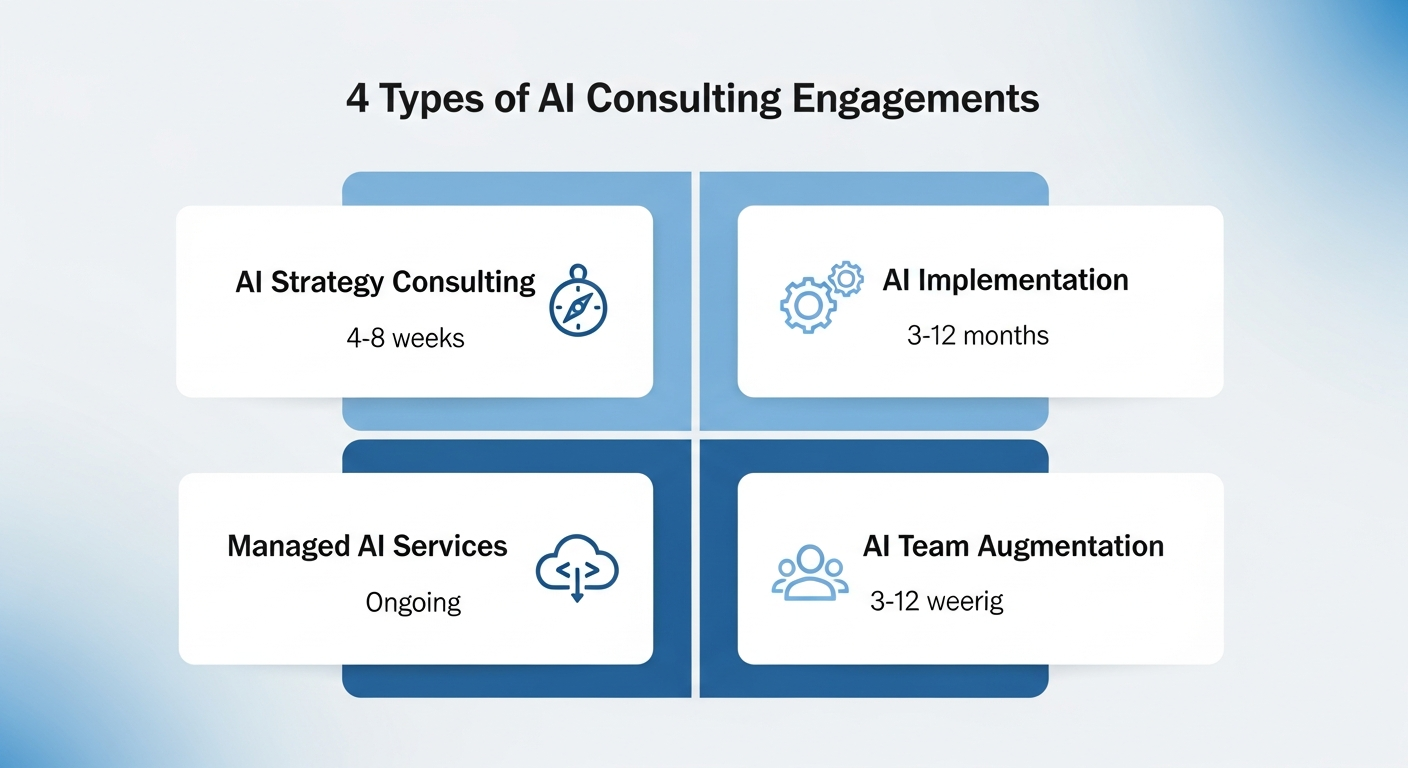
Four Types of AI Consulting Engagements: Choose the Right Fit for Your Organization
Red Flags to Watch For When Hiring AI Consultants
After evaluating hundreds of AI consulting proposals, these red flags consistently predict poor outcomes:
1. They Promise Guaranteed Results
AI is inherently experimental. Any consultant who guarantees specific accuracy levels or business outcomes before understanding your data is either dishonest or inexperienced. Reputable consultants commit to a rigorous process, not predetermined results.
2. They Cannot Explain Their Approach in Simple Terms
If a consultant drowns you in jargon without clearly articulating why a specific technical approach solves your business problem, that is a warning sign. The best AI consultants translate complex technology into business language.
3. They Skip the Data Assessment
Any AI firm that jumps straight to model building without thoroughly assessing your data quality, availability, and governance is setting you up for failure. Data assessment should be the first deliverable, not an afterthought.
4. They Have No Post-Deployment Plan
AI models degrade over time. If the proposal doesn’t include monitoring, retraining, and maintenance planning, you will inherit a system that works on day one and fails within months.
5. Their Team Is All Generalists
Effective AI consulting teams include specialized roles: ML engineers, data engineers, MLOps specialists, and domain experts. A team of “full-stack AI consultants” without deep specialization often delivers shallow solutions.
6. They Lock You Into Proprietary Tools
Beware of consultants who build solutions on proprietary platforms or frameworks that create dependency on their services. Insist on open standards, clear documentation, and full IP transfer.
AI Consulting Costs: What to Expect in 2026
Understanding cost ranges helps you budget effectively and evaluate proposals fairly. Here are current market rates based on analysis from McKinsey and industry benchmarks:
Hourly Rates by Firm Type
- Big Four / McKinsey / BCG: $300–$600/hour — Best for Fortune 500 strategy engagements with board-level deliverables
- Specialized AI Consultancies: $150–$350/hour — Best for implementation-focused engagements requiring deep technical expertise
- Boutique AI Firms: $100–$200/hour — Best for mid-market companies wanting personalized attention and cost efficiency
- Offshore AI Partners (Top-Tier): $40–$100/hour — Best for cost-conscious organizations with clear requirements and strong internal project management
Cost by Engagement Type
- AI Strategy and Roadmap: $15,000–$75,000
- AI Proof of Concept (POC): $25,000–$100,000
- Custom AI Model Development: $75,000–$500,000+
- Enterprise AI Platform: $200,000–$2,000,000+
- Managed AI Operations: $5,000–$50,000/month ongoing
- AI Team Augmentation: $10,000–$30,000/month per engineer
For a comprehensive breakdown of AI development costs, see our detailed guide on AI software development costs in 2026.
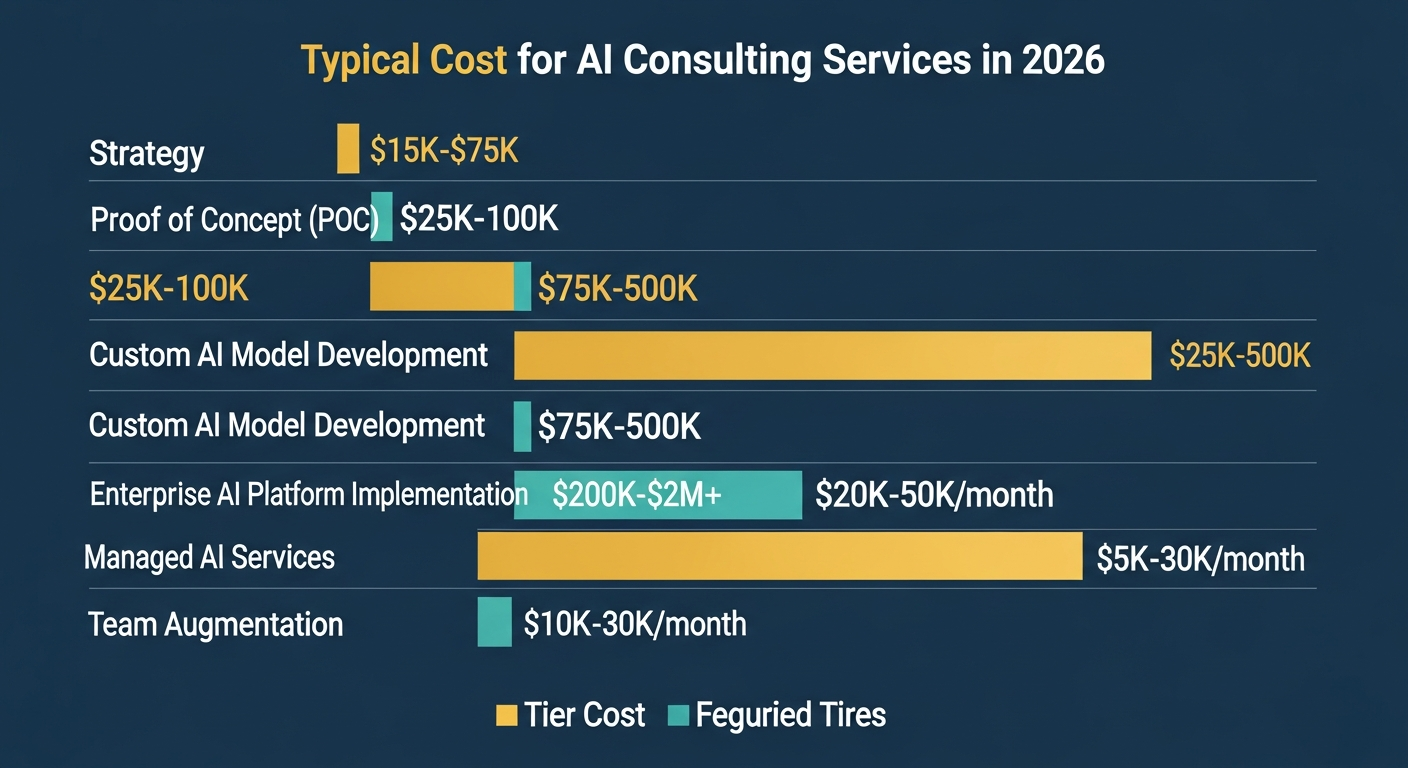
AI Consulting Cost Ranges in 2026 by Engagement Type
How to Evaluate AI Consulting Proposals: A CTO’s Framework
When you have proposals from multiple AI consulting firms, use this structured framework to compare them objectively:
Technical Evaluation (40% Weight)
- Technical approach clarity: Is the proposed methodology well-defined and appropriate for your use case?
- Architecture decisions: Are technology choices justified with clear reasoning (not just buzzword compliance)?
- Scalability planning: Does the proposal address performance at production scale, not just POC scale?
- Security architecture: Is security designed-in from the start, or bolted on as an afterthought?
Team Assessment (25% Weight)
- Named team members: Are specific individuals assigned with verifiable credentials?
- Relevant experience: Does the proposed team have experience in your industry and technology stack?
- Team stability: What is their retention rate? Will the same people who start the project finish it?
- Communication skills: Can technical team members explain concepts clearly to non-technical stakeholders?
Delivery and Risk Management (20% Weight)
- Milestone structure: Are milestones specific, measurable, and tied to business outcomes?
- Risk identification: Does the proposal proactively identify technical and organizational risks?
- Change management: Is there a plan for handling scope changes, data quality issues, or model performance challenges?
- Knowledge transfer: How will your team be equipped to own the solution post-engagement?
Commercial Terms (15% Weight)
- Pricing transparency: Is the pricing detailed and justifiable, or a single lump-sum number?
- IP ownership: Do you own all deliverables, code, models, and data outputs?
- Payment terms: Are payments tied to milestone delivery, not just calendar dates?
- Exit clauses: Can you terminate early without excessive penalties if the engagement isn’t delivering value?
Real-World AI Consulting Case Studies
Here are representative examples of successful AI consulting engagements across different industries:
Case Study 1: Healthcare — Clinical Document AI
- Challenge: A regional hospital network needed to automate clinical document processing, reducing physician administrative burden
- Engagement: 6-month implementation consulting with HIPAA-compliant AI solution
- Solution: Fine-tuned LLM with RAG architecture for clinical note summarization and coding suggestions
- Investment: $280,000
- Result: 60% reduction in documentation time, $1.8M annual savings, 94% physician satisfaction
Case Study 2: Financial Services — Fraud Detection Enhancement
- Challenge: A mid-size bank’s existing rule-based fraud system was generating 85% false positives, overwhelming the investigation team
- Engagement: 4-month AI implementation with dedicated data science team
- Solution: Ensemble ML model combining gradient boosting with graph neural networks for transaction analysis
- Investment: $180,000
- Result: False positives reduced by 72%, actual fraud detection improved by 34%, $2.1M annual savings
Case Study 3: Retail — Demand Forecasting Platform
- Challenge: A multi-location retailer struggled with inventory management, leading to 12% stockout rate and 18% overstock waste
- Engagement: 5-month strategy + implementation consulting
- Solution: Deep learning forecasting model integrating sales data, weather, events, and competitor pricing
- Investment: $150,000
- Result: Stockout rate reduced to 3%, overstock waste cut by 65%, $3.2M annual inventory savings
When to Hire AI Consultants vs. Build In-House
This is one of the most consequential decisions a CTO will make. Here is a practical decision framework:
Hire AI Consultants When:
- You’re starting your AI journey and need expert guidance to avoid costly mistakes
- You need specialized expertise (LLM fine-tuning, computer vision, MLOps) that doesn’t exist on your team
- Speed matters—consultants can start within weeks vs. 3–6 months to recruit and onboard full-time AI talent
- The project is time-bound—a specific AI initiative with a clear start and end date
- You need an objective assessment of your AI readiness, opportunities, and technology choices
Build In-House When:
- AI is core to your product or competitive advantage—you need permanent, deep AI capability
- You have ongoing AI needs across multiple projects and business units
- Data sensitivity is extreme—some organizations in defense or intelligence prefer zero external access
- You have a strong AI leader (VP of AI or Chief AI Officer) who can build and manage the team
The Hybrid Approach (Most Effective)
According to MIT Sloan Management Review, the most successful organizations use a hybrid model: build core AI leadership and strategy in-house while leveraging external consultants for specialized implementation, surge capacity, and continuous learning.
Start with AI consulting to accelerate your first 2–3 projects, use that experience to define what in-house capabilities you need, then gradually build your internal team while keeping a consulting partner for specialized needs.
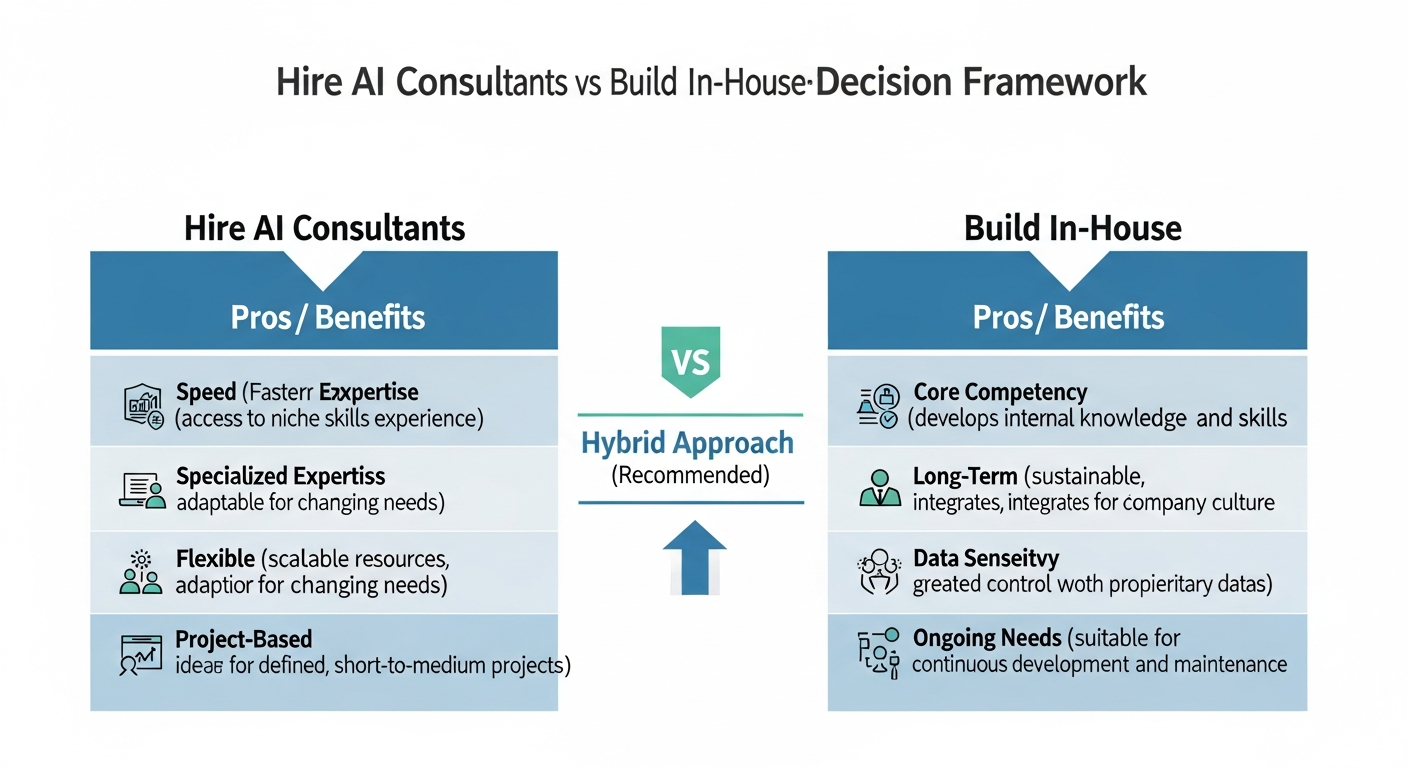
Decision Framework: When to Hire AI Consultants vs. Build an In-House AI Team
Conclusion: Make AI Consulting Work for Your Organization
Hiring an AI consulting partner is not about finding the cheapest option or the most prestigious brand name. It is about finding a firm that combines genuine technical depth with practical business understanding, transparent communication, and a commitment to outcomes that matter to your organization.
Use the seven critical questions as your evaluation framework. Watch for the red flags that predict poor outcomes. Start with a focused engagement to test the relationship before committing to large-scale implementation. And always ensure that knowledge transfer is built into the engagement so your organization grows stronger, not more dependent.
The organizations winning with AI in 2026 are not the ones with the biggest budgets—they are the ones that chose the right partners, asked the right questions, and executed with discipline.
About DreamzTech: We are a leading AI consulting services provider specializing in generative AI development, AI software development, and enterprise AI strategy. Our team delivers cost-effective AI solutions that create measurable business value for organizations worldwide.
Ready to discuss your AI consulting needs? Contact us today for a free, no-obligation consultation with our senior AI strategists.
Frequently Asked Questions
What does an AI consulting company do?
An AI consulting company assesses your business processes, identifies AI opportunities, designs AI implementation roadmaps, recommends the right models and platforms, and helps enterprises integrate AI into existing workflows. Top AI consultants also provide governance frameworks, change management support, and ongoing optimization services.
How do I choose the right AI consulting company?
Choose an AI consulting company based on: domain expertise in your industry, a portfolio of proven enterprise AI deployments, certifications (ISO 27001, SOC2), transparent pricing models, references from similar-sized clients, and the ability to provide end-to-end services from strategy through implementation and support.
What should CTOs ask an AI consulting company before hiring?
CTOs should ask: What AI projects have you completed in our industry? How do you handle data security and compliance? Do you build custom models or rely on third-party APIs? What does success look like and how is it measured? What ongoing support do you provide after deployment? And how do you price your engagement?
How long does an AI consulting engagement typically take?
An initial AI strategy assessment typically takes 4–8 weeks. A full AI implementation project for a specific use case (like a custom AI agent or predictive analytics system) typically takes 3–6 months. Enterprise-wide AI transformation programs are multi-year engagements with phased delivery milestones.
Related reading: Top 10 Benefits of AI-Augmented Software Development — explore the full ROI breakdown.