
The Short Answer: No, But Your Job Is Changing
The Reality: AI won’t replace software developers, but developers who use AI will replace developers who don’t. Think of it like the transition from assembly language to high-level programming languages. Did C++ eliminate programming jobs? No—it eliminated certain types of work and created entirely new categories of development. AI is following the same pattern, but accelerated. According to McKinsey’s 2026 Tech Workforce Report, demand for software developers has actually increased 34% since AI coding assistants became mainstream. But the nature of the work has fundamentally shifted.What AI Can Do (Really Well)
Let’s be honest about AI’s current capabilities:Code Generation
What AI Excels At:- Writing boilerplate code and standard patterns
- Generating CRUD operations
- Creating unit tests for existing functions
- Translating code between programming languages
- Implementing well-known algorithms
Code Review and Debugging
AI Strengths:- Identifying syntax errors and common bugs
- Detecting security vulnerabilities
- Spotting performance issues
- Enforcing coding standards
- Suggesting refactoring opportunities
Documentation
Where AI Shines:- Auto-generating API documentation
- Creating code comments
- Writing basic technical specifications
- Generating user guides from code
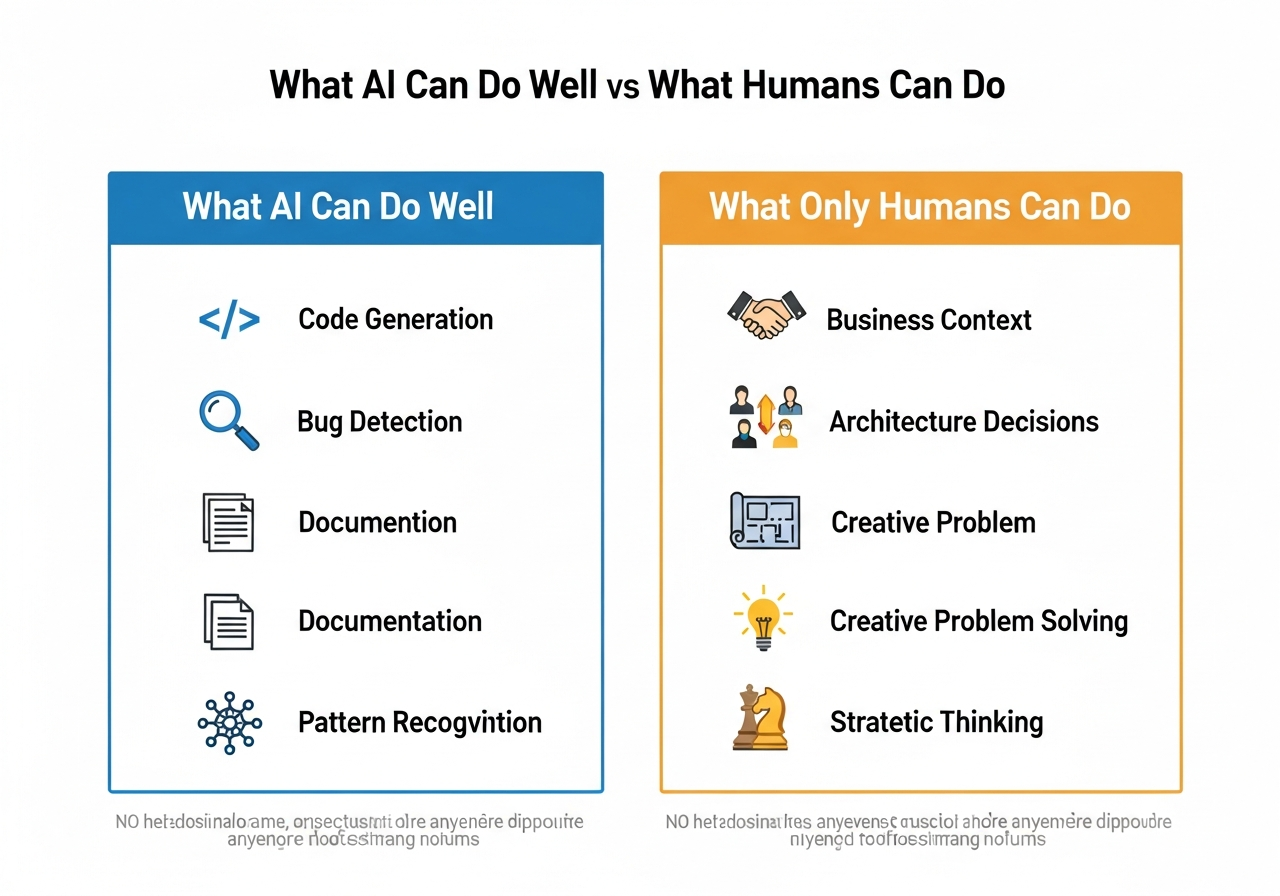
AI vs Human Developer Capabilities – What Each Does Best
What AI Still Can’t Do (And Won’t Anytime Soon)
Here’s what separates great developers from AI code generators:Understanding Business Context
The Human Advantage:- Translating vague business requirements into technical specifications
- Understanding why a feature is needed, not just how to build it
- Recognizing when a technical solution doesn’t solve the actual business problem
- Navigating organizational politics and stakeholder management
- What authorization is required?
- What are the transaction limits?
- How do we handle failures?
- What audit trail is needed?
- What happens if the source account has insufficient funds?
Architectural Decisions
Human-Only Territory:- Designing system architecture that scales for future needs
- Making technology stack choices based on team expertise and business constraints
- Balancing technical debt against feature velocity
- Understanding trade-offs between different approaches
Creative Problem Solving
Where Humans Dominate:- Solving novel problems without existing patterns
- Combining disparate technologies in innovative ways
- Creating elegant solutions to complex constraints
- Thinking outside the box when standard approaches fail
Debugging Complex Systems
Human Expertise Required:- Troubleshooting issues spanning multiple services and systems
- Understanding subtle timing and concurrency bugs
- Debugging problems caused by third-party integrations
- Investigating production issues with incomplete information
Code Taste and Judgment
The Intangibles:- Knowing when “good enough” is better than “perfect”
- Recognizing when to refactor vs. rebuild
- Understanding when technical debt is acceptable
- Balancing quality with delivery timelines
How AI Is Actually Changing Development Work
Instead of replacement, we’re seeing augmentation. Here’s what a typical developer’s day looks like in 2026:Then (2021):
- 30% writing boilerplate code
- 20% debugging syntax errors
- 15% writing tests
- 15% documentation
- 20% actual problem-solving and architecture
Now (2026):
- 5% reviewing AI-generated boilerplate
- 5% fixing AI-suggested bugs
- 3% reviewing AI-generated tests
- 2% reviewing AI-generated docs
- 85% problem-solving, architecture, business logic, and creative development
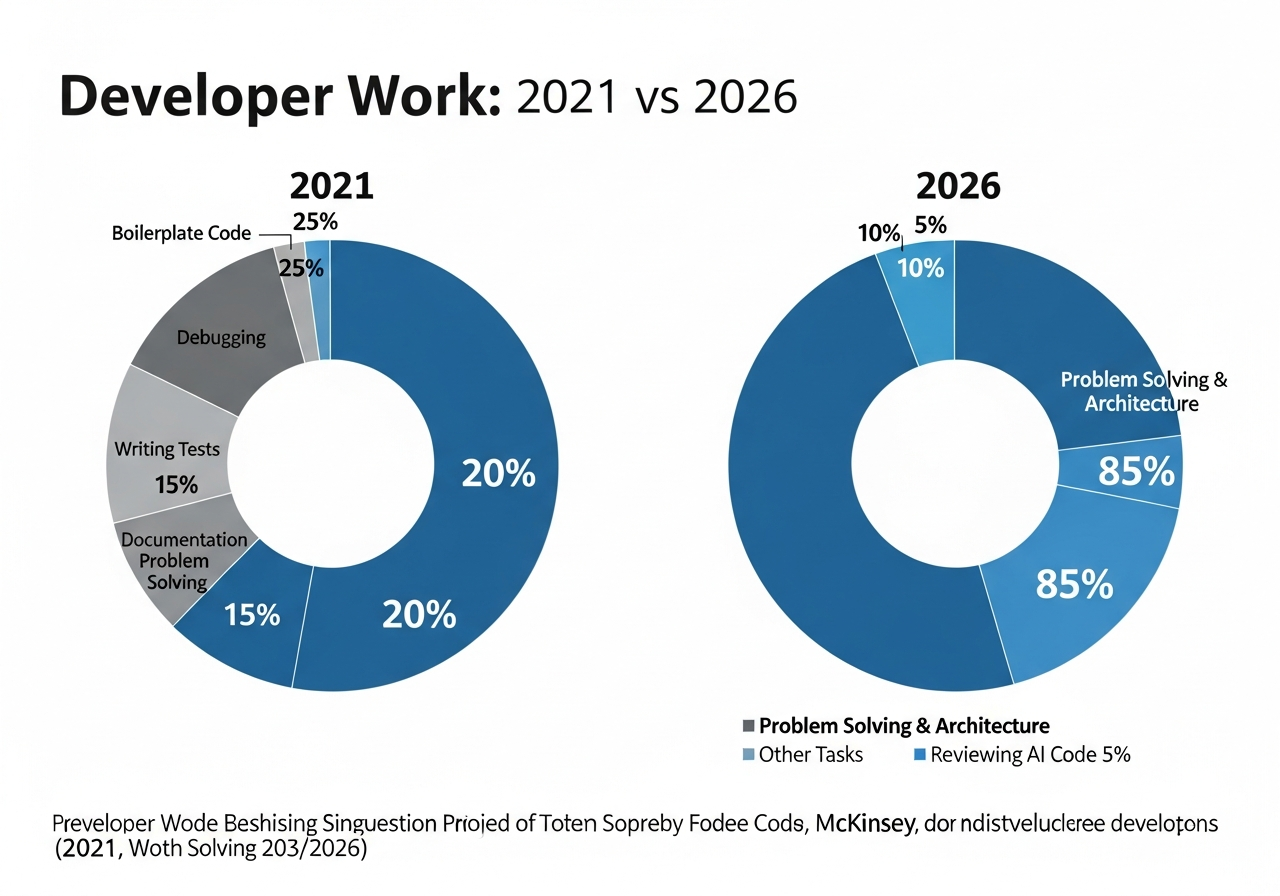
The Dramatic Shift in How Developers Spend Their Time
The Skills That Matter in 2026
The developers thriving in the AI era have adapted their skill sets:Essential Technical Skills
1. AI Tool Proficiency- Knowing which AI tools to use for what tasks
- Writing effective prompts for code generation
- Reviewing and improving AI-generated code
- Understanding AI limitations to avoid bad suggestions
Essential Soft Skills
1. Communication With AI handling code, the ability to:- Understand stakeholder needs
- Explain technical concepts to non-technical audiences
- Collaborate with cross-functional teams
- Document decisions and trade-offs
- Understanding business goals beyond technical requirements
- Anticipating future needs and building accordingly
- Evaluating technical decisions through a business lens
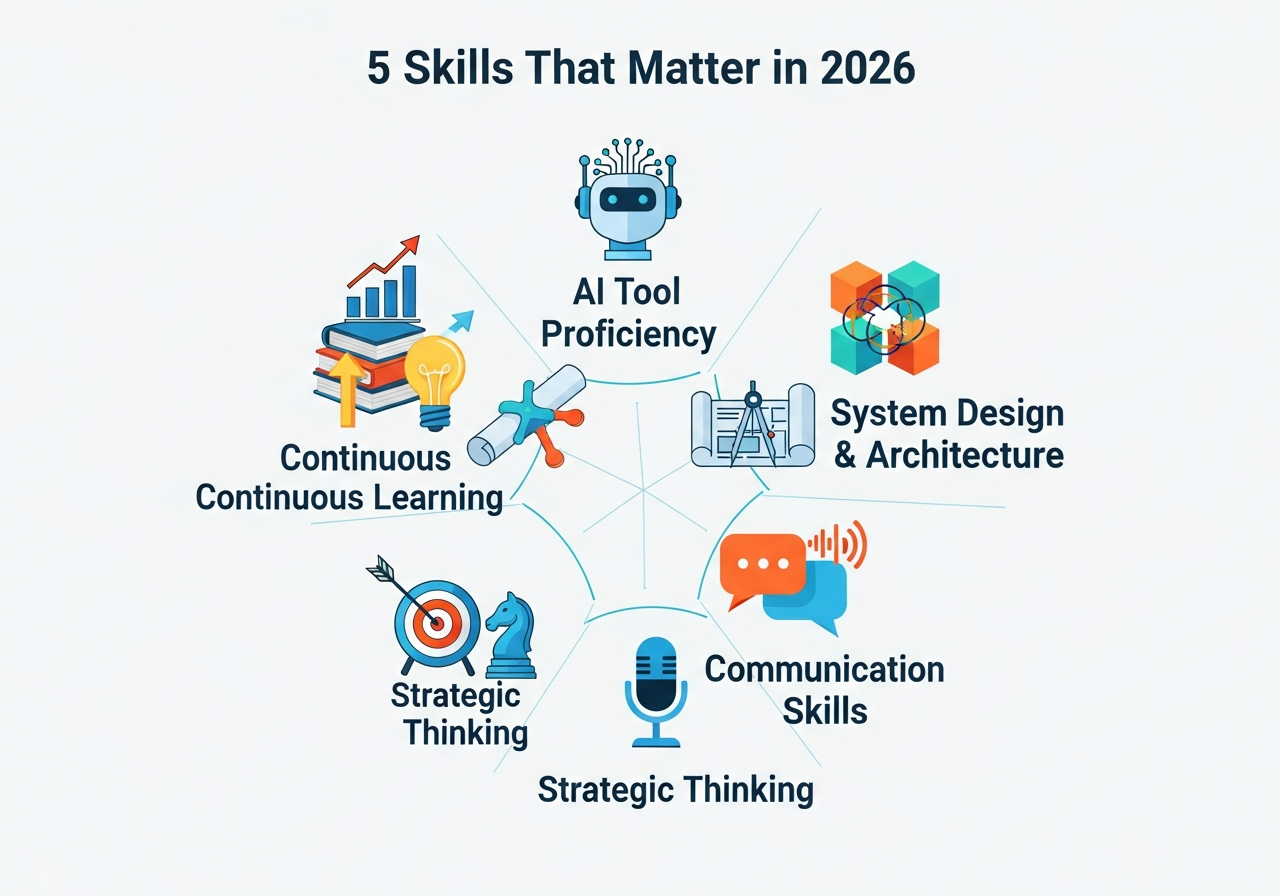
5 Critical Skills Every Developer Needs in 2026
The Jobs That Are Changing (Or Disappearing)
Let’s be honest: some roles are being disrupted:Junior Developer Transition
The Change: Traditional junior developer roles focused on writing simple code are evolving. Entry-level developers now need to start with higher-level skills. The Opportunity: This actually creates better career paths. New developers learn architecture and problem-solving faster because AI handles the grunt work. The Challenge: Getting that first job is harder. Bootcamp graduates who only learned syntax are struggling. Those who learned problem-solving and system design are thriving.Maintenance Coding
The Reality: Simple maintenance tasks—updating deprecated APIs, fixing straightforward bugs, updating dependencies—are increasingly automated. The Impact: This frees developers for more valuable work, but eliminates some entry-level opportunities.Code Monkey Positions
The Truth: If your entire job is translating specifications into code without any thought or judgment, yes, AI is coming for that role. The Good News: These were never satisfying jobs anyway. The industry is moving toward more intellectually fulfilling work.The Jobs That Are Growing
While some tasks are automated, new opportunities are exploding:AI Integration Specialists
The Need: Every company needs developers who can integrate AI into existing systems, fine-tune models for specific use cases, and build AI-powered features. The Demand: According to Stack Overflow’s 2026 Developer Survey, “AI Integration Engineer” is the fastest-growing developer job title, with 156% year-over-year increase in postings.Full-Stack Problem Solvers
The Opportunity: Companies want developers who can understand business needs, design solutions, oversee AI-assisted implementation, and deliver complete features. The Pay: These roles command 40-60% higher salaries than traditional developer positions.Developer Productivity Engineers
The Emerging Field: Specialists who optimize development workflows, select and configure AI tools, and help teams maximize productivity. The Growth: This was barely a role in 2023. In 2026, it’s a standard position in engineering organizations above 50 developers.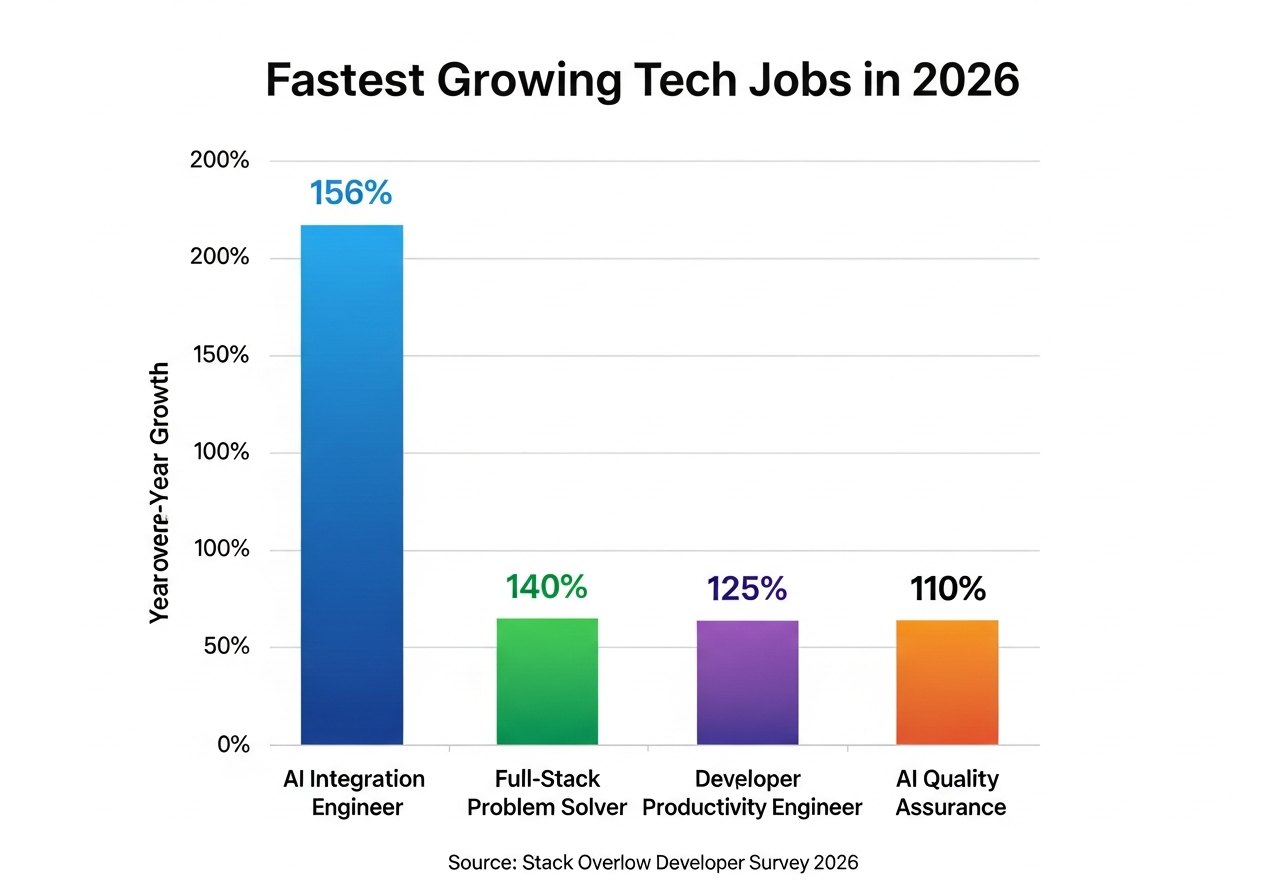
Explosive Growth in AI-Related Developer Roles
AI Quality Assurance
The New Challenge: Someone needs to verify that AI-generated code is correct, secure, and maintainable. This requires deep expertise.How to Future-Proof Your Developer Career
Strategy 1: Embrace AI Tools
Action Steps:- Use AI coding assistants daily
- Experiment with different AI tools
- Learn to write effective prompts
- Study how AI makes suggestions to understand its patterns
Strategy 2: Move Up the Stack
Focus Areas:- System architecture and design
- Business analysis and requirements gathering
- Technical leadership and mentoring
- Product thinking and user experience
Strategy 3: Develop T-Shaped Skills
The Concept:- Deep expertise in one area (the vertical of the T)
- Broad knowledge across multiple domains (the horizontal)
Strategy 4: Master Communication
Key Skills:- Writing clear documentation
- Explaining technical concepts simply
- Active listening to understand real needs
- Presenting ideas persuasively
Strategy 5: Continuous Learning
Approach:- Dedicate time weekly to learning new technologies
- Follow AI developments and new tools
- Experiment with emerging paradigms
- Share knowledge with your team
What Companies Should Do
If you’re managing developers or running a tech organization:Invest in AI Training
Don’t just give developers AI tools—teach them to use them effectively. The productivity difference between trained and untrained developers using AI is 400%.Redefine Roles
Update job descriptions, career paths, and expectations to reflect the AI-augmented reality.Focus on High-Value Work
Eliminate low-value tasks that AI can handle. Direct your team toward architecture, problem-solving, and innovation.Support Learning
Create space and budget for continuous learning. The teams that adapt fastest will win.The Historical Parallel: Spreadsheets and Accountants
Remember when spreadsheets were going to eliminate accountants? Here’s what actually happened: 1980s Fear: “Excel will replace accountants!” Reality: Accountant jobs grew 15% in the following decade. Why: Spreadsheets eliminated tedious calculation work, allowing accountants to focus on analysis, strategy, and advisory services. The value of human judgment increased. The Lesson: Tools that augment expertise don’t eliminate jobs—they transform them and often increase demand. We’re seeing the same pattern with AI and development.The Bottom Line: Adapt or Get Left Behind
Will AI replace developers? No. Will AI replace developers who refuse to adapt? Absolutely. The future belongs to developers who:- Embrace AI as a powerful tool
- Focus on high-level problem-solving
- Develop strong communication skills
- Think strategically about business needs
- Never stop learning
Conclusion: The Future Is Human + AI
The question isn’t “Will AI replace developers?” It’s “What kind of developer do you want to be in the AI era?” AI is removing the tedious parts of development—the boilerplate, the syntax errors, the repetitive tasks. What’s left is the interesting stuff: solving real problems, designing elegant systems, understanding business needs, and creating value through technology. For developers willing to adapt, the AI era isn’t a threat—it’s the most exciting time to be in software development. The tools are better, the problems are more interesting, and the impact you can have is greater than ever. The developers who thrive won’t be those who resist AI or those who blindly trust it. They’ll be those who master the art of human-AI collaboration, using machines to amplify their creativity, judgment, and expertise. That’s not a future where developers are replaced. It’s a future where developers are finally free to do what they do best: solve problems and build amazing things.About DreamzTech: We’re pioneering the future of AI-augmented software development. Our team combines world-class human developers with cutting-edge AI tools to deliver exceptional custom software solutions. Ready to embrace the future? Contact us to discuss how we can help your team thrive in the AI era.
Frequently Asked Questions
Will AI replace software developers in the future?
AI will not replace software developers — but it will dramatically change what developers do. AI handles repetitive coding tasks, freeing developers to focus on system architecture, complex problem-solving, and creative engineering. The demand for skilled developers who can work alongside AI tools is actually increasing.
Which developer roles are most at risk from AI automation?
Roles focused heavily on repetitive coding tasks — such as basic CRUD development, simple scripting, and boilerplate code writing — face the highest automation risk. However, roles requiring creativity, system design, stakeholder communication, and AI tool orchestration are growing in importance and demand.
What developer skills will be most valuable in an AI-first world?
In an AI-first development environment, the most valuable skills are AI prompt engineering, system architecture, complex debugging, security engineering, data engineering, and the ability to evaluate and orchestrate AI-generated code. Developers who understand AI capabilities and limitations will be in high demand.
Is the demand for software developers increasing or decreasing due to AI?
Overall demand for software developers continues to grow despite AI advancement. While AI automates some tasks, it also expands the scope of what’s possible — creating entirely new categories of software products, AI systems, and integrations that require skilled developers to build and maintain.
Related reading: How AI Is Transforming Custom Software Development in 2026 — our comprehensive guide to AI-augmented development.