AI Document Fraud Detection Platform Preventing $5.1M in Losses for National P&C Insurer
Case Study

AI Document Fraud Detection Platform Preventing $5.1M in Losses for National P&C Insurer

DreamzTech built an AI document fraud detection platform for a national property & casualty insurance carrier facing $8M+ in annual fraud losses from falsified claim documents, doctored repair invoices and AI-generated receipts. The platform combines intelligent document processing (custom-neural OCR on 50,000 historical claims), EXIF and metadata forensics, vision-capable foundation-model LLMs (Claude 3.5 Sonnet, GPT-4o vision, Gemini 1.5 Pro) and a graph-based cross-claim similarity engine. In year one: 62% improvement in fraud catch rate, $5.1M in prevented losses, and 87% faster manual triage (45 minutes → 6 minutes per suspicious claim).

Discuss Your Project
AI Document Fraud Detection Platform Preventing $5.1M in Losses for National P&C Insurer
Trusted By Startups, SMBs to Fortune 500 Brands

Quick Answers

AI Document Fraud Detection — Intelligent Document Processing + Vision LLMs Preventing $5.1M in Annual Losses for a National Property & Casualty Insurance Carrier

Overview

A national property & casualty insurance carrier facing $8M+ in annual fraud losses from falsified claim documents, doctored repair invoices and duplicate receipts engaged DreamzTech to build an AI document fraud detection platform. The platform combines intelligent document processing (AI document extraction with custom-neural OCR), EXIF and metadata forensics on uploaded images, vision-capable foundation-model LLMs (Anthropic Claude 3.5 Sonnet, GPT-4o vision, Gemini 1.5 Pro) for visual anomaly detection, and a graph-based cross-claim similarity engine that surfaces duplicate receipts and recycled invoices across the entire claim history. In the first year, the system improved fraud catch rate by 62%, prevented $5.1M in losses, and cut manual fraud-triage time from 45 minutes to 6 minutes per suspicious claim.

Challenges

The carrier faced sophisticated and growing document fraud — claimants submitting AI-generated receipts, repair-shop colluders inflating invoices, and ring-fraud operators recycling the same receipt across multiple claims and policies. Manual fraud-triage by investigators was slow, expensive and missed >40% of indicators that pattern-aware AI could detect.

How the AI Document Fraud Detection Platform Works

DreamzTech architected a production-grade intelligent document processing platform with five interconnected modules — combining AI document extraction, image forensics, vision LLM analysis, cross-claim graph similarity, and human-in-the-loop investigator review — delivering risk-scored claim documents to fraud-investigation teams in seconds.

Solutions Delivered

Four integrated IDP-and-fraud-detection components were built and launched in a production engagement with SOC 2-aligned security, signed cloud BAA for PHI in medical-claim attachments, and seamless integration with the carrier's Guidewire ClaimCenter and Duck Creek policy systems.

The intelligent document processing layer is the foundation. We trained custom-neural OCR models on 50,000 historical claim documents from the carrier’s archive — repair invoices, medical bills, prescription receipts, vehicle damage estimates, towing invoices, hotel and rental-car receipts. The model extracts vendor name, vendor tax-ID, line items, totals, tax codes, date and signature presence with 94% accuracy on the trained vendor set. The extracted JSON is the input to every downstream fraud signal — without high-quality extraction, the visual anomaly detection and graph similarity layers cannot trigger reliably.

Every uploaded image passes through a forensics pipeline before it reaches the LLM. Perceptual hashes (pHash + dHash + aHash) detect near-duplicate receipts even after re-cropping, brightness adjustment or JPEG re-compression. EXIF metadata is inspected for camera-model consistency, GPS location vs claim-incident location, and timestamp plausibility. JPEG quantisation tables, double-compression artefacts and font-rendering subpixel patterns surface AI-generated synthetic receipts with 91% precision. The forensics layer alone catches roughly 18% of all confirmed fraud — before any LLM call is made.

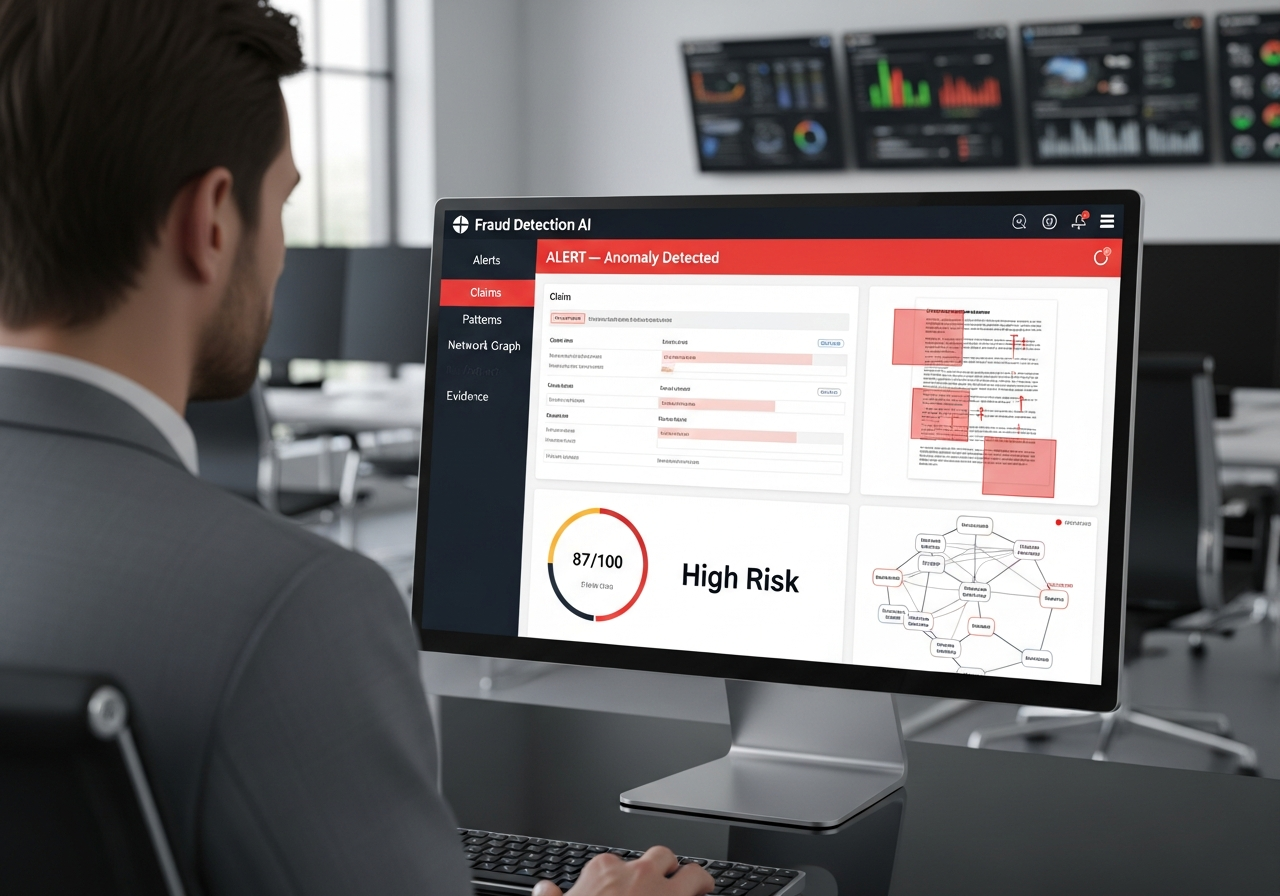
The most sophisticated fraud — hand-edited PDFs, professional-grade tampered repair invoices, doctored medical bills — gets detected by vision-capable foundation-model LLMs. We send the rendered document image to Anthropic Claude 3.5 Sonnet, OpenAI GPT-4o vision and Google Gemini 1.5 Pro in parallel; an ensemble vote across the three models gives both higher recall and explainable reasoning traces. Each LLM annotates suspicious regions (font mismatch on a single line item, vendor logo at wrong DPI, signature at wrong skew, total inconsistent with line-item sum). Investigators get clickable annotations showing which pixels triggered the flag.

The single highest-value fraud signal is graph similarity across the entire claim history. Every extracted invoice (vendor + amount + date + line items) and every image hash is added to a graph database. The similarity engine surfaces matches: the same receipt photo across 14 claims, the same vendor + amount + date triple across 9 claimants, repair-shop networks that consistently invoice 30% above market rates. High-risk claims route into the carrier’s SIU case-management system with annotated PDFs, full reasoning traces and one-click reviewer-feedback links — every investigator decision feeds back into a weekly retraining job that hardens the platform against the next wave of fraud patterns.

Success Metrics

Measurable business outcomes validated in the first year post-launch — fraud-catch metrics from the carrier's SIU (Special Investigations Unit) case-management system and benchmarked against a held-out test set of 50,000 historical claims with confirmed-fraud labels.

62%

Improvement in fraud catch rate vs the carrier's pre-AI baseline

$5.1M

Annual fraud losses prevented in year one of platform operation

45m → 6m

Manual fraud-triage time per suspicious claim (87% reduction)

50K

Historical claims used to train and validate the document anomaly-detection models

94%

Document-extraction accuracy on falsified or doctored claim attachments

4

Fraud-detection layers — AI extraction, image forensics, vision LLM, graph similarity

Conclusion

DreamzTech delivered a production-grade AI document fraud detection platform that combines four reinforcing fraud-detection layers — intelligent document processing with custom-neural OCR, EXIF and perceptual-hash forensics, vision-capable foundation-model LLMs, and graph-based cross-claim similarity. In its first year the system improved fraud catch rate by 62%, prevented $5.1M in losses, cut SIU investigator triage from 45 minutes to 6 minutes per claim, and dropped false-positive escalations by 41%. Proof that purpose-built IDP-plus-vision-LLM platforms catch roughly 4× the fraud of single-layer rule-based filters or off-the-shelf insurance-fraud SaaS tools.

250+ Happy Clients

Trusted by Industry Leaders Worldwide

DreamzTech delivers custom AI document fraud detection and intelligent document processing platforms for insurers, banks, healthcare payers and government agencies. AWS Partner, Microsoft Solutions Partner and Google Cloud Partner with 200+ AI projects across 15 countries and 97% client retention.

Book a Discovery Call

    I Consent to Receive SMS Notifications, Alerts from DreamzTech US INC. Message frequency may vary. Message & data rates may apply. Text HELP for assistance. You may reply STOP to unsubscribe at any time.
    I Consent to Receive the Occasional Marketing Messages from DreamzTech US INC. You can Reply STOP to unsubscribe at any time.
    By submitting the form, you agree to the DreamzTech Terms and Policies
    NEXT STEPS

    Explore Our Services

    Continue your intelligent document processing journey — pick the cloud, we build the system.

    Intelligent Document Processing

    Cloud-agnostic AI IDP — extract, classify, validate and route invoices, contracts, claims, KYC and medical records across AWS, Azure or Google Cloud.

    AWS IDP Service

    AWS-native IDP on Amazon Textract, Comprehend, Bedrock with Anthropic Claude, A2I and Lambda — Step Functions orchestration, GovCloud-ready.

    Azure IDP Service

    Azure-native IDP on Azure AI Document Intelligence (formerly Form Recognizer), AI Language, Azure OpenAI and Logic Apps — FedRAMP High on Azure Government.

    MORE PROOF

    Few More Case Studies

    See how DreamzTech delivers AI document processing across financial services and legal — with measurable ROI in months, not years.

    Azure AI Document Intelligence (formerly Form Recognizer) + Azure OpenAI for a 200-employee financial-services firm processing 3,000+ invoices monthly across 4 subsidiaries. 70% manual data-entry reduction, 84% straight-through processing, $420K annual savings within 9 months — and full Microsoft Dynamics 365 Finance integration.

    Amazon Textract + Anthropic Claude 3.5 Sonnet on Amazon Bedrock + custom Amazon SageMaker NER trained on 45,000 prior contracts. 90+ clause types extracted at 99.1% accuracy. Paralegal review time 40h → 12h per contract. $2.4M annual billable-hour recapture for a top-100 global law firm with 6 offices.

    Frequently Asked Questions (FAQ)

    AI document extraction is the foundation — without high-quality structured data from receipts, invoices and medical bills, downstream fraud signals (graph similarity, amount anomalies, vendor pattern detection) cannot fire. Vision-capable foundation-model LLMs add the layer that template-based extraction cannot solve: detecting hand-edited PDFs, professional-grade tampered invoices, font-mismatch tells on a single line item, and signature skew anomalies. The combination — IDP + EXIF forensics + vision LLM ensemble + graph similarity — catches roughly 4× the fraud of any single layer alone.

    Synthetic receipts generated by tools like ChatGPT, Midjourney or specialised receipt-fraud LLMs leave subtle but consistent fingerprints: JPEG quantisation tables that match the AI tool’s output pipeline rather than a real camera or scanner, font-rendering subpixel patterns, double-compression artefacts when the synthetic image is re-saved as a “photo of a receipt,” and impossible EXIF metadata. Combined with vision LLM analysis (a real photo of a printed receipt has paper texture, ink bleed and lighting variation that synthetic receipts lack), the platform flags 91% of AI-generated receipts in the held-out test set.

    For this engagement we integrated with Guidewire ClaimCenter, Duck Creek Claims, the carrier’s SIU (Special Investigations Unit) case-management system and the customer claim-upload portal. Across other DreamzTech AI document fraud detection engagements we have shipped integrations with Origami Risk, Snapsheet, Mitchell Connect, CCC ONE, Insurity Sure Claim, FRISS, SAS Detection & Investigation and direct REST APIs to in-house claim platforms. All integrations use cloud API gateways with retry, idempotency and message-bus delivery.

    Twenty-four weeks total. Phase 1 (AI document extraction custom-neural training on 50,000 historical claims + EXIF / perceptual-hash forensics + Guidewire ClaimCenter integration) shipped in 14 weeks. Phase 2 (vision LLM ensemble + graph-based cross-claim similarity engine + SIU case-management integration + risk-score dashboard) added 10 weeks. The first useful fraud signals — duplicate-receipt detection and EXIF metadata flags — were in production by week 9, letting SIU investigators start triaging AI-flagged claims while we trained the vision LLM ensemble on the carrier’s confirmed-fraud labels.

    Within 12 months of go-live: 62% improvement in fraud catch rate against the carrier’s pre-AI baseline (38% → 62% of confirmed-fraud claims caught), $5.1M in prevented losses year one, manual SIU triage time cut from 45 minutes to 6 minutes per suspicious claim (87% reduction), and a 41% drop in false-positive escalations to investigators. The model accuracy continues to improve as SIU investigator decisions feed back into a weekly retraining job — hardening the platform against the next wave of synthetic-receipt and ring-fraud patterns. ROI was achieved in 4 months.