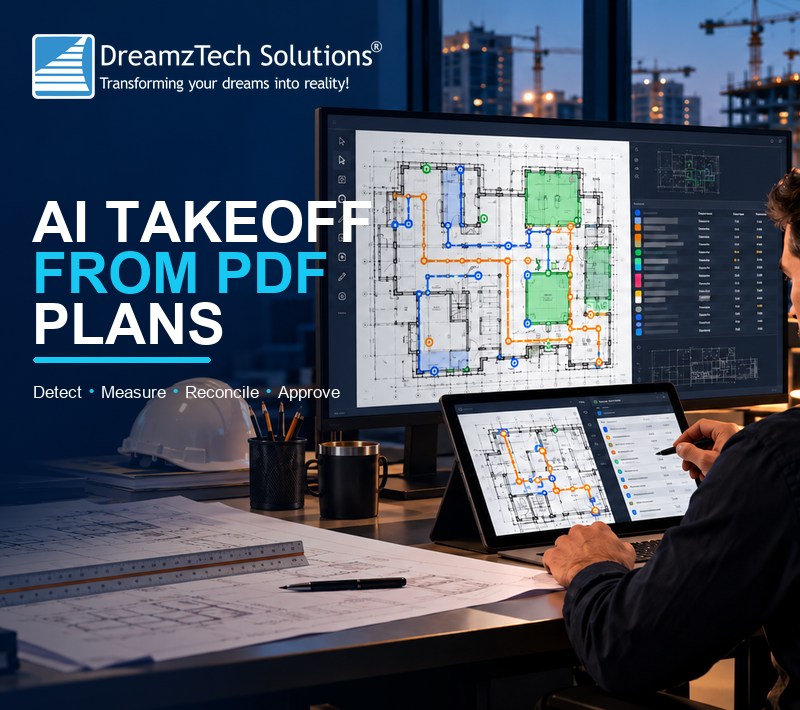
AI for Construction Estimating & Preconstruction

Custom AI Takeoff Software Development for Drawings & Workflow

Turn your plan sets, trade conventions and estimating process into faster, reviewable quantity takeoffs built for the way your team works. Bring us your real drawings and we’ll map the route from computer vision detection and estimator review to system-ready exports—then tell you honestly whether a custom build is the right fit.

Takeoff workflows built around your drawings and trade conventions Human-in-the-loop measurement validation, not unattended automation API and estimating-system integration engineered to scope Configurable deployment and ownership arrangements defined in contract
Trusted by Startups, SMBs and Fortune 500 Enterprises
Build Scope

Our Custom AI Takeoff Development Capabilities

What a takeoff build engagement actually covers. Each capability below states what goes in, what comes out and what it depends on — because the dependencies, not the model, are usually what decide whether a takeoff system is usable on real bid deadlines.

Construction Drawing Ingestion & Preparation

In: PDF plan sets, sheet indexes and revision packages. CAD or BIM import can be scoped where the formats and downstream use are defined. Out: normalized, page-indexed drawings with scale established and resolution checked. Depends on: drawing legibility — scanned or photographed plans need preprocessing and still constrain what detection can achieve.

AI Blueprint Recognition

In: prepared sheets plus an agreed class list of symbols and regions. Out: detected elements with location and a confidence value. Depends on: annotated examples from your own plan sets. Symbol libraries vary by firm and by designer, so class definitions are agreed with your estimators rather than assumed.

Quantity Takeoff & Material Measurement

In: detected elements and a verified plan scale. Out: counts, linear footage and areas with the derivation recorded. Depends on: scale accuracy above all. Measurement error is tracked as a distribution and surfaced to the estimator, not hidden behind a single headline figure.

Trade-Specific AI Takeoff Workflows

Electrical, plumbing, mechanical/HVAC and general construction workflows are scoped as custom project scopes, not pre-built modules you switch on. Each trade brings its own symbol set, counting rules and measurement conventions, and each needs its own annotated data and its own evaluation before it is trusted.

Estimator Review, Corrections & Audit Trails

Confidence flags, accept/edit/reject per item, annotations, revision comparison between drawing versions and a traceable history of who changed what. Where scoped, corrections are captured as training signal so the model improves against your drawings over time.

Model Evaluation & Continuous Improvement

Held-out validation sets segmented by trade, drawing quality and complexity; precision and recall for counted items; error distribution for measured items; and tracked human correction effort. Results are reported per segment, because an average across all drawing types hides the cases that matter.

Build Process

Our Custom AI Takeoff Software Development Process

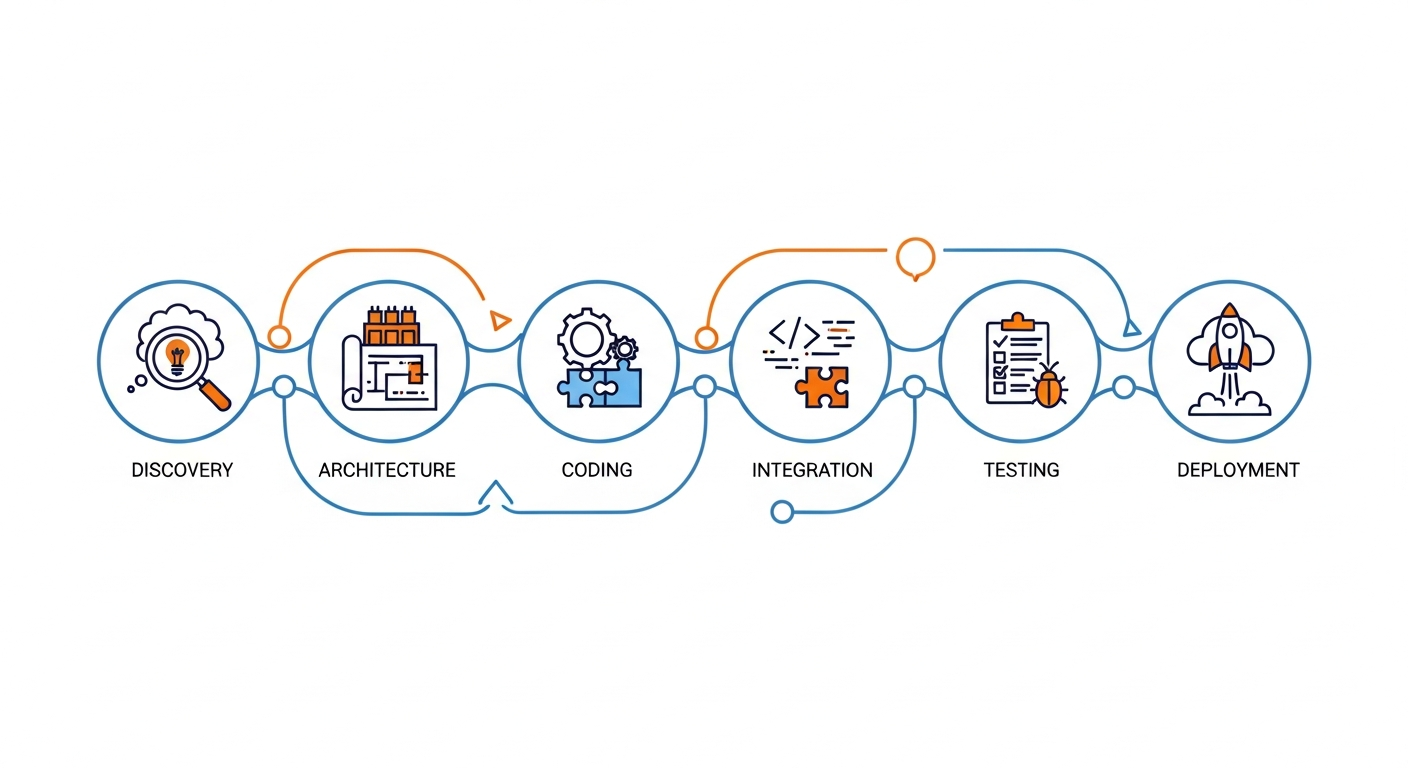
Six stages. Timeline is determined only after scope, drawing quality, trades in scope and integration surface are known — we do not quote a duration before we have seen representative drawings.

The Problem

Construction Takeoff Challenges We Help Solve

Manual takeoff is not slow because estimators are slow. It is slow because the same measurement work repeats across every sheet, revision and bid, while conventions change from one design team to the next. These are the failure points a custom build is usually commissioned to address.

Engagement Models

How a Custom Takeoff Build Can Be Structured

Four ways to engage, depending on how well defined the requirement already is. Fees, third-party infrastructure and any model or library licensing costs are itemized in the commercial proposal rather than quoted on this page.

Discovery & Proof of Concept

A bounded engagement to annotate a sample of your drawings, test detection and measurement, and produce a feasibility finding with evidence. Appropriate when nobody has yet established whether AI detection performs adequately on your plan sets.

Fixed-Scope MVP

Available once trades, class taxonomy, review workflow and integration targets are defined — normally after discovery. Fixed scope before those are settled tends to produce either padded pricing or a change request on week three.

Dedicated Engineering Team

A named team working to your roadmap across detection, application, integration and QA, with agreed working-hour overlap. Suited to multi-trade platforms and product vendors building takeoff into their own software.

Time & Materials and Ongoing Support

For evolving scope, additional trades added over time, and post-launch work: model retraining as corrections accumulate, new drawing conventions, integration changes and maintenance under an agreed support model.

Use Cases

AI Takeoff Development for Different Construction Trades

Each trade brings its own symbols, counting rules and measurement conventions, so each is scoped, trained and evaluated separately. These are build patterns and the validation each one requires — not ready-made modules available on day one.

AI Case Studies

How We Prove Blueprint Recognition Actually Works

Accuracy on construction drawings is a measurement, not a marketing number, and it is only meaningful per trade and per drawing type. Below is the evaluation method we run on every takeoff engagement. Published construction takeoff case studies are pending client approval — rather than present an unverified example, we would rather show you the method and then run it on your drawings.

Start in 3 Simple Steps

How an AI-Powered Takeoff Workflow Works

01

Upload & Validate Drawings

Plan sets are uploaded and indexed, then checked for resolution, rotation and — critically — plan scale. Automated: file handling, page indexing, scale detection where a scale bar or stated scale is present. Needs judgment: confirming the scale is correct, which the estimator does once per sheet set and which governs every measurement that follows.

02

Detect Elements & Calculate Quantities

The model locates symbols and regions in the agreed class taxonomy, and the measurement engine derives counts, linear footage and areas from the verified scale. Automated: detection, measurement and confidence scoring. Needs judgment: anything the model flags as low confidence, plus the cases it was never trained on.

03

Estimator Review & Export

Every detection is presented for accept, edit or reject, with annotations and revision comparison, and only approved quantities are exported. Automated: export formatting, mapping and the audit record. Needs judgment: the review itself — this step is deliberately not automated.

Architecture

Custom AI Takeoff Platform Architecture

Detection is one box. These are the others, and the ones teams skip tend to be the reason a takeoff pilot never reaches production. The patterns below describe how we architect these systems; which of them apply to a given build is settled in discovery.

File ingestion

Plan set upload, sheet indexing, revision handling and format normalization, with large multi-sheet packages treated as the default case rather than an edge case.

Parsing & preprocessing

De-skew, denoise, resolution handling and OCR for sheet metadata and legends. Scan quality sets the ceiling on everything downstream, so it is checked and reported, not assumed.

Detection model layer

Computer vision over symbols, linework and regions against your agreed class taxonomy, returning locations and confidence rather than bare totals.

Measurement engine

Counts, linear measurement and area derived from a verified plan scale, with the derivation retained so any quantity can be explained later.

Validation & review UI

The estimator's working surface: confidence flags, accept/edit/reject, annotations, revision comparison and queueing across projects.

Quantity export & APIs

Structured exports and APIs carrying approved quantities into estimating, ERP or project-management systems, with mapping to your assemblies and cost codes.

Identity & access control

SSO and role-based permissions applied to projects and drawings, so access to a client's plan set is restricted at the data layer rather than only in the interface.

Audit & analytics

Who changed which quantity and when, correction rates by trade and by drawing type, and the operational record a disputed bid may later depend on.

Data retention & monitoring

Where drawings and derived data are stored, for how long, under whose control, plus monitoring of detection quality and failure cases in production.

Accessible summary of the flow above: construction drawings are ingested and preprocessed, passed to the detection model layer, converted to quantities by the measurement engine, presented to an estimator in the review interface, and only then exported to downstream systems. Identity and access control, audit logging, retention and monitoring apply across every stage.

Engagement Models

Three questions to settle before a takeoff build starts

Client drawings are confidential commercial documents. Where they are processed, who can reach them and who owns what comes out are design decisions, not deployment afterthoughts — and the answers belong in the agreement, not on a feature list.

Who can see the drawings?

01 the first control

Where does it run?

02 decided in design

Who owns what?

03 settle it in contract
Talk to a Construction AI Team

Tell us about your drawings and your estimating workflow

The most useful things to share are a few representative plan sets, the trades in scope, how takeoff is done today and where approved quantities need to end up. We will come back with a feasibility view and the architecture we would propose.

What you want built

What already exists

Awards & Recognition

Ratings

Discuss a custom AI takeoff build

Share your drawings, intended trades, estimating process, review requirements and integration targets. We will respond with a feasibility view, the architecture we would propose and what we would need to evaluate before quoting scope.

    By submitting the form, you agree to the DreamzTech Terms and Policies
    Integration

    Construction Estimating and Enterprise Integrations

    Approved quantities are only useful once they reach the system where pricing actually happens. The integration approach is chosen against the interface your target system genuinely exposes — which is assessed during discovery, not assumed. Delivered through enterprise AI integration services.

    Integration approachWhat it covers
    Structured file exportCSV, Excel and structured formats mapped to your assemblies and cost codes. The most reliable starting point, and often sufficient for a first release.
    REST API integrationApproved quantities pushed into, or pulled from, systems that expose a documented API, with authentication, pagination and error handling engineered properly.
    Event and webhook flowsDownstream systems notified when a takeoff is approved or revised, so estimating picks up changes without a manual re-import.
    Quantity and assembly mappingDetected classes mapped to your assemblies, cost codes and units of measure, which is usually the part that takes longest and matters most.
    Approval gatesOnly estimator-approved quantities cross the boundary into estimating or ERP, with the approving user and timestamp carried through.
    Target platformsClients commonly ask about construction ERP, estimating and project-management platforms — for example Procore, Autodesk, Sage or QuickBooks. These are named here as integration targets clients raise, not as prebuilt or certified connectors; feasibility for any named platform is confirmed during discovery.
    IdentitySSO and role mapping so permissions are consistent between the takeoff application and the systems it feeds.
    Error handlingRetries, reconciliation and a visible failure record, so a silent sync failure cannot put a stale quantity into a live bid.
    Cost & Timeline

    Custom AI Takeoff Development Cost and Project Timeline

    We do not publish a price range or a delivery window for custom takeoff work, because both move by an order of magnitude with the variables below — and a number quoted before anyone has seen your drawings is a guess dressed as a quote. These are the eight drivers that actually set scope. A proof of concept, a scoped MVP and a full multi-trade platform are materially different commitments.

    Build or Buy

    Custom AI Takeoff Software vs Off-the-Shelf Software

    Three routes, and custom is not automatically the right one. Packaged takeoff products are mature and, where your drawings and process fit them, they will usually be faster and cheaper than commissioning a build. The comparison below is about fit, not about one option being better.

    Custom AI takeoff development
    this page
    Off-the-shelf takeoff productManual / digital takeoff
    Time to first useLonger — discovery, data and build before first valueShort — licence and configureImmediate, but effort repeats every bid
    Workflow fitBuilt around your process and review modelYour process adapts to the productFully manual, entirely your process
    Symbol taxonomyTrained on your symbol conventions and custom calloutsVendor's taxonomy, configurable within product limitsInterpreted by the estimator each time
    IntegrationsEngineered to your target systems, subject to their APIsVendor's existing connectors and export formatsManual re-entry or spreadsheets
    Support & maintenanceYour responsibility or an agreed support model; retraining continuesIncluded in licence, vendor roadmapNone required
    Deployment controlCloud, private tenancy or on-premise as scopedVendor's hosting modelLocal files
    Cost shapeDevelopment investment, then run and maintenance costsRecurring licence per seat or projectLabor cost per bid, scales with volume
    Data & securityControls designed to your requirements and jurisdictionVendor's security posture and termsLocal control, informal
    Ownership / IPDefined in the project agreement, subject to third-party component termsLicensed, not ownedNot applicable
    Choose it whenDrawings, trades, process or integrations fall outside packaged productsA packaged product already fits how you workVolume is low or occasional

    DreamzTech is positioned to advise on either route — see our ready-to-use AI takeoff software, or the trade pages for electrical takeoff software, plumbing takeoff software and the HVAC takeoff product workflow. If a packaged product fits your drawings and process, that is the recommendation you will get from discovery — a custom build is worth commissioning when the fit genuinely is not there. Related engineering context: computer vision development services and generative AI development expertise.

    Frequently Asked Questions

    Custom AI takeoff development — frequently asked questions

    What buyers ask when scoping a custom AI takeoff build: cost drivers, realistic timelines, training on your own drawings, supported formats, integration, ownership, accuracy validation and when to build instead of buy.

    It is scoped, not listed — we do not publish a range, because the same brief can differ by an order of magnitude depending on the variables below.

    Cost is driven by the number of trades in scope, how much annotated training data exists or has to be created, your input formats and drawing quality, whether CAD or BIM is required, how far the detection task sits from an available baseline, the depth of the estimator review interface, the number and maturity of integrations, and your deployment and security requirements. A proof of concept, a scoped MVP and a full multi-trade platform are three different commitments. We quote after discovery and a sample-data assessment, and the proposal itemizes third-party infrastructure and any model or library licensing separately.


    A duration is only meaningful after we have seen representative drawings. Anyone quoting a timeline before that is guessing.

    What sets the schedule: how many trades are in the first release, how much annotation is needed and who does it, drawing quality across your corpus, how much review and correction tooling estimators need, which integrations are in scope and what their APIs actually support, and your deployment and security review process. We scope in stages — discovery, feasibility on your sample drawings, then a deliberately narrow first release that reaches real estimators early — and give you a schedule once the feasibility stage has produced evidence rather than assumptions.

    Yes, subject to a feasibility assessment and written data rights. Training on your own plan sets is usually the main reason a custom build outperforms a generic tool.

    It requires annotated examples from your drawings, enough variation across design partners and project types to generalize, and agreement with your estimators on what each class in the taxonomy means. Before anything is used, we agree in writing how client drawings are handled, how long they are retained, who may access them and whether they may be used for training at all — many plan sets are confidential to your clients rather than yours to contribute. Rare symbols need deliberate sampling, and ongoing human review remains part of the workflow regardless of how well the model performs.

    PDF plan sets are the typical input. CAD and BIM can be supported through scoped engineering, but they are a separate body of work rather than a format setting.

    Vector PDFs carry structure that makes detection and measurement more reliable. Scanned or photographed sheets can be processed with de-skew, denoise and OCR preprocessing, but scan quality sets a real ceiling on achievable accuracy and we will say so after looking at your corpus. Support for any specific CAD or BIM format is confirmed during discovery against your actual files and intended downstream use — we do not claim implemented readers for formats we have not scoped for your project.

    Usually yes, and the approach depends on what your target system exposes. That is assessed during discovery rather than assumed.

    Options range from structured file export mapped to your assemblies and cost codes, through REST API integration, to event or webhook flows that notify downstream systems when a takeoff is approved or revised. The work that usually takes longest is mapping detected classes to your assemblies, units of measure and cost codes. Clients commonly ask about construction ERP, estimating and project-management platforms — for example Procore, Autodesk, Sage or QuickBooks. We name those as integration targets clients raise, not as prebuilt or certified connectors; feasibility for any named platform is confirmed before it is committed to scope. Delivered as part of enterprise AI integration services.

    Ownership is defined in the project agreement, and it is not a single yes or no.

    Application source code written for your project can be assigned to you under the agreement. Annotations and model weights produced during the build, and the rights attaching to drawings used as training data, are negotiated explicitly — particularly where the drawings belong to your clients rather than to you. Third-party components carry their own terms: open-source libraries, licensed pretrained models and commercial APIs are governed by their licences, which no supplier can transfer to you. We set these out in the contract rather than claiming blanket ownership of everything in the stack.

    Against an annotated validation set built from your own drawings, reported per segment rather than as a single headline number.

    We agree ground truth with your estimators first, then hold out a set of drawings the model has not seen. Counted elements are scored with precision and recall per class, so a rare symbol cannot hide behind a strong aggregate. Measured elements are compared against known quantities and reported as an error distribution, with plan-scale verification treated as its own check. Results are segmented by trade, by drawing quality and by complexity, failure cases are documented explicitly, and we measure how long estimators spend correcting output in realistic use. Acceptance criteria are agreed before release, and we do not publish accuracy figures for your build until that evaluation has actually run.

    When your drawings, trades, process or integration requirements fall outside what packaged products are built for — and not before.

    Packaged takeoff products are mature, and where they fit they are faster and cheaper than commissioning a build. A custom build tends to be justified when your symbol conventions or custom callouts are not recognised by available tools, when your inputs are unusual, when a proprietary estimating process has to be preserved rather than adapted, when integration or deployment and security requirements cannot be met by a vendor’s hosting model, or when long-term ownership of the capability is a strategic goal. It is a larger commitment with ongoing maintenance, so we test the premise during discovery — and if a packaged product fits how you work, that is what we will tell you.

    Client Validation

    Why Choose DreamzTech for Custom AI Takeoff Development?

    What we can evidence: custom application engineering, computer vision work, integration delivery into enterprise systems, and a discovery process that tests feasibility on your drawings before asking you to commit to a build. Where a claim needs client approval before publication, it is not on this page.

    Clutch Reviews

    How We Validate a Custom AI Takeoff Build

    Explore the evaluation protocol, worked example and standards used to test feasibility on your own drawings. See how measured evidence becomes review rules and clear acceptance criteria before development begins.

    On-page proof

    Custom AI Takeoff Development Case Studies

    Three representative build scenarios show how drawing-specific requirements become models, review rules and measurable acceptance criteria.

    Case Study 01Representative project evidence

    Proprietary Electrical Symbol Detection

    Takeoff scope: A custom symbol library for project-specific devices, tags and low-voltage callouts.

    Estimator evidence: Per-class precision, recall and estimator correction time define whether each detection class is ready for use.

    Case Study 02Representative project evidence

    Revision-Aware Plumbing Takeoff

    Takeoff scope: Fixture and piping quantities across base drawings, addenda and reissued sheets.

    Estimator evidence: A sheet register, revision comparison and correction log show exactly which quantities changed and why.
    Case Study 03Representative project evidence

    HVAC Measurement & Estimating Integration

    Takeoff scope: Duct, piping and equipment quantities routed into an existing estimating workflow.
    Estimator evidence: Scale calibration, measurement tolerances and export audit trails become written acceptance tests before deployment.

    DreamzTech engineering capabilities

    Custom AI Takeoff Capabilities DreamzTech Can Engineer

    DreamzTech designs and builds custom AI takeoff software around a contractor’s drawings, symbol conventions, review rules and downstream systems—from feasibility and training data through production deployment, monitoring and support.

    Drawing corpus and class taxonomy

    DreamzTech converts representative plan sets, legends and estimator decisions into a governed training and evaluation dataset.

    Preprocessing, OCR and sheet intelligence

    The platform can normalize scans, index sheets, read metadata and prepare legends, schedules and revisions for downstream analysis.

    Custom detection and measurement models

    Computer vision detects project-specific symbols, linework and regions while the measurement engine produces calibrated counts, lengths and areas.

    Estimator-first review application

    DreamzTech builds confidence queues, annotations, accept-edit-reject controls, correction logs and approval gates around the estimator’s authority.

    Revision-aware workflow and analytics

    Version comparison, change tracking, per-class quality metrics and production monitoring reveal where models improve or require review.

    Exports, APIs and deployment options

    Approved quantities can map to assemblies and cost codes, reach documented APIs, and run in cloud, private-cloud or agreed enterprise environments.

    Detect. Review. Export.

    Planning a Custom AI Takeoff Platform?

    Share a few example drawings, the trades you need covered, how your estimating process works today and where approved quantities have to end up. We will come back with a feasibility view, the architecture we would propose and what we would need to evaluate before scoping.