











Your software may still run the business — but outdated architecture, aging frameworks, technical debt and difficult integrations make every new change slower and riskier.
DreamzTech modernizes existing software without automatically replacing everything that already works. We upgrade codebases, architecture, databases, APIs, infrastructure, user experiences and delivery processes while preserving the business logic that still creates value.


Modernization does not always mean rebuilding. Mature systems contain years of proven workflows, business rules, integrations and operational knowledge, and replacing everything because the underlying technology is old creates unnecessary cost, migration risk and disruption. The real question is which parts of your software still create value — and which parts now prevent the business from moving forward.
DreamzTech’s software modernization services answer that question before development begins. We assess the current system, identify technical and operational constraints, define the target architecture and determine whether each component should be retained, upgraded, refactored, replatformed, rearchitected, rebuilt, replaced or retired. The goal is not modernization for its own sake — it is software that becomes easier to change, integrate, secure, scale and operate.
Upgrade aging business software while preserving valuable functionality and business rules. We assess the existing system and modernize the components creating the most technical or operational risk — frameworks, code structure, architecture, databases, APIs, interfaces, security and deployment.
Modernize established SaaS platforms and commercial software products without losing the functionality existing customers depend on, so mature products can support new features, larger customers, higher transaction volumes and modern experiences.
Improve code structure and maintainability without unnecessarily changing product behaviour: modularization, dependency reduction, framework upgrades, dead-code removal, test coverage, documentation and performance work.
Modernize rigid architectures and expensive technology stacks — modular monoliths, services, event-driven and API-first designs. We do not recommend microservices simply because they are modern; architecture should reflect your system, team and scale.
Modernize databases and data access without compromising critical business information: schema modernization, migration, performance tuning, data services, reporting and analytics-ready data architecture, supported by data migration services.
Expose valuable capabilities through modern APIs instead of rebuilding everything around the legacy system, and prepare the data, integration and permission layers so AI software development can interact safely with what you already run.
Whether you need to modernize one business-critical system or an established software product, DreamzTech supports the complete transformation lifecycle — software engineering, architecture, databases, APIs, cloud, DevOps, QA, security and AI enablement under one coordinated team.
Before changing production software, understand what exists today. We assess architecture, codebase, data, infrastructure, integration, security, user experience and delivery process to identify what is creating business risk, what should remain unchanged, what should be modernized first and where a rebuild may genuinely be justified.
Older software often keeps operating because it holds valuable business knowledge. The problem is rarely what the system does — it is how difficult it has become to maintain, integrate, secure, scale or extend. Our legacy software modernization services move you off outdated technology without discarding years of proven functionality, covering legacy web and desktop applications, monoliths, database-heavy systems and internal business platforms.
Commercial software has a different challenge: you cannot treat an established product like a greenfield application. Existing customers depend on workflows, integrations, reports, configurations, APIs and stored data. Our software product modernization services improve the technology underneath mature SaaS and packaged software while protecting the functionality that made the product commercially valuable.
Modernize rigid architectures and technologies that have become expensive to maintain — modular monoliths, services, event-driven and API-first designs, plus framework, runtime, database and frontend upgrades. Where practical we preserve proven business logic while replacing only the obsolete technical components.
Prepare existing software for modern infrastructure without treating cloud migration as an automatic requirement. Rehosting, replatforming, containerization, Kubernetes, managed services, infrastructure as code and observability, paired with CI/CD pipelines, automated testing and rollback procedures that replace fragile manual releases.
Security expectations have changed dramatically since many legacy systems were built: identity modernization, role-based access, dependency remediation, secrets management, encryption, API security and audit logging. Existing software also does not need a rebuild to use AI — we modernize the data, integration and permission layers so AI can interact with your systems safely and auditably.
Six stages that take a system from unknown risk to modernized, released and maintainable software. Each stage produces something reviewable, so the programme can stop, re-sequence or expand at any boundary rather than committing everything up front.
We map users, workflows, integrations, technology, data and operational dependencies before proposing any change, so modernization decisions are based on how the system is actually used rather than on assumptions about the code.

An evidence-based view of the current system: architecture and coupling, code maintainability and testability, data and migration complexity, infrastructure readiness, integration dependencies and security exposure.
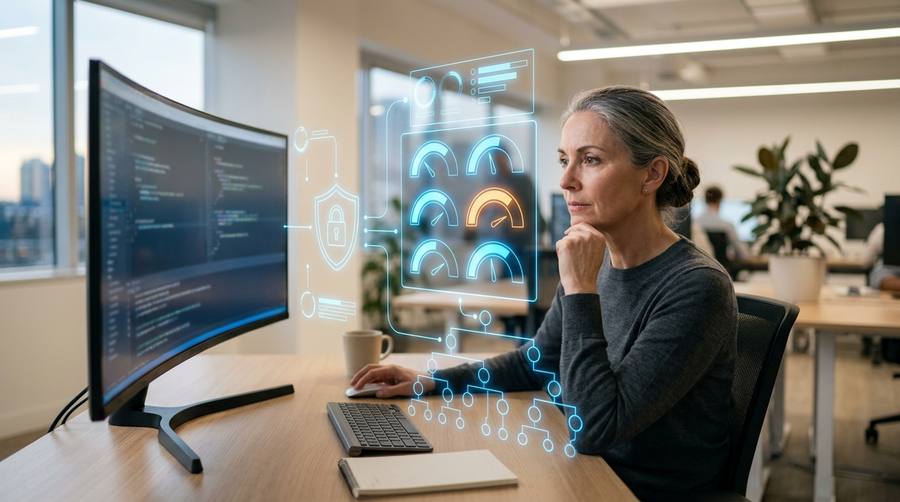
Not every technical issue deserves immediate investment. We sequence work by business value and risk, and determine for each component whether it should be retained, upgraded, refactored, replatformed, rearchitected, rebuilt, replaced or retired.
We design the architecture the software needs in order to be maintainable, then define migration sequencing, testing strategy, data approach and the operational controls that keep the business running during the transition.
Where architecture permits, we modernize by module, service, workflow or bounded domain so progress is verifiable and the programme is not dependent on one high-risk cutover at the end.

We test functionality, data, integrations, performance, security and user workflows, then move users, traffic, data and integrations through controlled releases with rollback options — and keep improving observability, cloud usage, release process and engineering productivity after transition.

Software often reaches a point where it still works — but changing it becomes increasingly difficult. The strongest modernization business cases usually start with operating friction rather than technology fashion.
The business depends on frameworks, libraries, databases or operating systems that are difficult to support, patch or upgrade, and vendor support has ended or is ending.
Engineering teams spend more time maintaining existing software than delivering new capability, and small product or operational changes require extensive development, testing and deployment effort.
Older architecture makes connecting modern APIs, SaaS platforms, mobile applications and enterprise systems unnecessarily complex, usually through fragile point-to-point connections.
Critical knowledge exists with only a few developers, former employees or undocumented code, which makes every change slower and increases operational risk.
Unsupported components and older authentication, permission and deployment patterns increase exposure, while releases still depend on manual scripts, individual knowledge and lengthy maintenance windows.
Architecture built for previous workloads struggles with growing users, transactions and data — and the APIs, permissions and data access needed to introduce AI safely are not in place.
The goal is not to replace one technology stack with another. A modernization programme should improve the economics, reliability and changeability of software the business already depends on.
Make existing software easier for engineering teams to understand, support and extend, and reduce the friction caused by tightly coupled code, manual testing and fragile deployments.
Replace unsupported components, introduce modern identity, access and security controls, and remove fragile integrations and single points of operational knowledge.
Remove architectural constraints that limit users, transactions, workloads or geographic expansion, and prepare appropriate workloads for cloud, hybrid or containerized environments.
Connect business-critical software to modern APIs, SaaS systems, mobile and partner platforms, make mature products easier to adapt, and create the integration, data and permission layers responsible AI requires.
A modernization programme should reduce risk, not create a new one. For operational software, replacing the entire system at once introduces unnecessary complexity, so we structure modernization around phased releases and controlled transition.
Replace specific functions gradually while the existing system continues operating, retiring old components only once the replacement path has been proven in production.
Run existing and modernized components together during validation so behaviour can be compared directly on real workloads before anything is switched over.
Expose legacy capabilities through controlled interfaces before deeper modernization, so new channels and services can be built without waiting for the underlying system to be rewritten.

Replace high-priority functionality first rather than rebuilding the complete system, so the programme delivers measurable value long before the final module is finished.
Control the release of modernized functionality to selected users or workflows and support fast rollback if behaviour differs from the system being replaced.

Move data through planned waves with validation and reconciliation, protect existing business behaviour with automated regression tests, and define clear recovery paths before any production migration.

Real DreamzTech AI engagements, chosen to show the integration, governance and production complexity behind systems that people actually use every day.
DreamzTech modernized a legacy insurance workflow by converting a desktop user experience into a browser-based ASP.NET Core application, while retaining the existing SQL Server data foundation, views and stored procedures where that reduced migration risk. The result is a modern multi-user interface without an unnecessary replacement of proven data logic.
DreamzTech replaced three disconnected CRM environments across 14 enterprise sites with a unified platform, migrating 2.3 million customer records without business disruption. The programme combined data migration, workflow consolidation, integrations, analytics and AI-enabled capabilities into a single operating system for the sales organization.
A mature payroll product needed to evolve into a broader HR management platform covering recruitment, onboarding, employee records, attendance, leave, benefits, payroll inputs, self-service and reporting. DreamzTech designed a modular platform with centralised administration, configurable workflows, role-based access, responsive portals, mobile workflows, integrations and reporting.
DreamzTech pairs US-led engagement and project management with a global engineering organization across software development, architecture, cloud, data, DevOps, QA and AI — so architecture discussions and escalations happen in your working hours while delivery capacity scales as modernization waves change.
Scoping, architecture reviews, sprint demos, escalations and executive reporting coordinated through US-facing project leadership.
Overlapping hours for the decisions that actually block progress — legacy behaviour, integrations, data migration, UAT and production cutover issues.
Ownership terms defined in the engagement agreement, so the modernized codebase, documentation and roadmap remain under your control, subject to third-party technology licences.
Three ways to work with us, depending on whether you need a partner to own delivery, a managed team alongside your product organization, or specific expertise added to engineers you already have.
Whether you are dealing with unsupported technology, technical debt, scalability problems, integration limits or a mature product that has become difficult to evolve, tell us what you are working with today. You do not need a finished modernization specification before the first conversation.


Share the software, current stack and modernization goals. We will help identify the likely modernization paths, the dependencies that matter and a sensible first wave.
Not every application should be rebuilt. Large modernization programmes usually run several strategies at once — a stable reporting module stays unchanged, infrastructure is replatformed, a high-change component is refactored, a problematic integration layer is rebuilt and obsolete modules are retired. Effective software modernization is a portfolio of evidence-based decisions, not one blanket technical strategy.
| Strategy | What changes | Best when |
|---|---|---|
| Retain | Keep the component largely unchanged | The software remains stable, secure and valuable |
| Rehost | Move to different infrastructure with minimal code change | Infrastructure is the main limitation |
| Replatform | Move to a newer runtime or platform with limited code changes | The core software remains useful |
| Refactor | Improve existing code structure without changing behaviour | Technical debt is slowing development |
| Rearchitect | Redesign major structural components | Architecture limits scalability or integration |
| Rebuild | Develop major components again on new foundations | Existing code no longer supports the roadmap |
| Replace | Move functionality to another product or platform | Custom ownership no longer creates enough value |
| Retire | Remove unused software or modules | Functionality is obsolete, duplicated or unnecessary |
Industry context matters because modernization has to preserve the rules, integrations, data and compliance requirements that made the software valuable in the first place.
Modernize production, maintenance, inventory and operational systems while connecting older software with cloud, mobile, analytics and automation.
Modernize warehouse, transportation, inventory and tracking platforms so they support real-time integration and connected operations.
Upgrade business-critical platforms while improving security, integrations, auditability and customer experience.

Modernize policy, broker, advisory and claims-related systems while preserving regulatory workflows and business rules.

Upgrade mature healthcare platforms while protecting sensitive workflows, integrations and operational continuity.
Modernize inventory, commerce, customer, payment and operational platforms for modern omnichannel requirements.
Modernize reservation, operations, customer and workforce software while integrating modern digital services.
Reduce technical debt in mature products while improving scalability, integrations, release velocity and AI readiness — and modernize the custom ERP, CRM, workflow and internal business systems that have become difficult to maintain.
Tell us what the software does, who depends on it, the current stack, the major integrations and where change is becoming difficult or expensive.
We review the modernization drivers and identify whether rehosting, replatforming, refactoring, rearchitecting, rebuilding, replacing or retiring is the right answer for each component.
Start with a bounded system, module or workflow that reduces meaningful risk or proves the target architecture before the wider programme is committed.
Verified client feedback consistently highlights responsiveness, practical problem solving, communication and delivery quality.
The difficult part of modernization is not learning a new framework. It is changing live business software while preserving the logic, data and workflows the organization depends on — and knowing what should not be rebuilt as clearly as what should.
Modernization rarely affects only the codebase. Software engineering, cloud, data, integration, DevOps, QA and AI capability come into one programme, with US-led engagement and overlapping working hours.
We do not assume every legacy component needs rewriting. The strategy reflects business value, technical condition and migration risk — not a predetermined modernization template.
Where architecture permits, large transformations are divided into controlled releases instead of a single high-risk switchover, so value arrives earlier and rollback stays possible.
Enterprise systems, operational platforms, SaaS products and data-intensive applications, delivered with secure-development practice, migration validation and full ownership of the source code you pay for.


You may not need a new system. You may need a better foundation for the system you already have. DreamzTech helps organizations modernize legacy software, mature SaaS products and business-critical platforms through practical engineering decisions based on value, risk and future requirements.
Direct answers to what buyers ask when scoping software modernization: what it covers, how it differs from application modernization and cloud migration, when to refactor rather than rebuild, and how cost and timeline are estimated.
Software modernization is the process of updating existing software, architecture, code, databases, integrations, infrastructure and user experience so the system can continue supporting current and future business requirements. It can include refactoring, replatforming, rearchitecting, rebuilding or selectively replacing parts of an existing system.
Software modernization services help organizations transform aging or difficult-to-maintain software into more secure, maintainable, scalable and integration-ready systems. Services may include code refactoring, architecture modernization, framework upgrades, cloud enablement, database migration, API development, UX modernization, DevOps and security improvements.
Legacy software modernization services focus specifically on older systems that still provide business value but depend on aging architecture or technology. The objective is to preserve useful functionality while replacing technical constraints such as unsupported frameworks, tightly coupled code, outdated interfaces, difficult integrations or manual deployment processes.
Legacy software modernization typically starts with an assessment of architecture, code, databases, integrations, infrastructure and business-critical workflows. The modernization team then determines which components should be retained, upgraded, refactored, replatformed, rearchitected, rebuilt, replaced or retired.
No. A full rebuild may be appropriate when existing code and architecture no longer provide sufficient value, but many systems can be modernized incrementally. Refactoring, replatforming, API enablement, UI modernization or selective module replacement may create better outcomes with less risk.
Software product modernization is the process of updating an established software product or SaaS platform so it can support modern technologies, customer expectations, integrations, security requirements, scalability and future product features without unnecessarily discarding proven functionality.
Software product modernization services can include architecture changes, framework upgrades, UI/UX redesign, API development, cloud enablement, DevOps automation, database modernization, security improvements, mobile modernization, scalability improvements and AI integration.
Application modernization generally focuses on updating specific business applications or application portfolios. Software modernization can be broader and may include commercial software products, SaaS platforms, codebases, architecture, infrastructure, databases, DevOps and supporting engineering processes. If your programme is scoped to a defined application portfolio, see application modernization services.
Refactoring improves the internal structure of existing code while preserving its intended behaviour. Rebuilding creates significant parts of the software again using new architecture or technology. Refactoring is often appropriate when valuable code and business logic can be retained; rebuilding may be justified when the current system no longer supports future requirements.
Yes. Cloud migration is only one modernization option. Software can be modernized through code refactoring, framework upgrades, APIs, architecture improvements, database changes, security modernization, DevOps automation or UI redesign while remaining on private cloud, hybrid or on-premises infrastructure. Where cloud is the right answer, see cloud migration and digital transformation.
Yes. Modernization can reduce technical debt by replacing unsupported dependencies, improving code structure, increasing automated test coverage, separating tightly coupled components, modernizing deployment and documenting previously undocumented systems.
The timeline depends on software size, code quality, architecture, data complexity, integrations, testing requirements and the modernization approach. A focused modernization initiative may be completed relatively quickly, while a large enterprise platform may need a phased programme across multiple releases.
Software modernization cost depends on the size and condition of the existing system, technology stack, source-code complexity, architecture changes, data migration, integrations, security requirements and testing. A technical assessment is usually needed before producing a reliable estimate.
Look for a software modernization company that evaluates your existing system before recommending a solution and can work across architecture, application development, cloud, databases, APIs, DevOps, testing and security. The team should also be able to explain how business continuity, migration risk and rollback will be managed.
Yes. Phased modernization is often appropriate for business-critical software. Techniques can include module-by-module replacement, API facades, parallel environments, staged database migration, feature flags and progressive traffic transition.
AI can assist engineers with code analysis, documentation, dependency discovery, test generation, repetitive refactoring and migration planning. AI-generated changes should still be reviewed, tested and validated by experienced engineers before production deployment.
In many cases, yes. Existing software can often be made AI-ready by creating APIs, controlled data-access layers, knowledge retrieval services, workflow orchestration and permission models. Whether deeper modernization is required depends on the current architecture. See AI software development services for how those capabilities are built.