If your organization still treats unstructured documents — invoices, claims, contracts, bills of lading, KYC packs — as a manual data-entry problem, you are quietly losing millions every year. McKinsey’s research on operational excellence consistently finds that knowledge workers spend 20–30% of their week on routine document handling. That is not a productivity tax you can outrun by hiring faster. It is a structural cost that Intelligent Document Processing (IDP) is now eliminating in production at Fortune 500 scale.
This guide is written for the people who actually have to make the call: CTOs, VPs of Engineering, COOs, and the digital-transformation leads sitting between them. By the time you finish reading, you will be able to define IDP precisely, compare it against legacy OCR with a straight face, walk a vendor through eight non-negotiable buying criteria, and forecast realistic ROI for your industry. We will also tell you what no glossy vendor deck will: where IDP projects quietly fail, and how to avoid each failure mode.
Let’s get into it.
The Short Answer: IDP Is Document Automation That Actually Reads
The Reality: Intelligent Document Processing is the AI-powered evolution of document capture that doesn’t just see text — it understands it, validates it against your business rules, and feeds it directly into the systems where work actually happens (your ERP, EHR, CRM, claims platform, or core banking system).
If old-school OCR was a photocopier with a typewriter glued on, IDP is a junior analyst that never sleeps. It ingests any document format, classifies it (is this a W-9, an invoice, or a lease?), pulls out the fields that matter, validates them against your master data, escalates the edge cases to a human, and learns from every correction.
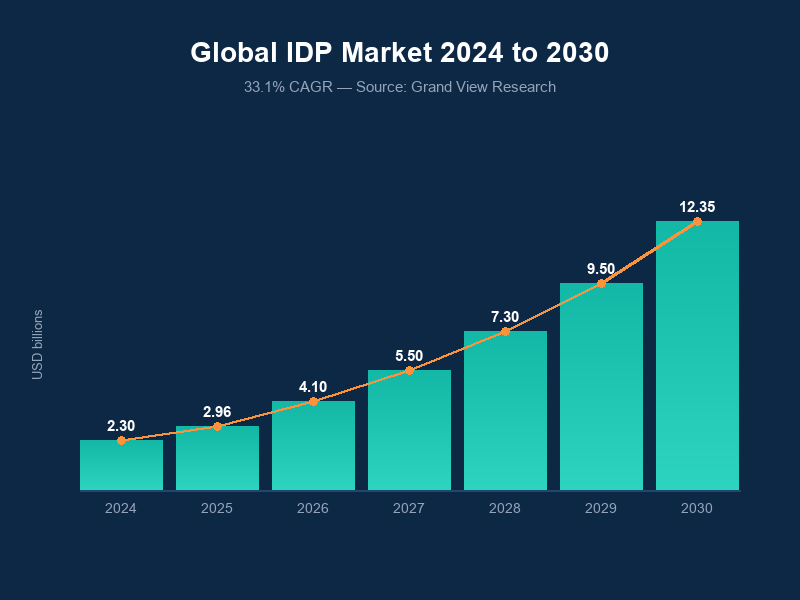
According to Grand View Research, the global IDP market was valued at $2.30 billion in 2024 and is forecast to grow at a 33.1% CAGR through 2030. Independent industry data from Market.us places the 2026 market size at roughly $4.4 billion. Whichever forecast you anchor to, the takeaway is identical: this is one of the fastest-growing categories in enterprise AI, and the buyers who move early are building durable cost advantages over the ones who wait.
What Intelligent Document Processing Actually Is
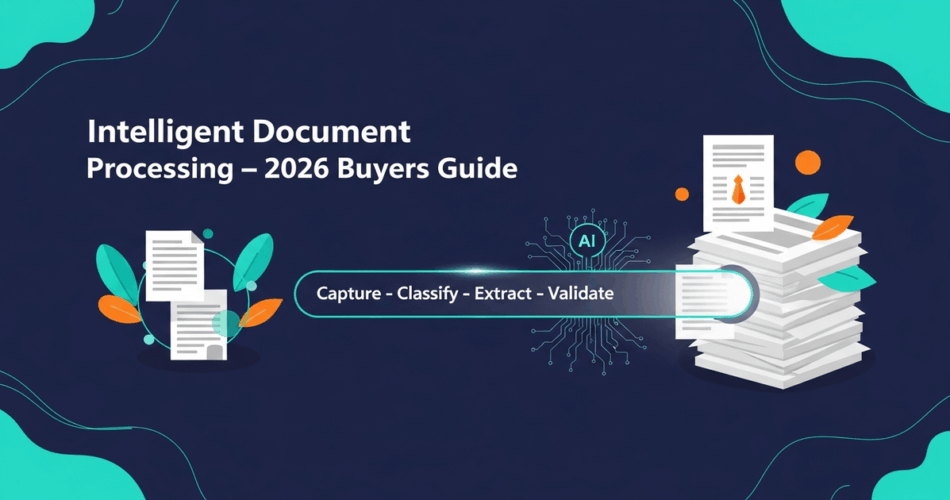
IDP is not a single product — it is a stack of capabilities that work together. Understanding the layers is the first step to evaluating any vendor honestly.
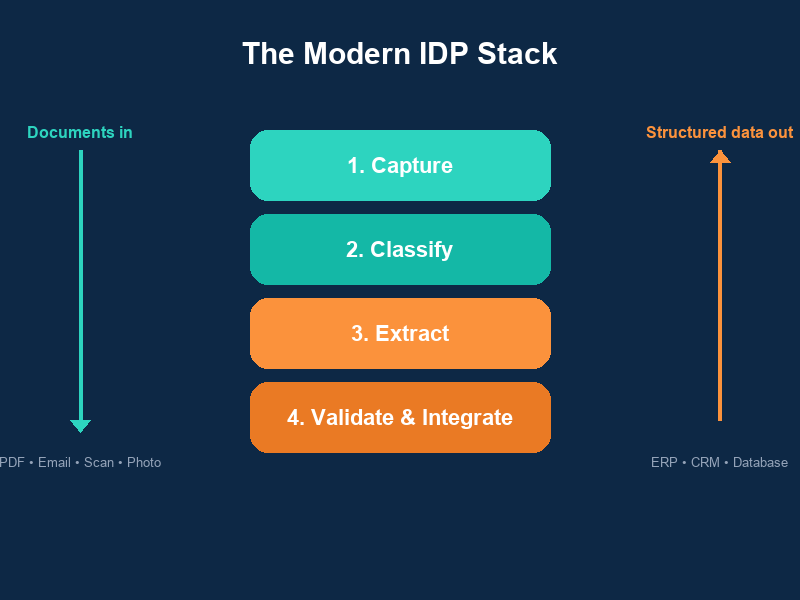
The Four-Layer IDP Stack
1. Capture (Ingestion). The system accepts documents from every channel your business actually uses: scanners, email attachments, mobile photo upload, secure file drop, API push from upstream systems, RPA bots harvesting documents from portals, even WhatsApp and SMS in some emerging-market deployments.
2. Classify (Understanding what it is). A model reads the document and decides what kind of document it is — invoice vs. credit note vs. purchase order — without you writing rules for every template variant. Modern IDP platforms handle thousands of document types out of the box.
3. Extract (Pulling out the data). This is where most buyers focus, but it is only the third step. Extraction means identifying the line items, totals, dates, parties, and reference numbers, regardless of whether the document is structured (a tax form), semi-structured (an invoice), or unstructured (a 60-page contract).
4. Validate and Integrate (Acting on it). The extracted data is checked against your business rules — does this invoice match an open PO? Is this claimant on file? Is the total within tolerance? — and then routed into the system of record. Anything ambiguous is sent to a human reviewer through a built-in queue, with the model learning from every correction.
Most failed IDP projects fail because the buyer evaluated only step three. The capture, classification, and integration layers are where the complexity — and the long-term cost — actually live.
How IDP Differs From Plain OCR
This is the comparison every vendor will dance around, so let’s name it directly.
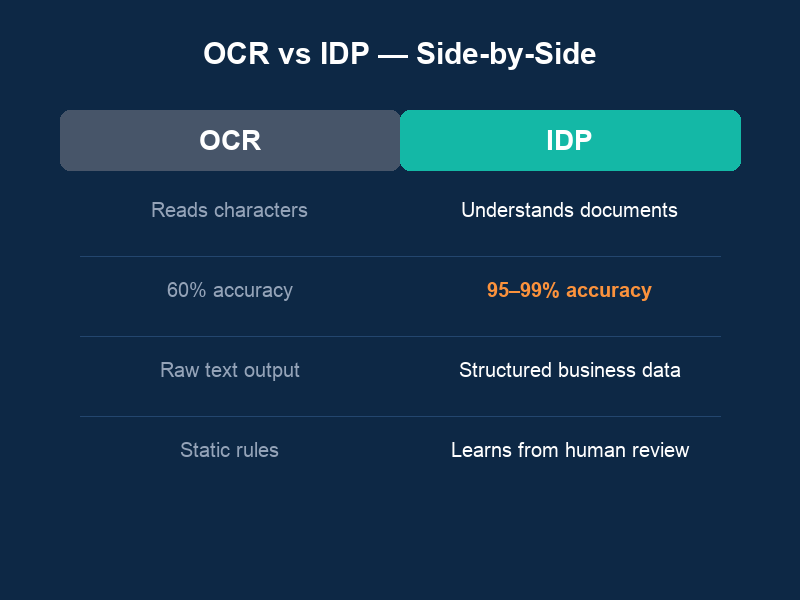
OCR (Optical Character Recognition) converts pixels to characters. That is its entire job. It does not know what it is reading. Hand it an invoice and a takeout menu, and it produces equally accurate text strings — and equally useless business output.
IDP uses OCR as one ingredient and adds machine learning, natural-language understanding, and (in 2026) large language models to interpret the text. It knows that “Invoice Total” and “Amount Due” might mean the same thing across two suppliers, that a date in DD/MM/YYYY format on a French invoice is not the same as MM/DD/YYYY on an American one, and that a vendor name buried in a footer might be the actual payee.
The accuracy gap shows up immediately at scale. Moxo’s 2026 analysis of OCR vs. IDP reports that legacy OCR plateaus around 60% accuracy on real-world business documents (handwriting, scans, low-quality faxes), while modern IDP routinely achieves 95–99% extraction accuracy on the same inputs. The implication is binary: at 60% accuracy, every document still requires human review. At 99%, only the 1% does.
Why IDP Matters in 2026
There are three forces converging to make 2026 an inflection year for IDP adoption — and any one of them by itself would be enough to justify a serious evaluation.
Force 1: The Market Has Crossed the Maturity Threshold
When the Gartner Competitive Landscape: IDP Platforms report first appeared, IDP was a fragmented space with dozens of overlapping vendors. As of 2026, the leaders have separated cleanly from the followers, deployment stories at over $1 billion of saved processing cost are public, and reference customers exist in every major industry. You are no longer placing a bet on whether the category works — you are choosing which vendor fits your stack.
Force 2: LLMs Have Eaten the Hardest Part of the Problem
Until 2023, the dirty secret of every IDP vendor was that 70% of engineering effort went into hand-tuning extraction templates per customer. Large language models have collapsed that work. A modern IDP platform can be pointed at a brand-new document type and reach 90%+ accuracy in under a day, where it used to take weeks of professional services.
This is why the new entrants — Rossum, Hyperscience, Docsumo, and the cloud hyperscaler offerings (AWS Textract, Azure AI Document Intelligence, Google Document AI) — have caught up so quickly with the legacy incumbents like ABBYY and Kofax. The moat moved from extraction accuracy to ecosystem fit.
Each of these cloud-native offerings has a different strength profile, and the implementation work that wires them into your business systems is where most rollouts succeed or stall. If you have already committed to a cloud, the right partner is one who has done deep deployments on your stack. DreamzTech runs dedicated practices for both — see the AWS Intelligent Document Processing practice for AWS-native rollouts, and the Azure Intelligent Document Processing practice for Microsoft-stack deployments — both built around the connector, security, and workflow work that determines whether a cloud-native IDP rollout actually pays back.
Force 3: The ROI Math Has Become Embarrassingly One-Sided
We will go deeper into ROI later, but the shape of the numbers is now well-documented. Deloitte’s automation studies consistently report 50–70% cost reduction and 60–80% cycle-time reduction in financial-services document workflows post-IDP. AIIM’s Market Momentum Index for IDP finds that 78% of surveyed enterprises now use AI for document processing, with adopters cutting approval cycle times by 40%.
When 78% of your peers have moved, the strategic question stops being “should we do this?” and becomes “are we already losing the talent and the customer-experience battle to the ones who did it last year?”
Core Capabilities of a Modern IDP Platform
Strip away the marketing surface and every credible IDP platform shipping in 2026 should expose six specific capabilities. If a vendor cannot demo any one of them on your documents, walk away.
1. Multi-Format Ingestion
The platform should accept PDFs (native and scanned), TIFFs, JPEGs, PNGs, Office documents, emails with attachments, mobile-phone photos taken in real lighting conditions, and structured payloads from upstream APIs. If you have a B2B partner who still faxes, it should also handle the noisy, low-DPI output of a TIFF-over-T.38 fax server.
Buyer signal: Ask to see ingestion of a phone-camera shot of a receipt with finger over one corner. If accuracy collapses, the platform is not production-grade.
2. Zero-Shot and Few-Shot Classification
You should not have to train a model with hundreds of examples to onboard a new document type. A modern platform uses LLMs to classify novel document types from a written description (“a Bill of Lading from a Vietnamese exporter”) plus zero to five examples.
Buyer signal: Ask the vendor to onboard a document type they have never seen before, live, on the call. Track the time-to-90%-accuracy.
3. Semantic Extraction Beyond Field Detection
Old extraction returned bounding boxes. Modern extraction returns meaning. A 2026-grade platform can answer “what is the indemnification cap on this contract?” or “what is the disputed amount between the freight invoice and the bill of lading?” — questions that require understanding relationships across multiple sections, not just reading a single field.
4. Human-in-the-Loop Validation
No platform is 100% accurate, and pretending otherwise is malpractice. The platform must include a usable review queue, configurable confidence thresholds (so high-confidence extractions auto-post and low-confidence ones get human eyes), and a feedback loop that pushes corrections back into the model.
Buyer signal: Time a reviewer correcting 50 documents. The unit of work should be seconds, not minutes.
5. Compliance, Security, and Data Residency
Documents are often the most sensitive data your business handles. A serious platform offers SOC 2 Type II attestation, ISO 27001, region-pinned data residency (US, EU, UK, India, GCC), HIPAA business-associate agreements where relevant, and clear data-deletion guarantees. GDPR.eu’s enterprise compliance guidance is a useful checklist for the EU side.
6. Workflow and System-of-Record Integration
This is where many buyers get burned. Extraction is the easy part; pushing the data into SAP, NetSuite, Workday, Epic, Guidewire, or your custom core platform without breaking — and surviving every release of those systems — is the hard part. Demand pre-built connectors for your specific stack, and ask to see the most recent connector regression test for your ERP version.
Industry Use Cases: Where IDP Pays for Itself in Months
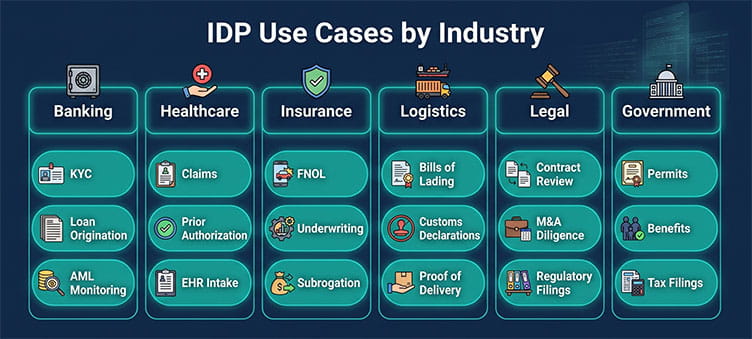
IDP is general-purpose technology, but the deployments that pay back fastest cluster in a few document-heavy industries. If you operate in any of the following, an IDP business case practically writes itself.
Banking and Financial Services
The documents: Loan applications, KYC packs, account-opening forms, mortgage origination files, AML transaction monitoring evidence, customer correspondence.
The numbers: Deloitte’s banking automation research finds that IDP cuts loan-origination cycle times from days to hours and reduces per-document handling costs by 50–70%. Major retail banks have publicly disclosed eight-figure annual savings in commercial-lending operations alone.
The story to tell your board: The first $10M of savings comes from headcount redeployed off keying. The next $10M comes from customer-experience wins (loans funded same-day vs. next-week) that move share.
Healthcare and Life Sciences
The documents: Patient intake forms, prior authorizations, claims, EHR records, lab reports, prescriptions, clinical-trial case-report forms.
The numbers: Manual claims processing costs hospitals and payers $40–$60 per claim by Deloitte’s measure; IDP-automated processing brings the per-claim cost under $20. At national-payer scale, that is a multi-hundred-million-dollar annual line item. HHS HIPAA guidance remains the binding compliance reference for any U.S. healthcare deployment.
Insurance
The documents: First Notice of Loss (FNOL), underwriting submissions, broker submissions, medical records for life and disability claims, subrogation files.
The numbers: AIG and Aviva have publicly reported nine-figure annual savings from IDP-powered claims and underwriting transformations. McKinsey’s insurance research attributes 20–40% productivity uplifts to IDP in commercial underwriting alone.
Logistics and Supply Chain
The documents: Bills of Lading, commercial invoices, packing lists, customs declarations, certificates of origin, proof-of-delivery slips.
The story: Cross-border logistics is the perfect IDP use case. The documents are noisy, multilingual, semi-structured, and time-sensitive — exactly the conditions where every percentage point of automation flows directly to faster customs clearance and lower demurrage.
Legal Services and In-House Legal Operations
The documents: Contracts, NDAs, M&A diligence files, regulatory filings, e-discovery review sets.
The story: A 2026-grade IDP platform combined with retrieval-augmented generation (RAG) is replacing the bottom 30% of contract-review work that used to land on associates and contract-management vendors. The remaining 70% (judgment, negotiation, drafting) is more valuable, more durable, and more interesting work.
Government and Public Sector
The documents: Permit applications, benefits forms, tax filings, FOIA-response packages, court filings.
The story: Public-sector IDP deployments are the unsung hero of the category. The volumes are enormous, the documents are messy, and the citizen-experience wins (a permit issued in 24 hours vs. 90 days) generate political capital that is difficult to ignore.
The IDP Buyers Checklist for 2026
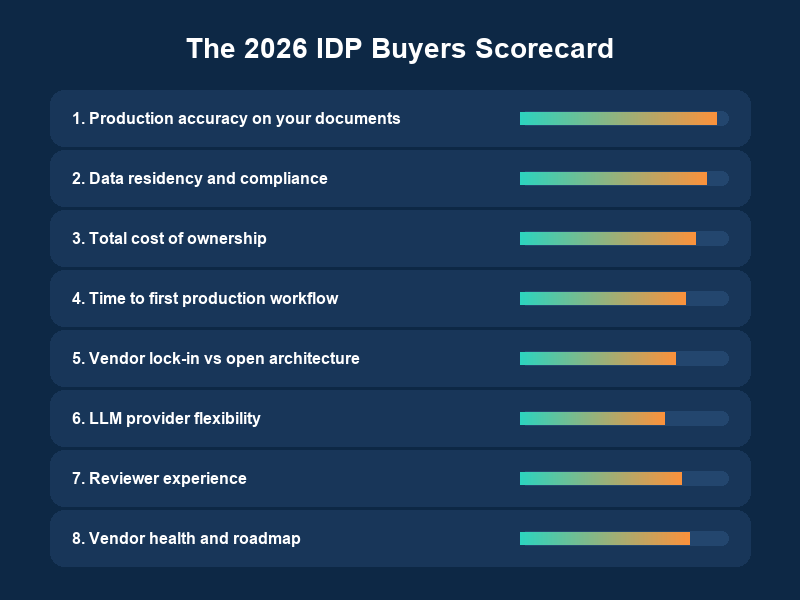
This is the section most buyers wish they had read before their first vendor demo. Eight criteria, each one a deal-breaker if missed.
1. Accuracy Benchmarks — On Your Documents
Vendor accuracy claims (the famous “99% accurate”) are derived from sanitized benchmarks on clean, machine-printed documents. Your real documents look nothing like that. Demand a paid pilot — not a 24-hour PoC — on 1,000 of your representative documents (including the ugly ones), measured field-by-field, with confusion matrices broken out by document type.
The bar: ≥ 95% straight-through processing on your top 5 document types. If a vendor cannot reach this on a paid pilot, no production deployment will.
2. Data Residency, Compliance, and Subprocessor Transparency
Where do your documents land? Where are the model inference calls served? Which sub-LLM providers (OpenAI, Anthropic, Google, in-house) are in the call path, and can they retain your data even briefly? Get the answers in writing and in the contract.
The bar: Region-pinned data residency, named subprocessors, zero data retention by sub-LLM providers, SOC 2 Type II report on file, HIPAA BAA available for healthcare buyers.
3. Total Cost of Ownership Beyond Per-Page Pricing
Vendor pricing is almost always quoted per page or per document. The real TCO includes professional services for onboarding, ongoing prompt and template tuning, integration build-out, human-in-the-loop reviewer time, and the inevitable model retrains. Forrester’s IDP research consistently flags professional-services overhang as the single most underestimated cost line.
The bar: A three-year TCO model that includes per-page fees, professional services, integration work, human review labor, and at least 15% reserve for model maintenance.
4. Time-to-Value: From Contract to Production
The legacy platforms can take 9–18 months to reach production. The modern platforms reach a single production workflow in 6–10 weeks. The compounding effect over a multi-workflow rollout is enormous.
The bar: First production workflow live within 90 days of contract signature, with a clear runway to three more workflows in the following 90.
5. Vendor Lock-in vs. Open Architecture
Does the vendor expose extracted data and trained-model artifacts as standard JSON over standard APIs, or are they locked inside a proprietary workflow engine? Can you migrate your annotated training data to another vendor if you need to?
The bar: Full API access, JSON export, no proprietary file formats holding your data hostage, and a written export-on-termination clause.
6. LLM Provider Flexibility
A 2026-grade platform should let you choose which sub-LLM powers extraction (or run a hosted open-source model in a customer-controlled VPC). Single-LLM platforms inherit pricing, latency, and policy risk you cannot control.
The bar: Multi-LLM routing, with at least one open-source option you can host privately for sensitive workloads.
7. Reviewer Experience and Operational Tooling
Spend an hour using the reviewer console with one of your real ops people in the room. If they roll their eyes, the platform will fail in production no matter how good the model is. Operational tooling — queue management, SLA dashboards, audit logging — is what separates platforms that survive year two from the ones that get ripped out.
The bar: Sub-30-second average review time on real documents, SLA dashboards your COO will actually look at, full audit logging.
8. Roadmap Credibility and Financial Health
You are buying a decade-long relationship, not a piece of software. Ask for the most recent ARR growth rate, gross retention, and net retention. Ask for the engineering org chart. Ask which sub-LLMs the platform will support in 2027. The answers separate platforms with ten-year horizons from the ones that will be acqui-hired into a stack you have never heard of.
IDP ROI: What the Data Actually Shows
Vendor ROI calculators are aspirational. The data below is what credible third parties have measured in production.
Cost-Per-Document Reduction
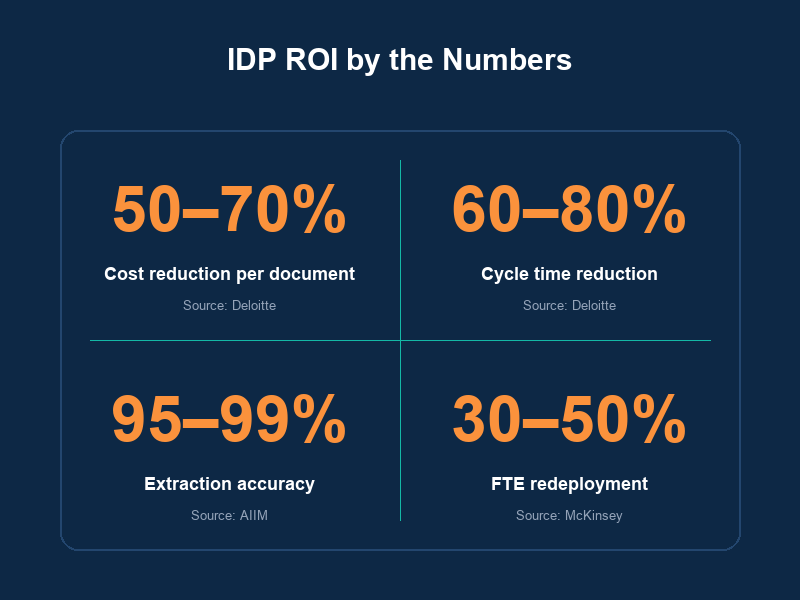
The most reliably reproduced number across multiple research firms is a 50–70% reduction in cost per document in financial-services workflows post-IDP. Deloitte’s automation research anchors this range, and McKinsey’s operational productivity work arrives at the same band from a different methodology. For a typical mid-market enterprise processing 1M documents a year at $1.50 each, that is $750K–$1.05M annual savings on a single workflow.
Cycle-Time Reduction
The cycle-time numbers are even more dramatic, because cycle time is not just an internal cost — it is a customer-experience and revenue lever. AIIM data shows IDP adopters cutting approval cycle times by 40% on average. Deloitte’s financial-services work consistently reports 60–80% cycle-time reduction for invoice and claim workflows.
Error-Rate Improvement
Modern IDP platforms reach 95–99% extraction accuracy, against legacy OCR’s 60% baseline on real-world inputs. The error-rate improvement is the gift that keeps giving — fewer rework loops, fewer downstream reconciliations, fewer customer complaints, less audit risk.
Headcount Redeployment
This is the conversation that requires care, but the numbers are clear. Enterprise IDP rollouts typically redeploy 30–50% of the FTEs previously dedicated to document keying onto higher-value exception handling, customer-facing work, or process-improvement initiatives. McKinsey’s research reports that Aviva alone saved £60M ($82M) in 2024 from AI-powered document transformation across its insurance operations.
The pattern in every credible deployment story is the same: payback inside 12 months, multi-year ROI in the 200–400% range, and the bigger the document volume, the steeper the curve.
Common Pitfalls and How to Avoid Them
Half of all IDP projects underperform their business case. The reasons are remarkably consistent across industries.
Pitfall 1: Underestimating Data Preparation
The trap: “The vendor said no training data is needed.”
The truth: Even modern LLM-powered platforms benefit enormously from a few hundred clean, labeled examples per document type. Going in with zero labeled data extends the time-to-accuracy by months.
The fix: Allocate 4–6 weeks at the start of the program for data labeling and ground-truth creation. It is the highest-leverage time you will spend.
Pitfall 2: Optimizing for Benchmark Accuracy, Not Production Accuracy
The trap: A vendor scores 99.2% on a clean-document benchmark and you sign.
The truth: Production accuracy on phone-photographed, partially-redacted, multilingual, marked-up documents will be 10–15 points lower than benchmark.
The fix: Insist on a paid pilot using your documents, not the vendor’s. Make pilot accuracy a contractual gate to the production rollout.
Pitfall 3: Ignoring the Cost of Exception Handling
The trap: You model the 95% straight-through case and forget the 5% exceptions.
The truth: The 5% exception cases drive 30–40% of total operational cost, because exceptions cluster in the most complex (and most valuable) documents.
The fix: Model the full workflow including exception handling, and design the reviewer console as a first-class part of the deployment, not an afterthought.
Pitfall 4: Skipping Pilot Governance
The trap: Engineering and the LOB pilot the platform without finance, audit, or compliance in the room.
The truth: The platform reaches production technically, but stalls in security review or fails an audit, costing months of delay and political capital.
The fix: Get audit, compliance, security, and data-protection officers into the pilot governance from week one. Write the production go-live criteria together.
Pitfall 5: Scoping Too Narrowly to Prove the Concept
The trap: A 1,000-document pilot on a single document type works beautifully, but production scale-out exposes performance bottlenecks no one stress-tested.
The truth: IDP platforms behave nonlinearly above 100K documents per day. Concurrency limits, throughput ceilings, and failover behavior matter more than per-document accuracy at that scale.
The fix: Pilot at production-representative scale on at least one workflow before signing the multi-year deal.
The Future of IDP: 2026–2028
Three near-term shifts will shape the IDP category over the next 24 months. Buying decisions made today should account for them.
Shift 1: Multimodal LLMs Will Collapse the OCR Layer
The most capable foundation models in 2026 — GPT-class, Claude-class, Gemini-class — already process images directly without a separate OCR step. Within 18–24 months, expect the entire “OCR + extraction” pipeline to compress into a single multimodal model call for most use cases. The platforms that architect for this collapse will widen their lead. The ones that don’t will be carrying a stack of legacy OCR licenses they cannot justify.
Shift 2: Agentic Workflows Will Replace Static Extraction
The “extract fields from a document” frame is already starting to feel narrow. The frame replacing it is the document-handling agent: a model that reads a document, decides what should happen next, gathers any missing context (calls a CRM API, looks up a contract), and either takes the action or escalates with a recommendation. Vendors building this are no longer competing with IDP — they are competing with BPO. The TAM expansion is enormous.
Shift 3: Native IDP Inside the Systems of Record
Every major ERP, EHR, and core-banking vendor is either building or acquiring IDP capability. Within two years, basic IDP will be a feature of SAP, Oracle, Workday, Epic, and the major insurance core systems — included in the existing license at no incremental cost. The independent IDP platforms will compete on advanced capabilities (complex contracts, multilingual, ultra-high-volume) and on portfolio breadth across multiple system landscapes.
What this means for your buying decision: If your only use case fits cleanly inside one ERP, the embedded option will likely win on TCO within 24 months. If you have document workflows spanning three or more systems of record, an independent IDP platform remains the right architectural choice for the long term.
The Bottom Line: How to Choose
If you take only three things away from this guide, take these:
1. Buy the platform that fits your operational reality, not the one with the best benchmark slide. A 95% accuracy platform that integrates cleanly with your ERP and has a usable reviewer console will outperform a 99% accuracy platform that needs three custom integrations and ships an unusable review queue. Operations beats marketing every time.
2. Run a paid, scoped, time-boxed pilot before you sign anything multi-year. Six weeks. One workflow. Real documents. Contractual accuracy gate. Anything less is hoping the demo holds up — and demos always hold up.
3. Treat the vendor as a 5–10 year relationship, not a procurement event. Roadmap credibility, financial health, and customer-success depth matter more than any single feature. The fastest-moving vendors in 2026 will look very different in 2028, and you want to be on the platform that adapts, not the one that gets refactored out of existence.
The IDP category has crossed the chasm. The leaders are real, the ROI is reproducible, and the technology is in production at scale across every document-heavy industry. The question is no longer whether to buy. It is which platform, for which workflows, and on what timeline.
Conclusion: Documents Are Solved — Decide Whether You Are on the Winning Side
Five years ago, “intelligent document processing” was a forward-looking phrase. In 2026, it is a category-leading enterprise software market with eleven-figure measured ROI and reference customers in every industry that handles paper. The technology works. The economics work. The only remaining question is which buyers move now and capture the cost, cycle-time, and customer-experience wins, and which buyers spend another year writing the same memo about why this is on next year’s roadmap.
The companies that adopted IDP in 2023 spent 2024 saving money. The companies that adopted in 2024 spent 2025 reinvesting those savings into growth. The companies that adopt in 2026 are joining a category whose leaders have a two-year operational head start. That gap closes only by moving — and moving with a clear-eyed evaluation framework, an honest pilot, and a partner who has run this play before.
The good news: there has never been a better time to be a buyer in this market. The platforms are mature, the price points are rational, the integration story is real, and the case studies are public. The bad news, only if you ignore the timing: every quarter you wait, your competitors compound the savings you could have been compounding too.
That is the choice. The framework above is how you make it.
Frequently Asked Questions
1. What is intelligent document processing in simple terms?
Intelligent Document Processing is AI-powered software that reads business documents — invoices, claims, contracts, KYC packs, bills of lading — extracts the data that matters, validates it against your business rules, and posts it directly into the systems where work actually happens. It is the modern replacement for manual data entry and the legacy stack of OCR plus rule-based scripts that most enterprises are still running.
2. How is IDP different from OCR?
OCR (Optical Character Recognition) only converts pixels into text characters. It does not understand what it has read. IDP uses OCR as one ingredient and adds machine learning, natural-language understanding, and large language models to interpret the text, classify the document, extract fields, validate them, and route them into downstream systems. Practically: legacy OCR tops out around 60% accuracy on real-world business documents; modern IDP routinely reaches 95–99%.
3. How accurate is modern intelligent document processing?
Production-grade IDP platforms reach 95–99% extraction accuracy on representative business documents when properly configured and given a few hundred labeled examples per document type. Vendor benchmark numbers (often 99%+ on clean, machine-printed inputs) are not the same as production accuracy. Always demand a paid pilot on your real documents — including the ugly ones — with a contractual accuracy gate before signing a multi-year deal.
4. What ROI should we expect from an IDP deployment?
The reproducible numbers across credible third-party research are 50–70% cost reduction per document, 60–80% cycle-time reduction, and 30–50% redeployment of FTEs previously dedicated to manual keying. Typical payback is inside 12 months and multi-year ROI lands in the 200–400% range for document-heavy workflows. The bigger the document volume, the steeper the curve — sub-100,000-document-per-year workflows often have weaker business cases than vendor calculators suggest.
5. How long does it take to get an IDP workflow into production?
In 2026, modern LLM-powered platforms reach a single production workflow in 6–10 weeks from contract signature. Legacy platforms still take 9–18 months. The right contractual target is first production workflow live within 90 days of signature, with a clear runway to three additional workflows in the following 90. Anything longer is a signal that the platform is built around heavy professional-services revenue rather than self-serve onboarding.
6. Which industries benefit most from intelligent document processing?
The deployments that pay back fastest cluster in document-heavy industries: banking and financial services (loan origination, KYC, AML), healthcare and life sciences (claims, prior authorization, EHR intake), insurance (FNOL, underwriting, subrogation), logistics (bills of lading, customs declarations, proof of delivery), legal services (contract review, M&A diligence), and government (permits, benefits, tax filings). If your operation moves more than 100,000 documents a year through any single workflow, IDP almost always builds a positive business case.
7. Is IDP secure for regulated industries like healthcare and banking?
Yes — when you buy carefully. A serious enterprise IDP platform offers SOC 2 Type II attestation, ISO 27001, region-pinned data residency, HIPAA business-associate agreements where relevant, and zero data retention by any sub-LLM providers in the call path. The security risk is rarely the platform itself; it is the integration architecture and the human-in-the-loop reviewer access controls. Engage your security, compliance, and audit functions in pilot governance from week one, not after technical go-live.
8. Should we buy an independent IDP platform or use the one built into our ERP?
If your only document workflows live cleanly inside one system (SAP, Oracle, Workday, Epic, Guidewire, etc.), the embedded option is likely to win on TCO within 24 months as the major vendors close their feature gaps. If your document workflows span three or more systems of record, an independent IDP platform remains the right architectural choice for the long term — it absorbs the integration complexity that no embedded option will. Match the choice to the operational reality, not to the demo.