







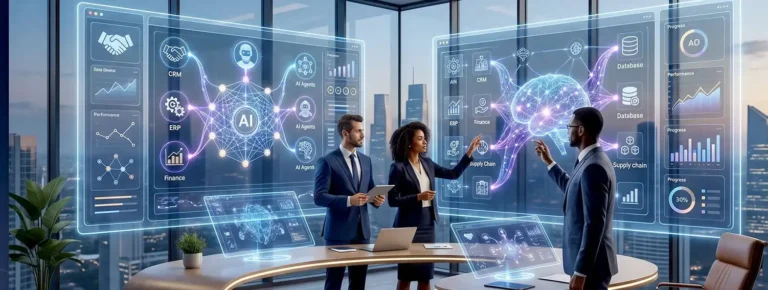
Dreamztech is an AWS Partner, Google Cloud Partner, Microsoft Solutions Partner, Salesforce Partner and SAP Build Partner with engineers certified across AWS Solutions Architect, Azure Solutions Architect Expert, Google Cloud Architect, Salesforce App Builder and SAP S/4HANA integration — plus 100+ production AI agent integration deployments across 15 countries since 2012.
An AI agent is only as valuable as the systems it can read from and write to. AI agent integration with CRM and ERP is what turns a chatbot demo into a production system that closes tickets, books meetings, posts journal entries, updates pipeline, opens claims and ships orders. We engineer that integration layer end-to-end — authentication, RBAC, audit logging, schema mapping, retry / circuit-breaker patterns, idempotency and bidirectional sync.
That is what we build — Model Context Protocol (MCP) tool servers and native adapters that connect any LLM agent (Claude, GPT-4o, Gemini, Llama) to Salesforce, ServiceNow, SAP, Oracle, Microsoft Dynamics 365, NetSuite, Workday, HubSpot and 50+ enterprise systems, deployed on AWS, Azure or Google Cloud as a HIPAA-eligible, SOC 2 Type II, ISO 27001-aligned production platform.
Quick Answer: AI agent integration with CRM and ERP is the engineering practice of connecting production AI agents to enterprise systems — Salesforce, HubSpot, Microsoft Dynamics 365 on the CRM side; SAP, Oracle, NetSuite, Workday, Microsoft Dynamics 365 F&O on the ERP side; plus ServiceNow ITSM and 50+ adjacent systems. Connection is via Model Context Protocol (MCP) tool servers, REST/GraphQL adapters, OAuth 2.0 authentication, record-level RBAC and immutable audit logs.
DreamzTech’s AI agent integration services range from $15,000 single-system MVP integrations up to $300,000+ enterprise platforms with 10+ CRM/ERP/ITSM integrations, custom MCP servers, observability and full compliance — HIPAA-eligible, SOC 2 Type II, ISO 27001 / 27018 and FedRAMP-aligned on AWS, Azure or Google Cloud. Typical delivery: 4–14 weeks.
Reviewed by the DreamzTech Integration Practice — Reviewed and updated 2026-05-12. Includes hands-on guidance from senior Salesforce, ServiceNow, SAP, Oracle and Microsoft Dynamics integration architects with 100+ production AI agent deployments.
Six tightly-scoped service tracks — integration discovery and architecture, CRM integration (Salesforce, HubSpot, Dynamics 365), ERP integration (SAP, Oracle, NetSuite, Workday), ITSM integration (ServiceNow, Jira, Zendesk), Model Context Protocol tool servers, and managed integration operations.
System inventory, authentication model selection (OAuth 2.0, API keys, JWT, SAML SSO), data-flow mapping (read-only vs write-back, batch vs real-time), RBAC scoping per agent role, MCP-vs-native-adapter decision and compliance scoping.
Production AI agent integration with Salesforce (REST + GraphQL + Apex + Tooling API), HubSpot (CRM v3 API), Microsoft Dynamics 365 Sales + Customer Service (Dataverse, OData, Power Automate). Lead enrichment, opportunity updates, Service Cloud automation, audit logs.
Production AI agent integration with SAP S/4HANA (OData + RFC + BAPI + IDocs), Oracle Fusion / E-Business Suite (REST + SOAP), NetSuite (SuiteTalk + RESTlets), Workday (REST + SOAP + RaaS), Microsoft Dynamics 365 Finance & Operations.
Production AI agent integration with ServiceNow (Table API + Scripted REST + MID Server + Flow Designer), Atlassian Jira Service Management, Zendesk Support and Sunshine Conversations, BMC Helix and Freshservice.
Build production MCP servers that expose your CRM, ERP, ITSM and internal systems to any MCP-compatible AI agent (Claude, GPT, Gemini). Standardise tool inventories across agents and unlock model portability.
Production integration ops — API version drift monitoring, OAuth token rotation, schema change detection, breaking-change alerts, 24/7 SRE and SLA-backed incident response across all your integrations.
AI agent integration services are the right fit when an off-the-shelf chatbot or hyperscaler agent cannot reach into your CRM, ERP or ITSM with the depth your workflow requires — when you need record-level RBAC, audit logs, bidirectional sync and production reliability.
Production AI agent integration with CRM and ERP delivers measurable ROI within 90 days. Across DreamzTech’s 100+ deployments, customers see 50–80% reduction in manual data entry, 3–5× lift in lead-to-opportunity conversion, 60–75% faster ticket resolution, 99.5%+ integration uptime after eval-driven tuning, and six-figure annual cost savings per integrated agent — with full audit trails, RBAC and human-in-the-loop approval on every high-risk write.
Every AI agent integration we build follows a six-layer reference architecture — authentication, tool inventory, schema validation, action execution, guardrails and observability. Scales from single-system MVPs to enterprise platforms with 50+ integrated systems.
OAuth 2.0, JWT, SAML SSO, API keys and certificate-based mutual TLS — agents authenticate as named service principals with scoped, refreshable, rotatable credentials.
Model Context Protocol (MCP) servers or native SDK adapters expose each system's read and write operations as discoverable, schema-typed tools to any agent.
Pydantic / JSON-schema validation on every tool call — rejects malformed inputs, enforces type contracts, prevents agents from corrupting CRM / ERP records.
Retry / fallback / circuit-breaker / idempotency-key patterns wrap every external call — production reliability against rate limits, transient failures and API outages.
Per-tool RBAC enforcement, dollar / volume thresholds, PII redaction at the boundary and human-in-the-loop approval on high-risk writes (>$10K transactions, mass updates, deletions).
Every tool call, response, retry, fallback and approval logged with replay-ready audit trails — SOX, HIPAA, GDPR, EU AI Act compliant. LangSmith / Langfuse / Arize tracing.
Buyers often confuse AI agent integration with iPaaS (MuleSoft, Boomi, Workato), native vendor AI features (Einstein, Joule) and direct LLM API calls. This section makes the distinction crisp.
| Integration Pattern | When to Use | DreamzTech Approach |
|---|---|---|
| MCP Tool Server | Default — when you want model portability and standardised tool inventories | Custom MCP server per system, deployed in your VPC |
| Native SDK Adapter | When platform-specific features (Salesforce Apex, SAP BAPI) are required | SDK wrapped in a typed tool interface — agent doesn't know the difference |
| Event-Driven Integration | When agent should react to CRM / ERP events in <2 seconds | Salesforce Streaming + Kafka / EventBridge + LangGraph trigger |
| Batch Integration | Daily / hourly bulk processing — invoice batches, lead enrichment | Bulk API 2.0 (Salesforce), $batch (SAP), Bulk Data Load (Workday) |
| Bidirectional Sync | When records must stay in lockstep across CRM ↔ ERP | Conflict resolution + idempotency keys + replay-safe Temporal workflows |
Our AI agent integration with CRM and ERP spans 8 high-stakes industries — from healthcare prior-auth integrations with Epic and Cerner to BFSI Salesforce + SAP + Oracle integrations, legal CLM connectors and retail Shopify + SAP Commerce automations.
HIPAA-eligible AI agent integration with Epic, Cerner, FHIR APIs, Salesforce Health Cloud and ServiceNow Healthcare — prior-auth, clinical-Q&A, patient triage workflows.
AI agent integration with Guidewire ClaimCenter / PolicyCenter, Duck Creek, Salesforce Financial Services Cloud — claims triage, FNOL automation, underwriting copilots.
AI agent integration with iManage, NetDocuments, HighQ, Salesforce Legal Cloud and Microsoft 365 — M&A due-diligence, contract review, CLM automation.
AI agent integration with SAP, Oracle Fusion, Microsoft Dynamics 365 Finance, Salesforce Financial Services Cloud, Workday — AP automation, KYC/AML, lending copilots.
AWS GovCloud / Azure Government deployments with Salesforce Government Cloud, ServiceNow Government — permits, benefits eligibility, FOIA workflows.
AI agent integration with Shopify, Magento, SAP Commerce, Salesforce Commerce Cloud, NetSuite — order-to-fulfilment, customer service, inventory automation.
AI agent integration with SAP S/4HANA, Oracle E-Business Suite, MES platforms and Salesforce Manufacturing Cloud — shop-floor, supplier-doc QA, predictive maintenance.
AI agent integration with Workday, BambooHR, SuccessFactors, Salesforce Service Cloud — onboarding, employee self-service, policy Q&A, recruiter pipelines.
You're reading our AI Agent Consulting and Development page (strategy + advisory + delivery). Already have a plan and need build only? See LLM Agent Development or Multi-Agent AI Systems. Need ongoing ops? See Managed AI Agent Services.
Bring your toughest integration challenge — Salesforce + SAP bidirectional sync, ServiceNow with custom tables, Workday RaaS for AI HR copilot, MCP server for legacy Oracle EBS — and a senior integration architect will walk you through the recommended pattern (MCP vs native SDK), authentication model, RBAC scope and a fixed-scope budget range. Live, on the call. Free, 30 minutes, no obligation.
AWS Partner, Google Cloud Partner, Microsoft Solutions Partner, Salesforce Partner and SAP Build Partner. Certified Salesforce App Builders, ServiceNow CSAs, SAP S/4HANA integration specialists, Microsoft Dynamics architects and Workday consultants. 100+ production AI agent integrations across 15 countries since 2012.



















Tell us which CRM / ERP / ITSM systems your AI agent needs to integrate with, your authentication model and your data volume. A senior integration architect will reply within one business day with a reference architecture (MCP server inventory, OAuth model, RBAC scope, audit log plan), a fixed-scope estimate and recommended next steps.
Explore how DreamzTech has engineered production AI agent integrations with Salesforce, ServiceNow, SAP, Oracle, Microsoft Dynamics 365, NetSuite and Workday — replacing manual data entry, accelerating lead-to-opportunity conversion and automating cross-system workflows for Fortune 500 enterprises.

A high-growth B2B SaaS company replaced manual lead qualification with a DreamzTech-engineered Salesforce + AI agent integration. Custom MCP tool server exposed Salesforce Leads, Opportunities, Contacts and Tasks to an Anthropic Claude 3.5 Sonnet researcher agent with Apollo, ZoomInfo and 6sense intent-data enrichment. Bidirectional sync via Salesforce Streaming API. Year 1: 4.2× SQL conversion lift, $14.2M new pipeline, 67% SDR productivity gain — with audit logs and brand-voice guardrails on every outbound message.

A global retail bank automated its IT service desk with a DreamzTech-engineered ServiceNow + AI agent integration. Custom MCP tool server exposed ServiceNow Incident, Request, Knowledge and CMDB tables to OpenAI GPT-4o triage agents and AutoGen specialist sub-agents for password reset, VPN, MFA and Microsoft 365 issues. Bi-directional ticket sync via Table API + Scripted REST. Year 1: 68% L1 auto-resolution, 73% faster resolution, $1.8M saved across 18,000 monthly tickets — with full audit logs and OAuth-scoped RBAC per agent.

A 200-employee regional financial services firm replaced manual AP for 3,000+ monthly invoices across 4 subsidiaries with a DreamzTech-engineered SAP + AI agent integration. Custom MCP tool server exposed SAP S/4HANA Accounts Payable, GL, Vendor Master and Purchase Order modules via OData + BAPI to a LangGraph orchestration with Claude 3.5 Sonnet AP-reasoning steps. Result: 70% manual entry cut, 84% straight-through processing, $420K saved in 9 months — with full SOX audit trails and human-approval gates on every >$10K transaction.
AWS Partner, Google Cloud Partner, Microsoft Solutions Partner, Salesforce Partner and SAP Build Partner. Engineers with deep certifications across Salesforce, ServiceNow, SAP S/4HANA, Microsoft Dynamics 365 and Workday. 100+ production AI agent integrations across 15 countries since 2012 — every project ships to production with named SLAs.

A structured, transparent four-phase process designed for production-grade AI agent integration with CRM and ERP — from system discovery to MCP server engineering, evals and managed operations.
We inventory your CRM / ERP / ITSM systems, identify required read and write operations, model authentication (OAuth 2.0 vs JWT vs SAML), design RBAC scopes per agent role, plan audit log architecture, run NIST AI RMF scoping and lock down scope with named success metrics.
Senior integration architects design the MCP server inventory (or native SDK adapters), schema mapping, retry / circuit-breaker / idempotency patterns, rate-limit handling, error-recovery flows and audit log emission — under each cloud's Well-Architected Framework.
We build MCP servers and adapters in production-grade Python / TypeScript, write integration tests against sandbox CRM / ERP environments, run end-to-end evals against ground-truth datasets, and iteratively benchmark accuracy, latency and cost against your manual baseline.
We cut over to production with phased rollout, build the agent-fronted application (chat / portal / API trigger), set up observability dashboards (LangSmith / Langfuse / Arize / Datadog), API drift monitoring, and hand off with documentation, SRE runbook and SLA tier.
AWS Partner, Google Cloud Partner, Microsoft Solutions Partner, Salesforce Partner and SAP Build Partner-grade AI agent integration platform — OAuth 2.0, record-level RBAC, PII redaction at the boundary, immutable audit logs and human-in-the-loop approval on high-risk writes.
Every AI agent integration uses OAuth 2.0 with named service principals — never user-impersonation. Tokens are refreshable, rotatable and scoped per agent role. Salesforce Connected App, ServiceNow OAuth Provider, SAP OAuth Authorization Server, Microsoft Entra ID, Okta and Azure AD all supported. Certificate-based mutual TLS for high-assurance integrations.
Granular RBAC limits which records each agent can read and write. The researcher agent reads Leads + Contacts; the executor writes Opportunities + Tasks; the reviewer approves. Backed by Salesforce sharing rules, ServiceNow ACLs, SAP authorization objects, Microsoft Dynamics security roles and Workday domain security policies. No agent has write access it does not strictly need.
Every tool call, input, response, retry, fallback and human approval logged to immutable audit stores (CloudTrail, Azure Monitor, ServiceNow Audit Log, Salesforce Field History). Logs include the agent identity, requesting user, payload hash and outcome — replay-ready for SOX, HIPAA, 21 CFR Part 11, GDPR and EU AI Act audits.
Sensitive fields are redacted before reaching the LLM and re-injected before writing back. Salesforce Field-Level Security, ServiceNow data policies, SAP Information Lifecycle Management and Microsoft Purview Sensitivity Labels are honoured. PII never leaves your tenant unmasked. Critical for HIPAA-eligible deployments and EU GDPR right-to-erasure.
Every external call wrapped in exponential-backoff retry, circuit-breaker on flaky endpoints, idempotency keys to prevent duplicate writes on retry, dead-letter queues for unrecoverable failures and compensation logic for partial-rollback scenarios. Rate-limit-aware throttling honours Salesforce API limits, ServiceNow concurrent-session limits and SAP gateway thresholds.
Configurable approval gates on dollar thresholds (e.g., >$10K AP transactions), mass updates (e.g., >50 record changes), deletions and any tool flagged “review required”. Approvals route through ServiceNow workflows, Salesforce approval processes, Microsoft Power Automate, Slack or email. Audit logs capture the approver, rationale and timestamp.
Information security
BAA across all major clouds
Responsible-AI documentation
Annual audit certified
Conformity assessment
ADA-accessible UI
Built on the AWS / Azure / Google Cloud Well-Architected Frameworks plus deep Salesforce, SAP, ServiceNow and Microsoft Dynamics specialisation.
Real feedback from CFOs, Directors of Sales Operations, and Heads of IT Service running production AI agents integrated with their Salesforce, SAP, ServiceNow, Oracle and Microsoft Dynamics environments.



Choose the engagement model that fits your AI agent integration build — from senior-led dedicated teams to fixed-price MVPs and flexible time-and-materials.
A full-time team of senior integration architects, Salesforce / ServiceNow / SAP specialists and AI agent engineers — typically 3 to 8 engineers — embedded into your delivery cadence for 6–18 months of integration build and operations.
Ideal for well-defined integrations — Salesforce + AI agent, ServiceNow + AI agent, SAP + AI agent, Workday + AI agent — delivered as a fixed-scope, fixed-price MVP in 4–12 weeks with MCP server, OAuth, RBAC and audit logs.
Quickly add senior Salesforce, ServiceNow, SAP, Microsoft Dynamics or Workday integration specialists plus AI agent engineers to your in-house team — fully managed by DreamzTech. 1–3 month minimum, scale up or down monthly.
Maximum flexibility for evolving integration requirements — MCP server R&D, schema-mapping spikes, OAuth/SSO experiments, custom adapter prototypes. Pay only for time used; transparent monthly invoicing.
Model Context Protocol tool servers, native Salesforce / ServiceNow / SAP / Oracle / NetSuite / Workday / Microsoft Dynamics 365 adapters, OAuth 2.0 with RBAC, audit logs and production reliability — engineered into a HIPAA-eligible, SOC 2 Type II integration platform in 4–12 weeks.
Four real options exist for adding AI to your CRM and ERP: (1) iPaaS platforms (MuleSoft, Boomi, Workato) for deterministic system glue; (2) Native vendor AI features (Salesforce Einstein, Microsoft Copilot, SAP Joule); (3) Direct LLM API calls from your application; or (4) Custom AI agent integration services with MCP tool servers, OAuth, RBAC and audit. Here’s the honest comparison.
| Capability | iPaaS (MuleSoft / Boomi / Workato) | Native Vendor AI (Einstein / Copilot / Joule) | Direct LLM API Calls | DreamzTech AI Agent Integration |
|---|---|---|---|---|
| AI Reasoning Steps | None — deterministic flows | Vendor-locked AI | You build everything | Multi-LLM routing — Claude, GPT-4o, Llama, Gemini per task |
| Cross-Platform Workflows | Strong — SaaS glue | Limited to vendor ecosystem | Manual | MCP servers across Salesforce, SAP, ServiceNow, Workday, Dynamics 365, 50+ systems |
| Record-Level RBAC | Inherits source system | Vendor-defined | DIY | Per-agent OAuth scopes honouring sharing rules, ACLs, authorization objects |
| Immutable Audit Logs | Run history | Vendor logs | DIY | SOX / HIPAA / GDPR / EU AI Act replay-ready trails per tool call |
| Model Portability | N/A | Locked to vendor model | Re-plumb per swap | MCP makes tools portable — swap Claude → GPT → Gemini without re-plumbing |
| Source Code & IP | SaaS lock-in | Vendor lock-in | You own (and maintain) | You own MCP servers, adapters, prompts, evals and infrastructure |
| Best For | Deterministic SaaS glue | In-platform productivity | Internal POCs | Production AI agents with deep CRM/ERP integration in regulated industries |
When DreamzTech’s AI agent integration services are the right call: when native vendor AI (Einstein, Joule, Copilot) does not cover your custom data or cross-system needs; when iPaaS deterministic flows cannot handle reasoning-required steps; when you need record-level RBAC and SOX / HIPAA / GDPR audit trails that vendor AI cannot deliver; when you want model portability (today Claude, tomorrow GPT-5) without re-plumbing integrations; or when you need MCP tool servers as a standardised tool layer across multiple agents. We help you make the trade-off call up front — often hybrid (Einstein + custom MCP + LangGraph) is the right answer.
Common questions from CIOs, CRMs administrators, ERP architects and AI leads evaluating AI agent integration services for enterprise deployment.
AI agent integration with CRM and ERP is the engineering practice of connecting production AI agents (built on GPT-4o, Claude 3.5 Sonnet, Llama 3.3 or Gemini 2.0) to enterprise systems — Salesforce, HubSpot, Microsoft Dynamics 365 on the CRM side; SAP S/4HANA, Oracle Fusion, NetSuite, Workday on the ERP side; plus ServiceNow ITSM and 50+ adjacent systems. Connection is via Model Context Protocol (MCP) tool servers, REST / GraphQL / SOAP adapters, OAuth 2.0 authentication, record-level RBAC and immutable audit logs.
MCP is Anthropic’s open standard for exposing tools, data sources and services to AI agents — a “USB-C for AI tools.” For CRM and ERP integration, MCP is powerful: (1) you write one MCP server per system (Salesforce, SAP, ServiceNow) and any MCP-compatible agent (Claude, GPT, Gemini) can use it; (2) tool inventories standardise across agents — no per-agent re-plumbing when you swap models; (3) discoverable schemas mean agents adapt as your CRM / ERP fields change. DreamzTech engineers production MCP servers for all major enterprise systems.
Always via OAuth 2.0 with named service principals — never user-impersonation. Salesforce: Connected App with Web Server / JWT Bearer flow. SAP: OAuth 2.0 Authorization Server with SAML Bearer or Client Credentials grant. ServiceNow: OAuth Provider with scoped REST API access. Microsoft Dynamics 365: Microsoft Entra ID (Azure AD) with service-principal client credentials. Tokens are refreshable, rotatable and scoped to least-privilege RBAC. SSO via Okta, Azure AD, Ping Identity or Microsoft Entra ID is standard.
iPaaS handles deterministic system-to-system glue — “when invoice arrives in Coupa, post to SAP, notify Slack.” No reasoning. AI agent integration adds an LLM that can extract, classify, decide and generate at decision points — “when invoice arrives, classify the vendor against 200+ formats, extract line items, three-way match against PO and GR, route exceptions to AP clerk with summary.” Best practice: iPaaS for deterministic glue, AI agent integration for reasoning-required steps. Often combined — iPaaS triggers an AI agent workflow at a key decision step.
Einstein, Joule and Copilot are vendor-native AI inside one platform. They are good for in-platform productivity (compose emails, summarise records, suggest replies). They struggle when you need: (1) cross-platform reasoning (Salesforce + SAP + Workday in one workflow); (2) custom domain knowledge not in the vendor’s training data; (3) custom guardrails or audit requirements; (4) model portability (lock-in to vendor’s model). DreamzTech’s custom AI agent integration complements native vendor AI — often we orchestrate Einstein + our own agents + LangGraph for cross-platform workflows.
Every AI agent integration honours your existing record-level security. Salesforce: sharing rules, OWD, role hierarchy, manual sharing. ServiceNow: ACLs and contextual security. SAP: authorization objects, derived roles. Microsoft Dynamics 365: security roles, field-level security, hierarchical security. Workday: domain security policies. The agent operates as a service principal with assigned roles — never with broader access than the highest-privilege human in its workflow.
Every tool call from an AI agent is logged immutably with: timestamp, agent identity, requesting user (if any), tool name, payload hash (or full payload for non-PII tools), response hash, retries, fallback, human approval (if applicable). Logs flow to SIEM (Splunk, Sumo Logic, Sentinel) and to native system audit tables (Salesforce Setup Audit, ServiceNow Audit, SAP Read Access Log). Replay-ready for SOX certification, HIPAA covered-entity audits, GDPR Article 30 records-of-processing and EU AI Act high-risk system evidence.
Two layers of defence. (1) Schema validation: every tool call is validated against Pydantic / JSON-schema; breaking responses are caught before they corrupt agent state. (2) Schema drift monitoring: nightly diff between live API responses and pinned schemas; alerts on additions, deletions, type changes. (3) Adapter regression tests run before every Salesforce / SAP / ServiceNow release. Managed Integration Operations includes API change monitoring as part of the SLA.
A single-system AI agent integration MVP starts at $15,000–$30,000 (one MCP server, OAuth, RBAC, 2–3 tool operations, 3–5 weeks). A multi-system production integration runs $50,000–$150,000 (3–5 systems, full audit log, observability, 5–10 tool operations per system, 6–12 weeks). Enterprise integration platforms with 10+ systems, custom MCP servers, schema drift monitoring, FedRAMP / HIPAA controls and 24/7 SRE run $150,000–$300,000+.
A focused single-system integration MVP ships in 3–5 weeks. A multi-system production integration (3–5 systems with bidirectional sync) ships in 6–12 weeks. Enterprise integration platforms with 10+ systems, schema drift monitoring, breaking-change regression suites and 24/7 SRE — 12–22 weeks. All timelines include OAuth setup, RBAC modelling, MCP server engineering, eval harnesses, integration testing and production cutover.
Yes — and we engineer it carefully. Pattern: agent reads from Salesforce (Opportunity won → trigger AP setup), executes business logic, writes to SAP (Customer Master, Sales Order). Conflict resolution uses last-write-wins or human-approval-on-conflict patterns. We use Salesforce Streaming API + Platform Events on the SF side, SAP Event Mesh + Webhook Bridge on the SAP side, all orchestrated through Temporal or LangGraph with idempotency keys to prevent duplicate writes.
For production CRM / ERP integration we recommend: LangGraph for stateful workflows that read and write across systems with explicit retry / fallback. CrewAI for role-based crews where different agents touch different systems. AutoGen for conversational agents that debate before writing. All three connect to your CRM / ERP via the same MCP tool servers — framework choice is per workflow complexity, not per system.
Yes — typically via custom MCP servers we engineer for your internal REST / GraphQL / gRPC / SOAP / database / message-bus interfaces. The agent doesn’t know it’s talking to a legacy mainframe vs Salesforce — it just sees a typed tool catalog. We’ve built MCP servers for proprietary insurance policy admin systems, hospital EHR sidecars, manufacturing MES platforms, custom loyalty programs and many internal services. The MCP layer makes legacy systems first-class citizens for AI agents.
Six layers: (1) Pydantic / JSON-schema validation rejects malformed tool calls at the boundary; (2) per-tool RBAC limits which records each agent can write; (3) dollar / volume thresholds trigger human approval (mass updates, >$10K transactions, deletions); (4) reviewer agents cross-check writes before commit; (5) idempotency keys prevent duplicate writes on retry; (6) shadow-mode evaluation in production catches accuracy regressions before they cause damage. For ERP especially, human approval on financial postings is non-negotiable.
An AI workflow is the orchestration of multi-step business processes that include AI reasoning steps. AI agent integration is the engineering layer that connects an agent (or workflow) to enterprise systems — authentication, RBAC, audit, schema validation, retry, etc. Workflows depend on integrations; you cannot have a Salesforce-aware sales-qual workflow without the underlying Salesforce integration. We deliver both, often together.
Every adapter is rate-limit-aware. Salesforce: API request limits are honoured per 24-hour rolling window with adaptive throttling and Bulk API 2.0 for high-volume writes. SAP: gateway threshold awareness with batch operations via $batch. ServiceNow: concurrent-session limits and Table API pagination. Workday: RaaS report cache. We monitor utilisation and alert at 70% / 85% / 95% thresholds; auto-backoff at 100%.
Yes. Salesforce: Streaming API, Platform Events, Change Data Capture. SAP: SAP Event Mesh, BTP Event Broker. ServiceNow: Business Rules + Outbound REST. Microsoft Dynamics 365: Dataverse webhooks + Azure Service Bus. We connect these event streams via Kafka, AWS EventBridge or Azure Service Bus into a LangGraph / Temporal orchestration that triggers the AI agent. Latency is typically <2 seconds from event to agent action.
Managed Integration Operations covers 24/7 monitoring of integration health (uptime, latency, error rate per system), API version drift and breaking-change alerts, OAuth token rotation, schema drift monitoring, adapter regression tests on every CRM / ERP release, capacity planning, cost optimisation and SLA-backed incident response. Three tiers — Bronze (business hours), Silver (extended), Gold (24/7 with named SRE).
Yes. We have production integrations with HubSpot (CRM v3 + Marketing Hub + Service Hub), Pipedrive, Zoho CRM, Freshsales, SugarCRM, Insightly and Copper. The MCP tool server pattern works the same way regardless of platform size — what changes is the underlying SDK / REST / GraphQL pattern beneath. Smaller CRMs typically take less time per integration but the architecture pattern is identical.
Absolutely — and that’s the recommended path. Start with the integration that has the highest ROI (typically Salesforce + AI agent for sales-ops or ServiceNow + AI agent for IT ticket deflection — both show payback fastest). Prove value in 3–5 weeks, then expand to adjacent systems that share authentication patterns, RBAC models and MCP tooling. Most clients reach 5–10 production integrations by month 9. Modular architecture means each new integration costs less than the last.
EDI is alive and well in AP. We integrate via specialised translators (Cleo Integration Cloud, OpenText, IBM Sterling) that convert ANSI X12 850 (PO), 810 (Invoice), 856 (ASN), 820 (Payment Order) into JSON our AI agents consume. The MCP layer wraps the translator output so the agent sees a clean structured invoice. Particularly valuable for SAP-AP integrations where suppliers send EDI but accounting teams want AI-powered exception handling.
Yes. Voice triggers (OpenAI Realtime API, Azure AI Speech) transcribe sales calls and trigger Salesforce updates. Multimodal vision (Claude 3.5 Sonnet, GPT-4o) reads invoice PDFs, claim photos, signed documents — and posts extracted data to SAP, NetSuite or Guidewire via the same MCP tool servers. The integration layer is identical; the input modality is just another upstream agent step.
Four phases — the DreamzTech AGENT Framework: Assess & Govern (system inventory, OAuth model, RBAC design, NIST AI RMF scoping); Engineer (MCP server engineering, schema mapping, retry / circuit-breaker patterns, audit log architecture); Build, Fine-Tune & Evaluate (adapter build, eval harnesses against ground-truth, integration testing); Integrate, Operate & Tune (production cutover, observability, SRE runbook, SLA-backed support).
Book a free 30-minute integration architect call. Bring your toughest integration challenge — Salesforce + SAP bidirectional sync, ServiceNow custom tables, Workday RaaS for AI HR copilot, MCP server for legacy Oracle EBS — and a senior architect will walk you through the recommended pattern (MCP vs native SDK), authentication model, RBAC scope, audit log strategy and a fixed-scope budget range. Then we send a written proposal within 1 business day. No sales pitch, no obligation.