Your logistics operation loses money every single hour it runs on outdated software. McKinsey estimates that supply chain leaders who digitize operations reduce costs by 15–30% and improve service levels by 10–20%. Yet the majority of logistics companies are still stitching together legacy TMS platforms, spreadsheet-heavy workflows, and disconnected carrier portals — hoping nothing breaks on a Friday afternoon. It always does. If you’re evaluating a new platform or building one from scratch, the features you choose define whether your logistics operation scales gracefully or buckles under volume. This guide is your definitive checklist.
This post is written for CTOs, VPs of Operations, and senior engineering leaders in logistics, 3PL, freight, and supply chain companies who are making platform decisions in 2026. Whether you’re buying off-the-shelf, building custom, or modernizing a hybrid stack, every feature listed here belongs in your requirements document.
Let’s get into it.
Quick answer — 25 essential logistics software features in 2026
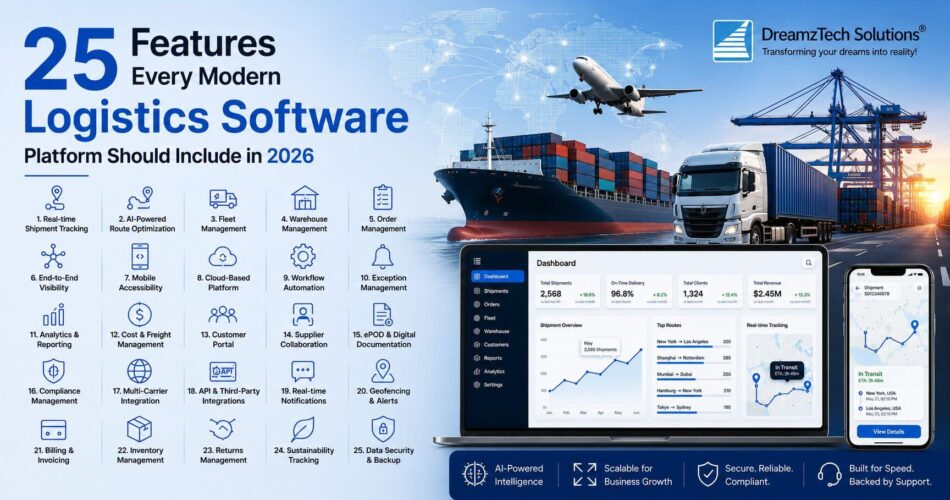
A modern logistics software platform in 2026 must cover 25 essential capabilities across four pillars: execution (real-time tracking, TMS core, WMS integration, RFID/IoT, carrier management, fleet/driver management, mobile-first field ops); intelligence (AI route optimization, predictive analytics, anomaly detection, digital-twin simulation, freight audit automation); customer experience (tracking portal, returns management, customs compliance, cold-chain monitoring); and platform economics (API-first architecture, cloud-native infrastructure, multi-warehouse orchestration, sustainability tracking, revenue management, 3PL collaboration, security). Platforms that ship all 25 typically deliver 15–30% cost reduction, 10–20% productivity uplift, and 12–18-month payback against manual or point-solution baselines.
What Modern Logistics Software Actually Means in 2026
The term “logistics software” used to mean a basic system for tracking shipments and printing labels. Those days are long gone. A modern logistics software platform is a real-time operational intelligence layer that connects carriers, warehouses, drivers, customers, and finance teams into a single source of truth. It automates decisions, surfaces exceptions before they become problems, and integrates with every touchpoint in the supply chain — from the moment a purchase order is created to the moment a customer signs for a delivery.
The shift happened fast. Gartner reports that by 2025, over 50% of global supply chain organizations will have invested in AI-augmented analytics — up from less than 10% in 2020. The pandemic exposed every crack in manual, siloed systems. E-commerce acceleration compressed delivery expectations from days to hours. And the explosion of IoT, RFID, and machine learning has made real-time visibility not just possible, but expected.
A modern logistics platform in 2026 is defined by five pillars: real-time visibility, intelligent automation, seamless integration, data-driven decision-making, and scalable architecture. Every feature we cover in this guide maps back to at least one of these pillars. If a feature doesn’t serve one of them, it’s bloatware — not a value-add.
Why the Feature Gap Is Costing You More Than You Think
Before we get to the list, let’s be clear about what missing features actually cost. Deloitte’s Supply Chain Resilience research found that companies with low supply chain maturity spend 26% more on logistics as a percentage of revenue than high-maturity peers. That gap is almost entirely explained by manual processes, poor data quality, and fragmented tooling — all symptoms of feature-deficient software.
The hidden costs are even more insidious. Every time a dispatcher calls a carrier to check a shipment status, that’s three minutes of labor that a real-time tracking feature eliminates. Every time a warehouse team does a manual cycle count because the system doesn’t support RFID, that’s a 6-hour shutdown that a modern WMS makes obsolete. Every time a customer calls your support line because they have no visibility into their order, that’s a churn risk that a customer-facing tracking portal would have prevented.
Feature gaps compound. A missing route optimization engine means higher fuel costs. Higher fuel costs eat into margins. Thin margins mean less budget for technology investment. Less investment means the feature gap widens. It’s a cycle — and the only way to break it is to build or buy a platform that covers all the bases from day one.
The global logistics management software market, valued at $18.3 billion in 2023, is projected to grow at a CAGR of 12.7% through 2030. The companies investing now are building competitive moats. The ones waiting are falling further behind.

Figure 2: 25 Features Every Modern Logistics Software Platform Should Include in 2026 market growth 2024-2030
The 25 Essential Features in Modern Logistics Software
1. Real-Time Shipment Tracking and Visibility
This is table stakes in 2026, but surprisingly few platforms do it well. Real-time shipment tracking means GPS-grade location updates every 60 seconds or less, integrated across all carriers — not just your preferred carriers. Look for platforms that aggregate tracking data from carriers, third-party logistics providers, and IoT devices into a single map view. Customers and internal teams should be able to see the exact same data without logging into multiple portals.
2. AI-Powered Route Optimization
Static routing tables are a liability. Modern platforms use machine learning to factor in real-time traffic, weather events, driver hours-of-service regulations, vehicle load capacity, and delivery time windows simultaneously. McKinsey’s logistics AI research shows that AI-driven route optimization reduces fuel consumption by 10–15% and improves on-time delivery rates by up to 23%. This feature pays for itself within the first quarter of deployment.
3. Warehouse Management System (WMS) Integration
Your platform must either include a native WMS or offer deep, bidirectional integration with third-party warehouse systems. RFID-enabled warehouse management is now the gold standard — it delivers 99.9% inventory accuracy versus the 65–75% accuracy typical of manual counting. Slotting optimization, pick-path routing, labor management, and dock scheduling should all be WMS capabilities your platform can access or control.
4. RFID and IoT Device Integration
RFID is no longer just for high-value goods or pharmaceutical cold chains. As tag costs have dropped below $0.10 per unit, RFID is economically viable across most logistics verticals. Your platform should support RFID readers at receiving docks, in transit, and at delivery points — and automatically reconcile RFID data with your order management and inventory systems. IoT sensor integration extends this to temperature monitoring, humidity tracking, vibration alerts, and tamper detection. This is particularly critical in food, pharma, and electronics logistics. You can learn more about how RFID-based logistics tracking systems transform supply chain visibility end to end.
5. Transportation Management System (TMS) Core
A TMS handles load planning, carrier selection, rate shopping, freight audit, and payment. In 2026, a standalone TMS is not enough — it must be deeply integrated with your WMS, OMS, and customer portals. Key TMS capabilities include multi-modal freight management (truckload, LTL, parcel, ocean, air), carrier contract management, load tendering, and freight bill auditing. Companies that automate freight audit and payment catch an average of 2–5% in billing errors, according to Forrester Research.
6. Order Management System (OMS) with Intelligent Orchestration
A modern OMS does far more than receive orders and push them to fulfillment. It orchestrates fulfillment logic — deciding which warehouse to ship from, whether to split a shipment, which carrier to use, and how to handle backorders — based on rules you define and AI recommendations it generates. Distributed order management, available-to-promise calculations, and omnichannel support (DTC, B2B, marketplace) are non-negotiable for 2026.
7. Carrier Management and Rate Shopping
Your platform should connect to 200+ carriers globally and surface the best rate for every shipment based on your business rules — not just the cheapest rate, but the optimal combination of cost, speed, and reliability. Automated carrier selection eliminates manual rate shopping, which typically takes 8–12 minutes per shipment. At volume, that’s tens of thousands of labor hours reclaimed per year.
8. Driver and Fleet Management
For asset-based carriers and last-mile operators, driver and fleet management is critical. This includes mobile driver apps with turn-by-turn navigation, electronic proof of delivery (ePOD), HOS compliance monitoring (ELD integration for US carriers), vehicle inspection checklists, and fleet maintenance scheduling. Driver performance scoring — using metrics like on-time rate, fuel efficiency, and customer ratings — drives continuous improvement.
9. Predictive Analytics and Demand Forecasting
Reactive logistics is expensive logistics. Predictive analytics lets you see around corners — forecasting demand spikes before they hit, pre-positioning inventory in the right DCs, and proactively managing carrier capacity. Deloitte’s analytics benchmark shows that companies using predictive supply chain analytics achieve 7.3% higher revenue growth than peers who don’t. Look for platforms with ML-powered demand sensing, not just historical extrapolation.

Figure 3: How 25 Features Every Modern Logistics Software Platform Should Include in 2026 works step by step
10. Customer-Facing Tracking Portal and Notifications
Your customers expect Amazon-grade visibility. A branded, self-service tracking portal reduces inbound “where is my order” calls by 35–50%. Proactive SMS and email notifications at every status change — picked, in transit, out for delivery, delivered — reduce anxiety and build trust. Exception notifications (delay alerts, failed deliveries) should be automatic and immediate. This is not a nice-to-have; it’s a customer retention feature.
11. Returns Management (Reverse Logistics)
Returns represent 20–30% of all e-commerce shipments, according to Gartner’s supply chain research. A modern logistics platform must handle returns as elegantly as forward logistics. This means self-service returns initiation, pre-paid return label generation, automated restocking workflows, refund triggers, and reverse logistics analytics. Platforms that treat returns as an afterthought create operational chaos at scale.
12. Multi-Warehouse and Multi-Site Inventory Management
As fulfillment networks become more distributed, managing inventory across 5, 15, or 50 locations from a single platform is mandatory. The system should provide a consolidated inventory view with location-level drill-down, support transfer orders between sites, manage safety stock levels per location, and trigger automatic replenishment based on velocity and lead time. Cycle count management and inventory reconciliation should run continuously, not on a quarterly schedule.
13. API-First Architecture and Third-Party Integrations
A modern logistics platform is not an island. It must integrate with ERPs (SAP, Oracle, NetSuite), e-commerce platforms (Shopify, Magento, WooCommerce), marketplaces (Amazon, eBay, Walmart), accounting systems, customs brokers, and freight marketplaces — via well-documented REST APIs and webhooks. API-first architecture means your team can build custom integrations in days, not months. Platforms with proprietary, closed ecosystems create vendor lock-in and slow your innovation velocity.
14. Customs and Compliance Management
Cross-border logistics is a compliance minefield. Your platform should automate customs documentation (commercial invoices, packing lists, certificates of origin, HS code classification), integrate with customs broker portals, and flag restricted or prohibited goods automatically. Trade compliance modules should monitor denied party lists, embargo updates, and import/export regulations across the markets you serve. Non-compliance penalties start at $10,000 per violation in most jurisdictions — automation here is risk mitigation, not just efficiency.
15. Real-Time Dashboard and KPI Reporting
What you can’t measure, you can’t manage. A modern logistics platform should offer configurable dashboards for every role — executive, operations manager, dispatcher, warehouse supervisor, customer service agent — showing the KPIs that matter to that persona in real time. On-time delivery rate, cost per shipment, order accuracy, dwell time, carrier performance scores, and exception rates should be visible without running reports. Automated report scheduling and email distribution keep stakeholders aligned without manual effort.
16. Freight Audit and Payment Automation
Carrier invoices are notoriously error-prone. Studies from AIIM show that 5–10% of freight invoices contain billing errors. Automated freight audit compares actual charges against contracted rates, flags discrepancies, and either auto-approves clean invoices or routes exceptions for manual review. Payment automation then pushes approved invoices to AP systems. Companies processing 10,000+ invoices per month save 2–4 FTE equivalents with full freight audit automation.
17. Exception Management and Alert Engine
Exceptions are inevitable. What defines a great logistics platform is how fast it detects and routes exceptions. An intelligent alert engine monitors all active shipments, inventory levels, driver statuses, and system integrations simultaneously — firing alerts the moment something deviates from plan. Alerts should be configurable by severity, routed to the right person via email, SMS, or in-app notification, and linked directly to the record that needs action. Every minute an exception goes undetected costs money.
18. Cold Chain and Temperature Monitoring
For pharma, food and beverage, and specialty chemicals, temperature-controlled logistics is a regulatory requirement, not an option. Your platform should integrate with in-transit temperature sensors (Bluetooth, cellular, or RFID-based), log temperature readings at configurable intervals, alert on excursions in real time, and generate FDA 21 CFR Part 11-compliant audit trails automatically. A single temperature excursion on a pharmaceutical shipment can result in a write-off worth hundreds of thousands of dollars.
19. 3PL and Multi-Party Collaboration Tools
Modern logistics involves networks of partners — 3PLs, 4PLs, freight brokers, co-packers, customs agents. Your platform needs collaboration tools that give each partner role-based access to the data they need without exposing data they shouldn’t see. Shared shipment milestones, collaborative exception resolution, performance scorecards for partners, and electronic document exchange are all core to multi-party logistics execution. Custom 3PL logistics software development often focuses on exactly this multi-tenant collaboration architecture — where the platform must serve both the 3PL operator and its client base simultaneously.
20. Cloud-Native, Scalable Infrastructure
On-premise logistics software is a dead end. Cloud-native architecture — built on AWS, Azure, or GCP — gives you elastic scalability during peak seasons, 99.9%+ uptime SLAs, automatic security patching, and global deployment capability. Cloud-based shipping software eliminates the capital expenditure of server infrastructure and shifts the cost model to predictable, usage-based operating expenses. Look for platforms built on microservices architecture — it means individual components can be updated, scaled, or replaced without system-wide downtime.

Figure 4: 25 Features Every Modern Logistics Software Platform Should Include in 2026 industry use cases
21. Mobile-First Field Operations
Your warehouse staff, drivers, and field agents are not sitting at desks. They need logistics software that works flawlessly on mobile devices — iOS and Android — with offline capability for areas with poor connectivity. Mobile apps should support barcode scanning, RFID reading, digital signature capture, photo documentation, task management, and two-way communication. Apps that require desktop fallback for core tasks create operational gaps at exactly the moments you can least afford them.
22. Labor Management and Productivity Tracking
Warehouse labor is the largest controllable cost in fulfillment operations. A labor management system (LMS) within your logistics platform sets engineered standards for every task — pick, pack, receive, replenish — and tracks actual performance against those standards in real time. Supervisors can see productivity gaps as they develop and intervene before a shift ends. Gamification elements — leaderboards, performance badges — improve employee engagement. Companies that implement LMS see productivity improvements of 10–20%, according to Grand View Research’s warehouse technology analysis.
23. Billing and Revenue Management
For 3PLs and carriers, billing is a core platform function — not an afterthought. The platform should automate customer invoicing based on contracted rates, accessorial charges, and actual service delivery. Rating engines must handle complex billing models — per-pallet storage, activity-based billing, fuel surcharges, dimensional weight calculation — without manual calculation. Automated billing eliminates revenue leakage from unbilled activities, which industry research consistently shows runs at 3–8% of gross revenue in manually billed operations.
24. Sustainability and Carbon Footprint Tracking
ESG reporting is no longer optional for enterprise shippers. McKinsey’s sustainability research shows that 60% of enterprise procurement teams now include carbon footprint data in carrier selection criteria. Your platform should calculate Scope 3 emissions per shipment, aggregate carbon data by trade lane and carrier, support carbon offset purchasing workflows, and generate sustainability reports in GHG Protocol-compliant formats. This feature is moving from differentiator to baseline expectation fast.
25. AI-Powered Anomaly Detection and Risk Scoring
The most advanced feature on this list — and the one that separates category leaders from everyone else. AI anomaly detection continuously scans shipment data, carrier performance metrics, weather forecasts, port congestion reports, and geopolitical risk feeds to score the risk level of every active shipment and every upcoming order. When a high-risk scenario is detected, the system surfaces it with recommended mitigation actions — reroute, pre-book alternative carrier, notify customer proactively. This is the difference between reactive fire-fighting and proactive supply chain leadership.
How to Evaluate Logistics Platforms Against These Features
Knowing the 25 features is step one. Knowing how to evaluate vendors against them is where most procurement processes fall apart. Here’s a structured framework for your evaluation process.
Tier Your Requirements
Not every feature carries equal weight for every operation. Start by categorizing all 25 features into three tiers: Must Have (operational blocker if missing), High Value (significant efficiency gain), and Future Roadmap (important within 24 months). For a last-mile delivery company, real-time tracking, route optimization, and driver management are Tier 1. For a 3PL, multi-tenant billing, WMS integration, and partner collaboration tools take priority. Tier your list before you write your RFP.
Demand Live Demonstrations, Not Slide Decks
Every logistics software vendor will tell you they have all 25 features. Ask them to demonstrate the five most critical ones in a live environment with your own data scenarios. Specifically test exception handling — inject a delayed shipment scenario and watch how the platform surfaces and routes the exception. Test the API with a live call to see actual response times. Slide decks lie; live demos tell the truth.
Assess Build vs. Buy vs. Custom
For companies with highly specialized logistics models — temperature-controlled 3PLs, heavy industrial freight, specialized last-mile networks — off-the-shelf platforms often cover only 60–70% of requirements. The remaining 30–40% gets “worked around” through manual processes that quietly drain productivity. Working with a dedicated logistics software development company gives you the ability to build a platform that covers 100% of your operational requirements — without the customization limitations of off-the-shelf products. The total cost of ownership over a 5-year horizon often favors custom development for operations above a certain complexity threshold.
Evaluate Integration Depth, Not Just Breadth
A vendor claiming 200+ integrations means little if those integrations are one-directional, batch-based, or require manual mapping every time a data structure changes. Ask specifically: Are your ERP integrations real-time or batch? What is your average integration deployment time? Do you support custom webhooks for event-driven architecture? What is your API uptime SLA? The answers reveal far more about integration maturity than a partner logo grid on a marketing page.

Figure 5: 25 Features Every Modern Logistics Software Platform Should Include in 2026 evaluation scorecard
ROI: What the Data Shows When You Implement These Features
Every feature in this guide has a measurable return. Here is what the data shows across the most impactful capability areas:
Route Optimization ROI
Carriers and last-mile operators who deploy AI route optimization consistently report fuel cost reductions of 10–15% and driver productivity improvements of 15–25%. For a fleet operating 100 vehicles at $3,000/month in fuel costs, that’s $450,000 in annual fuel savings alone. Add the labor savings from eliminated manual routing and the on-time delivery improvement that reduces customer credits, and payback periods of 3–6 months are standard.
WMS and RFID Inventory Accuracy ROI
The inventory carrying cost impact of moving from 70% to 99.9% accuracy is dramatic. Safety stock buffers shrink by 30–40% when you can trust your inventory counts. Shrinkage and write-offs — typically 1–2% of inventory value in manual operations — drop to near-zero. A $10 million inventory operation running RFID-enabled WMS can expect $150,000–$400,000 in annual carrying cost reduction and shrinkage elimination.
Customer Visibility and Retention ROI
WISMO (Where Is My Order) calls account for 35% of inbound customer service volume in most e-commerce fulfillment operations. At $5–8 per call, that’s a significant labor cost. A self-service tracking portal eliminates 80–90% of those calls. More importantly, Deloitte’s last-mile consumer research shows that 73% of consumers say delivery transparency directly influences their repurchase decision. Visibility features are customer retention investments, not just operational efficiency tools.
Freight Audit ROI
The math on freight audit automation is simple. If you’re shipping $50 million in freight annually and 5% of invoices contain errors averaging 3% overbilling, you’re leaving $75,000 on the table every year. Automated freight audit catches errors that manual review misses — especially on complex accessorial charges — and pays for itself in recovered revenue within months.

Figure 6: 25 Features Every Modern Logistics Software Platform Should Include in 2026 ROI metrics
Common Mistakes When Building or Buying Logistics Software
Knowing what features to include is only half the battle. Knowing what mistakes to avoid during selection and implementation is equally important. We’ve seen these patterns repeat across dozens of logistics technology projects.
Mistake 1: Optimizing for Today, Not for Scale
The most common mistake in logistics software selection: choosing a platform that solves today’s operational volume without asking whether it can handle 3× growth without re-platforming. Always demand load testing data. Ask for reference customers running at 5–10× your current volume. Architecture decisions made at 10,000 shipments per month are often wrong at 100,000 per month. Build for scale from day one — re-platforming mid-growth is three times as expensive as getting the architecture right initially.
Mistake 2: Underestimating Integration Complexity
Integration projects consistently take 2–3× longer than estimated when the source systems have poor data quality. Before committing to any platform, audit your existing data: How clean is your carrier master? How consistent are your SKU hierarchies across systems? How current is your customer address database? Data quality problems that surface during integration delay go-live dates, inflate project costs, and undermine confidence in the new platform. Data remediation before migration is always cheaper than data remediation during migration.
Mistake 3: Treating Mobile as an Afterthought
Many logistics platforms advertise mobile capability but deliver a responsive-web wrapper of their desktop application. That’s not a mobile app — it’s a compromise. Warehouse workers scanning 500 items per hour on a mobile device need native app performance: sub-100ms barcode scan response, offline mode that queues transactions during connectivity loss, and a UI designed for gloves and rapid task switching. Demand native mobile app demonstrations in your evaluation process.
Mistake 4: Ignoring Change Management
The best logistics platform in the world fails if your team doesn’t adopt it. Dispatcher resistance to AI route recommendations, warehouse staff reverting to paper pick lists, managers who bypass the system and manage via phone calls — these behavioral patterns kill ROI. Budget 20–25% of your implementation cost for training, change management, and the first 90 days of hypercare support. Executive sponsorship and departmental champions are not soft requirements — they are hard requirements for successful logistics technology deployments.
Future Trends: What Features Will Define Logistics Software in 2027 and Beyond
The 25 features we’ve covered are the baseline for 2026. The next wave of capability is already taking shape, and the platforms being built or selected today should have a credible roadmap toward these emerging capabilities.
Autonomous Decision Orchestration
The next evolution beyond AI-assisted decisions is fully autonomous decision orchestration — where the platform handles routine operational decisions end-to-end without human intervention. Carrier selection, load tendering, exception routing, and inventory replenishment will all become fully autonomous within the next 24–36 months for leading platforms. Humans will manage by exception only, reviewing edge cases that fall outside defined confidence thresholds.
Supply Chain Digital Twins
Gartner identifies digital twin technology as one of the top supply chain technology trends through 2027. A supply chain digital twin creates a real-time virtual replica of your entire logistics network — every warehouse, carrier lane, inventory position, and demand signal — and continuously runs simulation scenarios to identify optimization opportunities and risk exposures before they materialize. Early adopters are already using digital twins to model the impact of carrier disruptions, port closures, and demand spikes before committing resources.
Generative AI for Logistics Operations
Generative AI is moving from a novelty into operational logistics tooling. In the near term, expect AI copilots that write carrier RFP responses, generate exception commentary for customer communications, summarize operational performance in natural language, and answer operational questions via chat interface. Longer term, generative AI will author SOP documentation, generate carrier contracts, and provide real-time coaching to dispatchers during high-stress operational periods.
The Bottom Line: Three Takeaways for Decision-Makers
If you walk away from this guide with only three things, make them these:
First, feature gaps compound. A missing route optimization engine seems like a single line item. But it drives higher fuel costs, worse carrier relationships, lower customer satisfaction scores, and reduced margins — all of which circle back to less budget for technology investment. Every feature in this guide is connected to the others. Partial implementation produces partial results.
Second, build versus buy is a false binary. The real decision is build the right things custom, buy the commodity capabilities off-the-shelf, and integrate them cleanly via API-first architecture. Most successful logistics technology deployments in 2026 are hybrid: a commercial platform for core TMS/WMS functions, custom modules for differentiated capabilities, and deep integrations across the stack. This is exactly the model that sophisticated logistics software development companies deliver for their clients.
Third, the window to build a technology moat is closing. The logistics companies that invested in modern platforms in 2021–2023 have 2–3 years of operational learning advantage over their competitors. The ones investing now can still close that gap. The ones waiting another 12–18 months are making a strategic error. The market is not pausing while they decide.
Conclusion
The 25 features covered in this guide are not a wish list — they are the operational baseline for logistics companies that intend to compete in 2026 and beyond. Real-time visibility, AI-powered optimization, seamless integration, mobile-first execution, and predictive analytics are no longer differentiators. They are entry requirements. The companies that treat them as such will build platforms that scale, delight customers, and generate sustainable competitive advantage. The ones that treat logistics software as a commodity cost center will spend the next five years firefighting problems that modern platforms solve automatically.
The technology to build all 25 features exists today. The development expertise exists. The cloud infrastructure to run it reliably and affordably exists. The only question is whether you’re ready to invest in getting it right. We are.
Frequently Asked Questions
1. What is the most important feature in modern logistics software?
There’s no single most important feature — it depends on your operational model. For asset-based carriers, real-time tracking and route optimization deliver the fastest ROI. For 3PLs, multi-tenant billing and WMS integration are typically the highest priority. For e-commerce fulfillment operations, OMS with distributed order management and customer-facing tracking portals drive the most visible customer impact. The right answer starts with tiering your requirements based on your specific operation, then evaluating platforms or building custom solutions against that prioritized list.
2. How long does it take to implement a full-featured logistics software platform?
Implementation timelines vary significantly by scope and approach. A basic cloud TMS with carrier integrations can go live in 60–90 days. A full platform covering TMS, WMS, OMS, mobile apps, and analytics typically takes 6–18 months for a custom build or 4–12 months for a configured commercial platform. The biggest variables are data migration complexity, the number of third-party integrations required, and the change management timeline. Phased implementations — core TMS first, WMS second, analytics third — often produce faster time-to-value than big-bang deployments.
3. Should I build custom logistics software or buy an off-the-shelf platform?
The honest answer is: it depends on your operational complexity and differentiation requirements. Off-the-shelf platforms work well for standard logistics workflows and deliver faster time-to-value for straightforward operations. Custom development makes more sense when your operation has specialized workflows (e.g., temperature-controlled 3PL, heavy industrial freight, hyper-local last-mile networks) that commercial platforms can’t accommodate without significant configuration workarounds. Many sophisticated operations use a hybrid approach — commercial core with custom modules for differentiated capabilities. A qualified logistics software development partner can help you model the total cost of ownership for each approach over a 5-year horizon.
4. How does RFID improve logistics operations compared to barcode scanning?
RFID delivers several significant advantages over traditional barcode scanning. First, RFID doesn’t require line-of-sight — a forklift driving through a dock door can automatically read 200 tagged pallets simultaneously without anyone scanning individual labels. Second, RFID read rates are dramatically faster, enabling real-time inventory counts without operational downtime. Third, RFID enables passive tracking — tags are read automatically as items move through defined zones, creating continuous location data without manual scan events. The result is inventory accuracy rates of 99%+ versus 65–75% in typical barcode-based operations, dramatically reducing safety stock requirements and shrinkage.
5. What is the ROI timeline for logistics software modernization?
ROI timelines depend heavily on which features are deployed and how completely they’re adopted. Route optimization typically delivers payback within 3–6 months for fleet operators. Freight audit automation pays back in 2–4 months for high-volume shippers. WMS and RFID implementations typically show ROI in 12–18 months when carrying cost reductions and labor savings are fully accounted for. Full platform modernizations — TMS, WMS, OMS, analytics — typically achieve full ROI within 24–36 months, with ongoing efficiency improvements accelerating returns in years 3–5. The companies that fail to achieve ROI typically do so because of incomplete adoption, not because the technology doesn’t work.
6. What makes a logistics platform truly cloud-native versus cloud-hosted?
Cloud-hosted means your existing software runs on cloud infrastructure — it’s a hosting change, not an architecture change. Cloud-native means the platform was designed from the ground up for cloud environments: microservices architecture that allows independent scaling of components, containerization (Kubernetes/Docker) for consistent deployment, event-driven integrations via message queues, and stateless application design that supports horizontal scaling. Cloud-native platforms handle peak season volume spikes automatically, update without downtime, and recover from failures in seconds rather than hours. Cloud-hosted legacy platforms often break under the same conditions. The distinction matters enormously at scale.
7. How do modern logistics platforms handle data security and compliance?
Enterprise-grade logistics platforms should include role-based access control (RBAC) with the principle of least privilege, encryption at rest and in transit (AES-256 and TLS 1.3 minimum), SOC 2 Type II certification, GDPR-compliant data handling for European operations, and comprehensive audit logs for all data access and system changes. For carriers operating in regulated industries, additional compliance frameworks apply — HIPAA for healthcare logistics, FDA 21 CFR Part 11 for pharmaceutical cold chains, and CTPAT for cross-border security. Always ask logistics software vendors for their most recent SOC 2 report and penetration test results before signing a contract.
8. Can logistics software integrate with existing ERP systems like SAP or Oracle?
Yes — and this integration is critical for financial reconciliation, inventory accuracy, and order management continuity. Most modern logistics platforms offer pre-built connectors for SAP ECC, SAP S/4HANA, Oracle EBS, Oracle Cloud, and Microsoft Dynamics. The quality of these integrations varies significantly. Demand real-time, bidirectional integration — not nightly batch files. Test the integration with actual transaction volumes during your evaluation. For custom-built logistics platforms, API-first architecture ensures that ERP integration can be built cleanly using standard REST or SOAP interfaces, with full control over data mapping and transformation logic.
9. What should I look for in a logistics software development partner?
Look for five things: proven logistics domain expertise (not just generic software development experience), a portfolio of live logistics deployments at comparable operational scale, in-house expertise across the full stack (frontend, backend, mobile, cloud infrastructure, data engineering, AI/ML), a structured discovery and requirements process before any code is written, and transparent pricing with fixed-scope or milestone-based contracts. References from logistics clients who can speak to post-deployment performance — not just go-live success — are the most valuable validation. Ask specifically about how they’ve handled integration challenges, data migration issues, and post-launch support for logistics operations that run 24/7/365.