AI-Powered Tax Document Processing POC Case Study

AI-Powered Tax Document Processing POC Case Study

Case Study

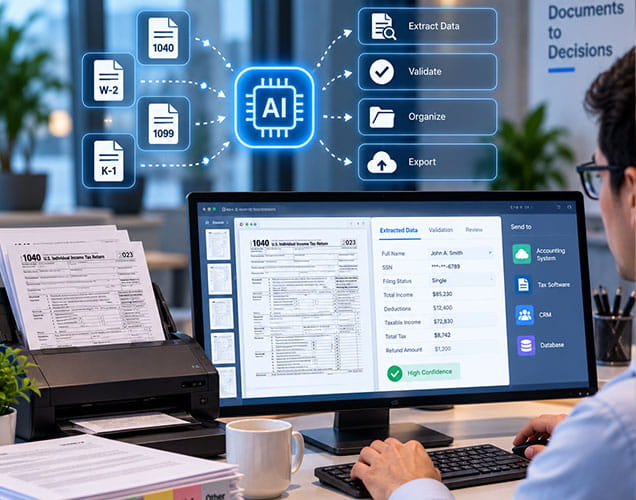
DreamzTech built and validated an enterprise proof of concept for intelligent tax document processing. The solution combined the DreamzTech AI document processing framework, Azure AI Document Intelligence and a separate enterprise LLM orchestration layer to extract structured, traceable data from complex digital and scanned tax documents.

  • What we built: Configurable AI tax document extraction POC
  • Industry: Financial services and capital markets
  • Delivery: Validated proof of concept for a large-scale, regulated environment
Discuss Your AI Document Processing Project
AI-Powered Tax Document Processing POC Case Study
Trusted By Startups, SMBs to Fortune 500 Brands

Quick Answers

  • What we built: An AI-powered proof of concept that extracts tax-document fields and returns structured JSON with confidence and traceability data.
  • Who it was for: A leading global financial market infrastructure organization; the client name remains confidential under NDA.
  • The problem: Manual, resource-intensive extraction from diverse digital and scanned tax documents across markets and document formats.
  • The technology: DreamzTech's AI document processing framework, Azure AI Document Intelligence, a separate enterprise LLM orchestration layer, FastAPI and PostgreSQL.
  • The outcome: The POC satisfied 100% of the agreed functional validation requirements, according to DreamzTech's internal project confirmation.

Overview

The client operates in a highly regulated, high-volume financial-services environment where tax operations receive many types of documentation across countries and markets. Documents arrive as both digitally generated and scanned PDFs, with variable layouts, page counts, image quality and handwritten content. Manual extraction was time-consuming and difficult to scale consistently.

The client did not want to replace its existing document intake, orchestration, validation or downstream tax systems. It needed a focused extraction service that could fit into the current architecture, process defined document segments, return structured output, expose uncertainty and preserve traceability. DreamzTech used its AI document processing services framework to create a working proof of concept around those functional requirements - the same discipline behind DreamzTech's broader fintech software development practice.

The Challenges

  • Many tax document types and market-specific variations.
  • Digital PDFs, scanned pages, handwriting and degraded image quality.
  • Typical documents of several pages plus exceptional files exceeding 100 pages.
  • A need for structured, field-level output - not raw OCR text.
  • Strict integration, confidence and auditability requirements.

What Success Meant for the POC

The proof of concept was evaluated against functional acceptance - not against an invented production KPI. It needed to demonstrate that the proposed extraction approach could:

How the Solution Works

The POC uses a controlled extraction pipeline in which Azure document intelligence, configurable rules and LLM-based reasoning each have a defined role.

Solutions Delivered

DreamzTech delivered six connected components covering the extraction framework, Azure document understanding, LLM orchestration, configurable templates, confidence controls and API-first architecture:

A reusable extraction pipeline coordinates classification context, OCR output, LLM extraction, validation signals and audit logging.

  • Reusable extraction pipeline for classification context, OCR output, LLM extraction, validation signals and audit logging.
  • Configuration-driven document definitions for fields, prompts, rules and thresholds.
  • Clear separation between extraction and the client’s existing intake, validation and tax-processing systems.

Azure AI Document Intelligence supplies the document-reading layer beneath the extraction framework.

  • Azure AI Document Intelligence for text, layout, tables, key-value pairs and readable handwriting.
  • Support for both digitally generated PDFs and scanned documents.
  • Quality-aware processing for blurred, skewed or otherwise degraded pages.

A separate LLM orchestration layer maps recognized content into the fields each tax-document type requires.

  • A separate LLM layer converts recognized document content into the required tax-document fields.
  • Document-type instructions can be versioned and adjusted without redesigning the entire extraction service.
  • LLM output is bounded by expected fields, validation rules and confidence handling; it does not autonomously approve tax data.

Document types are onboarded through configuration rather than one-off, hard-coded layouts.

  • Designed around a defined scope of 30 document types and their market or country variations.
  • New types and field mappings can be onboarded through configuration rather than hard-coded page layouts.
  • A React and TypeScript management interface was included in the POC foundation for template configuration.

Every extracted value carries confidence and traceability data so uncertainty stays visible.

  • Numeric field-level confidence with configurable confidence bands.
  • Request, document, page-range, model/prompt version and timestamp traceability.
  • Transparent exception signals for unreadable or low-confidence content, supporting human-in-the-loop review.

The POC foundation is API-first and built on an Azure-ready data and services stack.

  • FastAPI-based extraction service with HTTPS/JSON integration.
  • PostgreSQL/JSONB for configuration and extraction records in the POC foundation.
  • Architecture prepared for Azure services such as Blob Storage, Service Bus, Container Apps, Key Vault, Application Insights and Azure DevOps in a production pathway.

Success and Outcome

The working POC demonstrated that DreamzTech's AI document processing framework could meet the agreed functional needs for enterprise tax-document extraction. It validated the complete path from contextual API request and page-range processing through Azure document understanding, LLM-orchestrated field extraction, confidence scoring, traceability and structured JSON output.

The project also reduced solution risk before a broader rollout. The client team could evaluate a working extraction flow against real business requirements while keeping document intake, validation decisions and downstream tax processing within its existing systems. The validated POC created a practical technical foundation for production planning, document-type onboarding, security hardening, performance testing and operational governance.

100%

The POC satisfied 100% of the agreed functional validation requirements, according to DreamzTech's internal project confirmation. This is not a claim of 100% extraction accuracy.

30 Document Types

The architecture demonstrated a configuration-led approach designed for the client's defined scope of 30 tax-document types and future variations.

Digital + Scanned

The solution combined Azure document understanding with quality-aware processing for digital PDFs, scans and readable handwriting.

100+ Page Ready

The page-range and segmentation approach addressed exceptional documents exceeding 100 pages without requiring every page to be processed as one undifferentiated file.

Field-Level Confidence

Structured results included confidence and traceability data so uncertain values could be reviewed rather than silently accepted.

Integration Validated

The API-first design showed how extraction could complement the client's orchestration, validation and downstream tax systems instead of replacing them.

Conclusion

This proof of concept showed how intelligent document processing can support complex tax operations without replacing established enterprise systems. By combining DreamzTech's configurable AI document processing framework with Azure AI Document Intelligence, controlled LLM orchestration, confidence scoring and traceable JSON output, the solution turned varied tax PDFs into structured data ready for validation. For financial-services teams evaluating AI document extraction, a focused POC can test document quality, field definitions, integration contracts and human-review rules before a larger implementation.

Leading Global Software Company

Trusted by Industry Leaders Worldwide

Trusted by startups to Fortune 500s, including DHL, Nestlé, and Stanford — partners who rely on us for high-impact, scalable software solutions.

Book a Discovery Call

    I Consent to Receive SMS Notifications, Alerts from DreamzTech US INC. Message frequency may vary. Message & data rates may apply. Text HELP for assistance. You may reply STOP to unsubscribe at any time.
    I Consent to Receive the Occasional Marketing Messages from DreamzTech US INC. You can Reply STOP to unsubscribe at any time.
    By submitting the form, you agree to the DreamzTech Terms and Policies

    Frequently Asked Questions (FAQ)

    Intelligent document processing, or IDP, uses document AI, OCR, machine learning, rules and LLM-based reasoning to turn tax forms and supporting PDFs into structured data. A complete system also exposes confidence, exceptions and traceability so extracted values can be validated before downstream use.

    DreamzTech built a configurable extraction proof of concept for an NDA-protected global financial market infrastructure organization. It accepted document context and page ranges, analyzed digital and scanned PDFs, extracted defined tax fields and returned structured JSON with confidence and traceability data.

    Azure AI Document Intelligence was used for document reading and layout understanding, including printed text, tables, key-value relationships and readable handwriting. Its output supplied structured document context to the wider DreamzTech extraction framework.

    A separate enterprise LLM orchestration layer mapped recognized document content to the fields defined for each tax-document type. The LLM worked within configured instructions, expected fields, rules and confidence handling; it did not autonomously approve tax data.

    The POC architecture supported digital PDFs, scanned pages and readable handwriting. It also assessed quality and surfaced confidence or exception signals when blur, skew, damage or low legibility could reduce reliability.

    The API accepts the relevant page range with the document request. The framework can segment long or composite PDFs and process only the requested pages, an important pattern for documents that may exceed 100 pages.

    No. The solution uses configuration records for document types, expected fields, extraction instructions, validation rules and confidence thresholds. This reduces dependence on a fixed page layout and makes new variations easier to onboard.

    The service returns structured JSON containing the requested field values plus confidence and traceability information. The client’s orchestration layer can then route the results to existing validation and downstream tax-processing workflows.

    No such accuracy claim is being made. DreamzTech’s internal project confirmation states that the POC satisfied 100% of the agreed functional validation requirements. Field-level accuracy should be measured separately on an approved, representative test set before production.

    No. It was a validated proof of concept designed for a large-scale enterprise document-processing environment. Production rollout would require agreed accuracy baselines, security and operational controls, performance testing, monitoring, user acceptance testing and go-live approval.

    Start with representative documents, clearly defined fields, an agreed ground-truth set and explicit acceptance criteria. Validate difficult scans and layout variations, expose uncertainty, keep humans in control of exceptions and confirm the API contract with downstream systems before scaling.

    Yes. The framework is designed around configurable document types and integration contracts. A new engagement would still begin with sample-document analysis, field definitions, quality assessment, security requirements and a purpose-built validation plan for the target workflow.