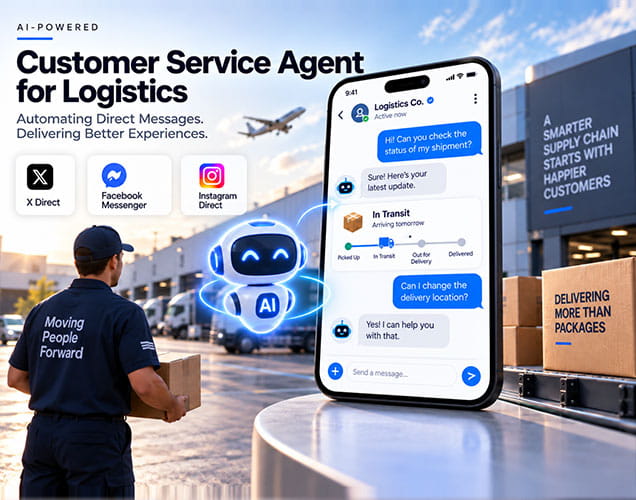
AI Customer Service Agent for Logistics Direct Message Automation Case Study

AI Customer Service Agent for Logistics Direct Message Automation Case Study

AI + Logistics Case Study

DreamzTech built a production, bilingual AI customer service agent for a logistics and express-delivery company. The solution automates private conversations across X Direct, Facebook Messenger and Instagram Direct, helping customers track shipments, request delivery-location changes, find career information and reach a live agent when human support is required.

  • 21,489 inbound customer messages handled across three channels in 30 days
  • 84% of 2,888 conversations closed without a human agent
  • 92% of 860 shipment lookups returned a live status
  • 1.4-1.8 seconds median message-ingestion latency by channel
Build Your Logistics AI Agent
AI Customer Service Agent for Logistics Direct Message Automation Case Study
Trusted By Startups, SMBs to Fortune 500 Brands

Quick Answers

Overview

Logistics customers often contact a brand through whichever private social channel is already open on their phone. They may send a partial waybill, multiple message bubbles, an image, an address or a complaint in Arabic or English - the same operating reality behind DreamzTech's broader transportation and logistics software development work. A useful AI agent must do more than answer FAQs: it must preserve session state, call shipment and address services, verify sensitive actions and escalate cleanly.

DreamzTech delivered a production direct-message automation platform that unifies three social networks behind one bilingual state machine. It combines selective AI agents for customer service automation with deterministic workflows: the AI interprets intent and extracts structured data, while scripted responses keep operational answers predictable and auditable. The platform remains LLM-agnostic so model choices can evolve without redesigning channel ingestion, business flows or the agent console.

The Challenges

The Solution DreamzTech Delivered

This build extends DreamzTech's broader AI chatbot development services into private, logistics-specific workflows. DreamzTech delivered eight connected components spanning bilingual conversation handling, hybrid AI workflows, tracking, address verification, live-agent handoff, native channel experience, analytics and reliability engineering:

One stateful engine serves all three channels. It detects Arabic or English, supports synonym-based selection with an AI fallback, and follows the customer’s language for the rest of the thread. Unsupported languages receive a clear notice, while mid-conversation language changes remain possible.

AI is applied where interpretation adds value: intent classification and extraction of waybills, OTPs and structured address details. Customer-facing answers, transitions and validation rules remain scripted. This hybrid approach supports predictable responses, clearer testing and auditable business behavior while retaining an LLM-agnostic model adapter.

The tracking flow extracts a waybill, allows up to three attempts and disambiguates multiple numbers. It then calls the client’s shipment system and returns a live status and hub code. In the measured 30 days, the platform completed 860 tracking lookups; 788 returned a live status, 51 encountered a client-backend error and 21 found no matching waybill.

The address-change flow captures the waybill, verifies the customer through OTP and accepts either a format-validated KSA short national address or map coordinates. The validated request is then submitted to the client’s address-update service. This separates identity verification, input quality and backend acceptance into observable steps.

Customers choose a request subject, receive a controlled acknowledgement and are transferred to a human agent with an SLA clock. The bot stops responding on the thread until the agent closes it. The console shows the conversation, customer photos, drafts, backlog, breach state and end-of-session sweeps.

  • X Direct: Triple-redundant ingestion through a real-time activity stream, platform webhook and reconciliation poll; adaptive polling, cost-aware paging, six-second burst coalescing and protected image capture.
  • Facebook Messenger: Push ingestion, native quick-reply buttons, button templates, 2.5-second burst coalescing and customer-photo handling.
  • Instagram Direct: Dedicated push worker, automatic Business-account discovery, onboarding subscription, Messenger-parity workflows and prepared quick-reply chips pending enablement.

Dashboards and CSV exports share one query contract, so on-screen totals reconcile with downloaded reports. The platform records module, channel, outcome, status code, unique-user and rating data. A 90-day analytics API provides redacted event access, and cost reporting separates social-platform API charges from AI inference cost.

The request mix also reveals why customers need support: of 1,061 service requests, 46% concerned delayed delivery, 24% other issues, 19% courier attitude, 7% rescheduling, 3% mobile-number changes and 1% customs. This creates a ranked operational view as a by-product of customer service.

Each channel runs in an isolated worker with its own health endpoint. X uses three ingestion paths sharing one deduplication key, while the conversation engine uses per-thread locking. Every pipeline, timer family and AI feature can be disabled independently without redeployment. Twenty controlled deployment scripts and 1,180 passing automated tests supported production verification as of September 7, 2026.

How the AI Agent Works

Eight stages carry a private message from first contact to a recorded, auditable outcome.

LLM-Agnostic Reference Architecture

The AI adapter is one replaceable layer among several stable ones - deterministic business flows and enterprise integrations do not move when the model does:

LayerResponsibility
Channel AdaptersX activity stream/webhook/polling, Messenger webhook and Instagram Direct webhook workers
Conversation ControlSession state, burst coalescing, staleness boundaries, per-thread locks and timer claims
AI AdapterReplaceable intent-classification and entity-extraction model interface
Deterministic FlowsTracking, address change, requests, careers, help center, out-of-office and survey state machines
Enterprise APIsShipment lookup, OTP verification, address-update service and approved link destinations
Agent OperationsHandoff queue, SLA timer, thread console, photos, replies and session close
ObservabilityModule event log, dashboards, CSV exports, redacted analytics API, costs, health and kill switches

Success and Outcomes

The figures below cover the first measured production period from the August 10 launch through September 7, 2026. They demonstrate operational adoption, automated closure and system reliability; they do not establish long-term customer satisfaction or cost reduction.

21,489 Inbound Messages

Private customer messages processed across X Direct, Instagram Direct and Facebook Messenger.

2,888 Conversations

Distinct sessions with at least one inbound message across the three channels.

84% Closed Without a Human

Derived across all sessions; 456 conversations required live-agent handoff.

1,370 Unique Customers

Distinct sender identities served during the production window.

860 Tracking Lookups

788 returned live shipment status, producing the documented 92% success result.

1,061 Service Requests

Captured and classified for human-agent handling; delayed delivery represented 46% of subjects.

1,013 Daily Messages

Combined latest-seven-day daily average: 737 X, 249 Instagram and 27 Facebook.

1.4-1.8 Second Median Ingestion

Median pickup latency by channel; not end-to-end resolution and not a tail-latency guarantee.

Exactly-Once Delivery Controls

Shared deduplication across three X ingestion paths plus per-conversation engine locking.

732 Survey Ratings Collected

Evidence of feedback capture only; do not publish a satisfaction score until scale direction is confirmed.

What the Results Do - and Do Not - Prove

The figures above are read from production data on a stated date. Here is exactly what they support, and what they do not:

Closing Thoughts

This case study shows how DreamzTech combines AI agent development with deterministic workflow engineering. The result is not an uncontrolled generative chatbot: it is a bilingual, integrated customer-service product that interprets customer input, validates data, calls logistics systems, escalates with context and remains observable in production. For logistics, courier, freight and last-mile delivery companies, the same LLM-agnostic pattern can support shipment tracking, delivery updates, service requests and multilingual handoff across the channels customers already use.

Leading Global Software Company

Trusted by Industry Leaders Worldwide

Trusted by startups to Fortune 500s, including DHL, Nestlé, and Stanford — partners who rely on us for high-impact, scalable software solutions.

Book a Discovery Call

    I Consent to Receive SMS Notifications, Alerts from DreamzTech US INC. Message frequency may vary. Message & data rates may apply. Text HELP for assistance. You may reply STOP to unsubscribe at any time.
    I Consent to Receive the Occasional Marketing Messages from DreamzTech US INC. You can Reply STOP to unsubscribe at any time.
    By submitting the form, you agree to the DreamzTech Terms and Policies

    Frequently Asked Questions (FAQ)

    It is a software agent that understands a customer’s request, follows logistics workflows, accesses approved operational systems and escalates when human support is required. In this project, one bilingual engine served private conversations on X, Facebook Messenger and Instagram Direct.

    A basic chatbot often answers fixed FAQs. This agent maintains conversation state, detects language and intent, extracts waybills and OTPs, calls live shipment and address services, tracks workflow outcomes and hands a complete thread to a live agent when needed.

    Yes. The platform captures and validates a waybill, handles retries and multiple-number ambiguity, calls the shipment system, and returns a live status and hub code. In the measured period, 788 of 860 lookups returned live status.

    The engine uses a language picker, synonym matching and an AI fallback, then follows the customer’s language through the thread. Customers can switch languages mid-conversation, while unsupported languages receive a clear notice.

    The channel connectors, state machine, business APIs, scripts, handoff, analytics and safety controls remain separate from the model used for classification and data extraction. This reduces model lock-in and allows model evaluation without rebuilding the full system.

    AI is used where interpretation matters, while scripted responses keep shipment and service instructions predictable, testable and auditable. The combination delivers flexibility in understanding without giving a generative model uncontrolled authority over operational answers.

    The workflow captures the shipment waybill, verifies the customer through OTP, validates a KSA short national address or map coordinates, and submits the request to the approved address-update service.

    Requests, enquiries and conversations that the automated workflow cannot close are transferred to an agent queue with an SLA clock. The bot stands down until the agent completes the thread, preventing competing replies.

    X uses three redundant ingestion paths with one shared deduplication key, so the first copy wins. The engine also locks each conversation while processing it, preventing simultaneous actions from sending more than one reply.

    The X pipeline combines a real-time stream, a platform webhook and reconciliation polling. The poll normally runs every five minutes and tightens to 75 seconds when it detects a message missed by the stream.

    Yes. Burst coalescing briefly groups rapid message bubbles into one conversational turn – six seconds on X and 2.5 seconds on Messenger – so the engine does not respond before the customer finishes the thought.

    Useful measures include messages, conversations, unique customers, module usage, tracking outcomes, backend errors, handoffs, SLA status, language, channel cost, response latency and satisfaction with a clearly defined scale and response rate.

    Yes. The architecture can call shipment tracking, OTP, address, CRM, help-desk and knowledge APIs. Each integration should define authentication, validation, timeout, retry, source-of-truth and human fallback behavior.

    The schedule depends on channel approvals, languages, use cases, operational APIs, knowledge quality, handoff tooling, data retention, security and evaluation requirements. A responsible timeline follows a short workflow and integration assessment.

    DreamzTech combines LLM-agnostic AI design with custom software, social-channel integrations, deterministic workflow engineering, live-agent tooling, analytics, testing and production reliability. The solution is built around the customer’s actual logistics operations rather than a generic bot template.