AI Agent for Logistics Social Media Customer Service Case Study

AI Agent for Logistics Social Media Customer Service Case Study

AI + Logistics Case Study

DreamzTech built a production, LLM-agnostic AI customer service agent for a logistics and express-delivery company. The system monitors public conversations across X, Facebook and Instagram, drafts bilingual responses from approved knowledge, sends sensitive replies through human review and automatically publishes only configured low-risk responses.

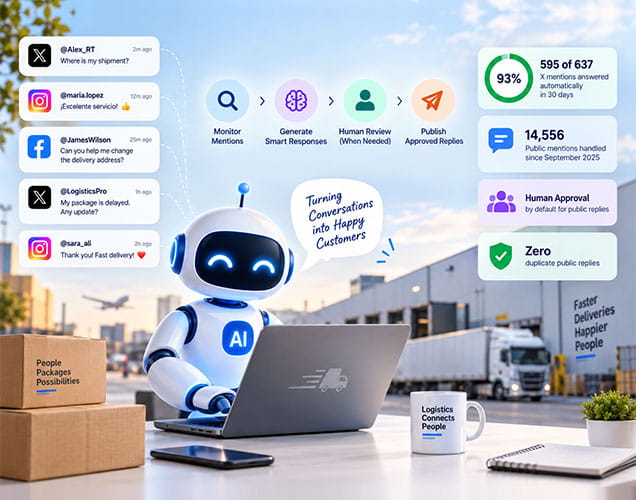
  • Latest automation result: 595 of 637 X mentions answered automatically in 30 days - 93%
  • Production reach: 14,556 public X mentions handled across platform versions since September 2025
  • Governance: Human approval by default for public replies, with narrow policy-based automation
  • Reliability: Zero duplicate public replies, backed by exactly-once posting controls
Build Your Logistics AI Agent
AI Agent for Logistics Social Media Customer Service Case Study
Trusted By Startups, SMBs to Fortune 500 Brands

Quick Answers

Overview

Public customer service is harder to automate than a private chatbot. A wrong answer can be seen, shared and preserved by anyone. Logistics conversations also arrive with incomplete shipment context, complaints, images, bilingual language and repeat-customer history - the same operating reality behind DreamzTech's broader transportation and logistics software development work. The client needed the speed of AI without giving up brand control or operational traceability.

DreamzTech delivered a production social customer service agent that unifies channel ingestion, context retrieval, AI response drafting, policy gates, human review, publication, analytics and reliability engineering. The design is LLM-agnostic: the business workflow is not locked to a named model provider, and models can be evaluated or changed behind stable orchestration and integration boundaries - the same discipline behind DreamzTech's broader AI agent development services.

The Challenges

The Solution DreamzTech Delivered

This build extends DreamzTech's broader AI agents for customer service automation practice into public social channels. DreamzTech delivered seven connected components spanning channel capture, orchestration, human governance, channel-specific experience, exactly-once publishing, review analytics and controlled deployment:

The platform captures X mentions and quote posts, Facebook comments, post edits, page mentions, recommendations, reviews and ratings, plus Instagram comments, nested replies and @mentions. Tenant-specific OAuth onboarding, token refresh and subscription checks keep connected accounts operational.

A channel-neutral orchestration layer prepares each interaction for drafting. It assembles thread history, approved FAQ content, tenant rules, language, tone and available media context, then calls the configured model through a replaceable adapter. This separates the AI model from social APIs, reviewer workflows, business policies and publication controls.

Optional live web context and image understanding can be enabled where policy permits. Granular switches allow those capabilities to be disabled independently without redeploying the platform.

Every public draft enters an Open review queue by default. A reviewer can approve it, edit the wording, reject it or close the item when no reply is needed. The exact approved text is what gets published, and the audit trail retains drafting, review, editing and posting events.

Only narrowly defined, low-risk intents can bypass the queue: bilingual out-of-office notices during configured windows and short acknowledgements when a customer asks the brand to check a private inbox. Complaint-sensitive logic prevents higher-risk items from auto-posting.

  • X: Persistent filtered-stream capture, reconciliation search, quote-post preservation, plain-repost filtering, switchable handle blocklist, delivery retry and full thread context.
  • Facebook: Page onboarding, broad webhook coverage, FAQ-grounded bilingual drafting, image context, durable media thumbnails, page review dashboards and low-risk intent handling.
  • Instagram: Business-account discovery, account subscription, real-time comments and mentions, edit/delete synchronization, nested replies and reliable username resolution.

The platform uses claim-before-post protection so a webhook retry or stream reconnect cannot create a second public reply. A separate reconciliation sweep searches for events that real-time capture may have missed. Drafting delivery retries protect mentions during transient automation failures, while workers expose health and ingestion status endpoints.

Reviewers work from a live queue with status, username, date and repeat-customer filters. They see complete thread context, media thumbnails and prior contact signals before deciding. Reporting covers approval, rejection, open, closed and automated outcomes by channel and period, with export support for offline quality review.

Public ingestion runs separately from direct-message workers and the web tier. Twenty feature-specific deployment scripts include read-only drift checks, backups, syntax and invariant checks, safety gates and verification modes. Retweet filtering, blocklisting, reconciliation and AI web search can each be disabled through granular kill switches. As of September 7, 2026, the platform-wide automated suite contained 72 test files and 1,180 passing tests.

How the AI Agent Works

Seven stages carry a public interaction from first contact to a recorded, auditable outcome - with a policy gate between drafting and publishing.

LLM-Agnostic Reference Architecture

The AI orchestration layer is deliberately separated from the foundation model, so the model can be evaluated or replaced without redesigning the workflow around it:

LayerResponsibility and Portability
Channel AdaptersOAuth, subscriptions, streams, webhooks and platform-specific post/reply APIs for X, Facebook and Instagram
Event NormalizationConvert different channel payloads into a stable public-interaction record
Context AssemblyThread history, FAQ knowledge, tenant settings, language, media, user history and optional approved web context
AI OrchestrationPrompt and policy flow, intent/risk classification and a replaceable foundation-model adapter
GovernanceHuman review queue, low-risk automation rules, complaint exclusions, permissions and kill switches
Publication ControlClaim-before-post, idempotency, retries, edit/delete synchronization and platform API delivery
ObservabilityStatus analytics, audit trail, exports, worker health, ingestion status and deployment verification

Success and Outcomes

The solution moved a high-volume public-response workflow from review-heavy processing toward policy-controlled automation. The figures below come from the production database on September 7, 2026 and retain their original measurement windows.

93% X Automation Rate

595 of 637 X mentions were answered automatically in the latest 30 days, leaving reviewers to manage exceptions and policy-sensitive cases.

52% All-Time Current-App Automation

1,930 of 3,681 X mentions were automated over the current production application's full history, showing a material shift toward automation over time.

3,123 Published Replies

Automated plus reviewer-approved replies published through the current production X application.

14,556 Public Mentions Handled

All X application variants since September 28, 2025; evidence of sustained production operation, not a current-app-only number.

Zero Duplicate Public Replies

Exactly-once posting protection prevented duplicate public replies despite retry and reconnect behavior.

621 Media-Bearing X Mentions

The platform tracked interactions containing photos or video for richer review and handling.

Multi-Channel Coverage

135 Facebook items and 112 Instagram items handled since January 25, 2026, including comments, nested replies, mentions, edits, reviews and ratings.

Production Quality Controls

72 automated test files, 1,180 passing tests and 20 controlled per-feature deployment scripts as of September 7, 2026.

What the Results Do - and Do Not - Prove

The figures above are read directly from production data on a stated date. Here is exactly what they support, and what they do not:

Closing Thoughts

This case study demonstrates that enterprise AI agent development is not only about generating text. Production value comes from reliable channel capture, grounded context, explicit risk policies, human control, idempotent actions, observability and safe deployment. By separating those responsibilities from the selected foundation model, DreamzTech created an LLM-agnostic platform that can evolve without rebuilding the customer-service workflow. If your logistics, courier, freight or last-mile delivery company needs an AI customer service agent for public social channels, DreamzTech can help define the use cases, knowledge layer, model strategy, review policies, integrations, quality measures and production controls.

Leading Global Software Company

Trusted by Industry Leaders Worldwide

Trusted by startups to Fortune 500s, including DHL, Nestlé, and Stanford — partners who rely on us for high-impact, scalable software solutions.

Book a Discovery Call

    I Consent to Receive SMS Notifications, Alerts from DreamzTech US INC. Message frequency may vary. Message & data rates may apply. Text HELP for assistance. You may reply STOP to unsubscribe at any time.
    I Consent to Receive the Occasional Marketing Messages from DreamzTech US INC. You can Reply STOP to unsubscribe at any time.
    By submitting the form, you agree to the DreamzTech Terms and Policies

    Frequently Asked Questions (FAQ)

    It is a software agent that understands customer interactions, uses logistics knowledge and business rules to prepare or complete support actions, and escalates when human judgement is needed. In this project, the agent monitored public social channels, drafted bilingual replies, followed posting policies and recorded each outcome.

    Use risk-based automation. Low-risk, repeatable intents may post automatically, while complaints, ambiguous requests and reputation-sensitive replies go to a human reviewer. The platform should also preserve context, permissions, audit history, kill switches and exactly-once posting controls.

    It means the channel integrations, context pipeline, business policies, review workflow, audit data and action tools are not tightly coupled to one foundation model. A model can be evaluated or replaced through a stable adapter without redesigning the entire social customer-service product.

    The AI prepares a draft and the item enters a review queue. An authorized reviewer can approve the draft, edit it, reject it or close the item. Only preapproved low-risk categories bypass review. Every action and change is retained in an audit trail.

    Yes, when channel-specific connectors feed a normalized interaction model. The agent can share common knowledge, orchestration and governance while preserving each network’s authentication, webhook, media, thread and publishing behavior.

    It claims an item before posting and treats the publication action as idempotent. If a webhook is delivered again or a stream reconnects, the platform recognizes the claimed or completed event instead of posting a second response.

    Real-time capture is backed by reconciliation. A separate search sweep checks for mentions that a stream may have missed, while retry logic redelivers items to the drafting workflow after transient failures.

    Yes. The delivered flow supports bilingual drafting and bilingual policy messages such as out-of-office responses. Language quality should still be evaluated by intent, dialect, brand tone and risk category before automation is expanded.

    The platform can include image context for eligible photo comments and stores durable media thumbnails for reviewers because external CDN links expire. Image understanding is an optional capability that can be disabled independently when policy or reliability requires it.

    Measure automation rate with a clear denominator and time window, but also track reply accuracy, reviewer edit rate, escalation rate, first-response time, duplicate-post incidents, missed-event recovery, stale items, customer satisfaction and cost per published response.

    This implementation was designed to move routine, low-risk work to automation and let reviewers focus on exceptions. It does not prove that all logistics support can or should be autonomous. Human judgement remains important for complaints, ambiguity, policy exceptions and public reputation risk.

    Yes. A production design can connect the social response workflow with customer, shipment, case and knowledge systems through APIs and events. The exact integration depends on data access, security, actions, latency and which system remains the source of truth.

    The schedule depends on channel count, API approval, languages, knowledge quality, integrations, autonomous-action scope, security and evaluation requirements. A responsible estimate should follow a short technical and workflow assessment rather than rely on a generic fixed timeline.

    DreamzTech combines AI orchestration with custom software engineering, channel and enterprise integrations, human-review design, reliability controls, analytics and production deployment. The engagement can remain LLM-agnostic so the solution is shaped around the customer’s workflows and governance needs.