AI Agent for Trade Show Exhibitor Data Collection

AI Agent for Trade Show Exhibitor Data Collection

AI + Event Technology Case Study

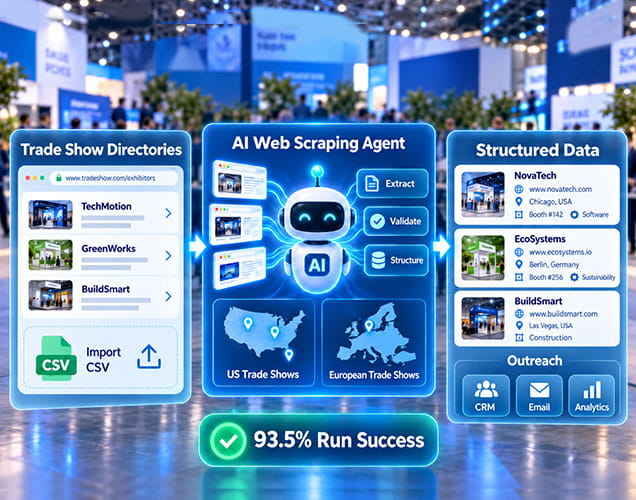
DreamzTech built a region-aware AI web scraping and data acquisition platform for a US-based trade show exhibit and event-services company. The solution converts fragmented exhibitor directories into structured company records and sends approved datasets to enrichment and outreach workflows. Across roughly six months of production, the agent captured 563,333 exhibitors from 1,160 distinct event codes, found 470,033 company websites and completed 93.5% of 2,133 scraper executions successfully.

  • 563,333 exhibitors captured from 1,160 distinct event codes
  • 470,033 company websites found — an 83.4% website capture rate
  • 93.5% of 2,133 scraper executions completed successfully
  • Production database snapshot: September 7, 2026 (~6-month window)
Discuss Your AI Agent Project
AI Agent for Trade Show Exhibitor Data Collection
Trusted By Startups, SMBs to Fortune 500 Brands

Quick Answers

Overview

Trade show directories contain valuable B2B company data, but directory structures, access patterns and field quality vary across event platforms and regions. Manually visiting each show, copying exhibitor details and preparing clean files for sales research does not scale across hundreds of events.

DreamzTech delivered the first stage of a three-part event-data pipeline: Scraper, Enrichment and Outreach. The scraper operates through region-scoped agents on BestBrain. It accepts individual directory URLs or bulk event CSVs, captures structured exhibitor data, manages execution state and hands completed records to the matching enrichment workflow.

The implementation supports 14 US directory platforms and 27 European platforms. Each agent has its own region, history, permissions, credentials, supported-platform list and downstream destination, helping the operation maintain clear boundaries as volume grows.

The Challenges

The Solution DreamzTech Delivered

DreamzTech delivered the first stage of the event-data pipeline as eight connected components spanning regional control, source intake, multi-platform extraction, self-healing orchestration, selective AI recovery and enrichment handoff.

DreamzTech configured dedicated United States and Europe agents with portal single sign-on. Each workflow carries its own credentials, permissions, supported platforms, execution history and same-region enrichment destination. Region is selected during setup and cannot be casually changed from the application.

Users can launch a scrape from a trade show directory URL or import multiple events through one CSV. Live checks validate platform support and reachability. CSV rows are reviewed for missing required values, invalid email addresses, date format issues and non-numeric data before import.

The agent detects supported platforms by region and applies the appropriate event-directory workflow. Production coverage includes 14 US platforms and 27 European platforms, allowing the same operating interface to coordinate many underlying directory structures.

Single-URL runs use a first-in, first-out queue with a deployment-wide limit of five concurrent scrapes and live queue positions. Stuck dispatches are automatically failed, while orphaned runs are returned to the queue. Bulk CSV imports follow a separate high-volume path and do not wait in the URL queue.

Finished runs create structured records for exhibitors, company websites, booth sizes, categories, locations and event details. A ten-character event code is derived automatically from the show URL so repeat runs can be grouped and reviewed together.

Where a directory does not publish a company website, authorized users can start a server-side AI lookup that writes verified findings back to the run output. One recorded production run filled 16 of 17 gaps; this is promising operational evidence but not a platform-wide accuracy benchmark.

Completed company data can be pushed to the matching regional enrichment agent for AI agents for sales workflows. Users can configure employee ranges, geographic inclusion and exclusion rules, job titles, management levels, departments, functions, maximum contacts per company and verified-email requirements. A live estimate previews expected unique people and companies before the handoff.

Operators receive KPI cards, status tabs, filters, grouped repeat events, execution detail, failure descriptions, editable show metadata, CSV export, adaptive refresh and synchronization controls. Nine granular permissions cover execution, listing, editing, enrichment handoff, website filling, download and settings management.

How the AI Agent Works

Ten stages carry a directory URL or CSV import from intake through orchestration to an enrichment-ready output.

Region-Aware Reference Architecture

Regional control is one governed layer among several stable ones — acquisition logic and downstream routing do not change when a new directory platform is added:

LayerDelivered responsibility
ExperienceBestBrain SSO, agent picker, run modals, CSV review, execution history and settings
Regional controlPersistent US/EU scope, credentials, permissions, supported platforms and downstream routing
ValidationPlatform detection, reachability checks, file schema validation and row-level issue reporting
OrchestrationQueue, concurrency limits, status tracking, adaptive polling and self-healing dispatch logic
AcquisitionPlatform-specific extraction of exhibitor, event, website, booth, category and location fields
AI assistanceAuthorized missing-website discovery with server-side progress and writeback
Data operationsGrouped execution history, editable event details, CSV download and production KPIs
DownstreamSame-region enrichment filters, Apollo estimate and push/re-push controls
GovernanceNine permissions, owner/admin bypass, fail-closed access and credential management

Success and Outcomes

The following results come from the production database snapshot dated September 7, 2026. The execution window spans approximately six months. They demonstrate data throughput and execution reliability; they are not a measure of sales conversion, revenue or labor savings.

563,333 Exhibitors Captured

Recorded from execution output across the ~6-month production window.

470,033 Company Websites Found

Equal to an 83.4% website-capture rate against captured exhibitors.

200,019 Booth Sizes Captured

Structured booth-size values captured alongside exhibitor records.

1,160 Distinct Event Codes

Spanning 1,509 show names across the production window.

2,133 Scraper Executions

Total run volume recorded in the production database.

93.5% Execution Success Rate

1,994 of 2,133 executions completed successfully.

8.7-Minute Average Duration

Recorded across 1,021 runs with duration data; not a platform-wide figure.

5,384-Exhibitor Largest Import

The largest single CSV import processed in production.

14 US / 27 EU Directory Platforms

Regional directory coverage supported by the region-scoped agents.

10 Countries Recorded

Led by the United States and Germany.

What the Results Prove—and What They Do Not

The figures above are read from production data on a stated date. Here is exactly what they support, and what they do not:

Supported conclusionDo not claim without more evidence
The system operated at high data volume across hundreds of events.A specific percentage reduction in manual work.
Execution-level success was 93.5% during the measured production window.Perfect uptime or a universal extraction-accuracy rate.
83.4% of captured exhibitors had a website in execution output.That every website was AI-discovered or independently verified.
The platform prepared company records for enrichment and outreach.Revenue, qualified-pipeline value, conversion uplift or closed sales.
US and EU agents enforced distinct operating contexts.A regulatory or data-residency certification not supplied in the evidence.

Conclusion

This project shows how a custom AI agent can turn fragmented event directories into a governed, production-ready data pipeline. DreamzTech combined regional workflow control, source validation, multi-platform acquisition, self-healing execution, selective AI website discovery and enrichment handoff in one operating experience. If your sales, event or research team spends hours collecting company information from changing web sources, DreamzTech can design an AI data acquisition agent around your sources, permissions, review rules and downstream systems. Explore DreamzTech's AI agent development services or the automated data extraction services behind this build.

Leading Global Software Company

Trusted by Industry Leaders Worldwide

Trusted by startups to Fortune 500s, including DHL, Nestlé, and Stanford — partners who rely on us for high-impact, scalable software solutions.

Book a Discovery Call

    I Consent to Receive SMS Notifications, Alerts from DreamzTech US INC. Message frequency may vary. Message & data rates may apply. Text HELP for assistance. You may reply STOP to unsubscribe at any time.
    I Consent to Receive the Occasional Marketing Messages from DreamzTech US INC. You can Reply STOP to unsubscribe at any time.
    By submitting the form, you agree to the DreamzTech Terms and Policies

    Frequently Asked Questions (FAQ)

    An AI web scraping agent is a goal-driven workflow that collects data from web sources, validates inputs, tracks execution state and prepares structured outputs for another business process. In this project, regional agents collected exhibitor and event records and handed approved company data to enrichment.

    The strongest primary industry is Event Technology, specifically exhibitions and trade shows. It also belongs in the Artificial Intelligence category and can carry secondary SalesTech and Marketing Technology tags because the output supports contact enrichment and outreach.

    The delivered platform captures exhibitor records, company websites, booth sizes, categories, locations and event metadata. The exact fields available in any deployment depend on the source directory and permitted access.

    The platform detects a supported directory, validates its reachability and routes the job to a region-appropriate workflow. The delivered implementation supports 14 US and 27 European directory platforms through one operating interface.

    Yes. Users can submit an individual event URL or upload a multi-show CSV. The CSV workflow validates rows and lets authorized users proceed with valid rows when selected records contain errors.

    AI is used selectively where flexible discovery adds value, such as finding a likely company website when the source directory does not publish one. Validation, permissions, queueing, execution tracking and handoff rules remain controlled workflow components.

    During the measured period, 1,994 of 2,133 executions finished with a success or succeeded status, equal to a 93.5% execution success rate. The figure covers March 4 through September 7, 2026.

    The execution records contain 563,333 captured exhibitors across 1,160 distinct event codes. They include 470,033 company websites and 200,019 booth-size values.

    The execution layer detects stuck dispatches and marks them failed while orphaned runs can be returned to the queue. Operators can see status, failure context and retry guidance instead of leaving unresolved work hidden.

    Each agent has a fixed US or EU region with its own credentials, permission rules, supported platforms, history and downstream enrichment destination. Missing permissions fail closed, while owner and administrator roles retain controlled full access.

    Yes. Completed company records can move to a same-region enrichment agent with filters for company size, geography, titles, management levels, departments, functions, contact caps and verified email requirements.

    Authorized users can run an AI-assisted missing-website lookup. The source records one completed run that found 16 of 17 missing websites; more production samples are needed before publishing a general accuracy percentage.

    The recorded average was approximately 8.7 minutes across 1,021 executions that contained duration data. Actual time varies with event size, source behavior, platform limits and data quality.

    A production design should use authorized sources, respect applicable site terms and technical controls, limit collection to necessary business data, protect credentials and personal information, and retain review and audit controls appropriate to the use case. Legal review may be required for specific sources and jurisdictions.

    Look for measurable production evidence, source-specific validation, recoverable workflows, secure credentials, granular permissions, observability, human control and clean integration with downstream systems—not only a model demonstration.

    Yes. The same architectural pattern can support permitted data acquisition in market intelligence, procurement research, supplier discovery, real estate, ecommerce, recruiting or compliance monitoring. Sources, fields, review rules and downstream actions should be designed for each domain.