Merchant Services CRM Development Case Study

Merchant Services CRM Development Case Study

Case Study

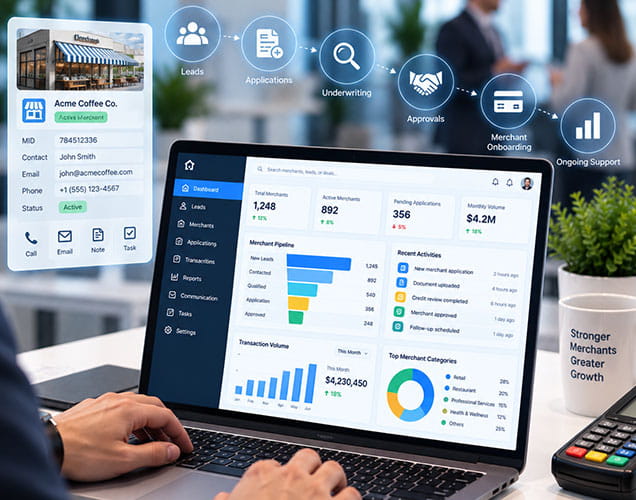
DreamzTech designed a configurable merchant services CRM for a US-based payment technology company. The platform connects lead management, merchant onboarding, portfolio monitoring, residual reporting, payments, communications, documents, support and administration in one role-based workspace.

  • What we built: Custom CRM for merchant services and payment operations
  • Industry: Fintech, merchant acquiring and payment processing
  • Delivery: Sales, merchant, onboarding, finance, support and administration modules
Discuss Your Fintech CRM Project
Merchant Services CRM Development Case Study
Trusted By Startups, SMBs to Fortune 500 Brands

Quick Answers

  • What we built: A web-based CRM that unifies merchant acquisition and financial operations.
  • Who it serves: Payment processors, ISOs, merchant-service providers and multi-team fintech operations.
  • Core workflow: Capture leads, manage proposals, onboard merchants, monitor portfolios, track residuals and resolve support issues.
  • Connected services: Payment processors, e-signature, email, SMS, WhatsApp and AI-assisted support integrations.
  • Outcome: One configurable system with clearer ownership, traceable activity and better cross-team visibility.

Overview

A US-based payment technology company needed more than a conventional sales CRM. Its teams had to manage the full relationship with each merchant, from initial lead and proposal through underwriting, onboarding, portfolio monitoring, residual payments, support and retention. Separate systems made it difficult to understand current status, ownership and financial activity.

DreamzTech designed a configurable CRM platform around merchant-services operations. The solution combines role-based dashboards, lead and merchant records, onboarding application views, risk and dispute monitoring, residual management, payments and invoices, communications, documents, e-signatures, helpdesk processes and centralized settings. An integration framework connects the CRM with payment processors and communication services while preserving one operational record for each lead and merchant.

Challenges

  • Disconnected lead, merchant, finance, communication and support records
  • Limited visibility across qualifying, underwriting, onboarding and retention stages
  • Complex merchant portfolio risk, dispute and deposit-exception monitoring
  • Manual residual imports, calculations, exceptions and line-item review
  • Different access, workflow and reporting needs across sales, agents, managers and administrators

How the Merchant Services CRM Works

The platform coordinates the merchant relationship through five connected stages.

Solutions Delivered

DreamzTech delivered a configurable merchant services CRM connecting lead management, onboarding, portfolio risk monitoring, residual operations, communications and centralized administration:

  • Portfolio, lead, task, webform, signature, payment and report snapshots
  • Role-based access for representatives, agents, managers and administrators
  • Configurable users, classes, groups, fields, statuses and workflow triggers
  • Activity logs, alerts and site-wide administration
  • Manual entry and bulk lead import
  • Proposal generation, sending and response tracking
  • Appointment board, task management and follow-up visibility
  • Lead dashboards, pipeline metrics and customizable webforms
  • Views for submitted, incomplete and in-review applications
  • Merchant onboarding dashboard and progress monitoring
  • Document upload, categorization, access rules and version control
  • PDF field mapping and e-signature workflow integration
  • Central merchant records, filters, activity logs and portfolio dashboards
  • Non-performing merchant tracking and retention workflows
  • Configurable risk alerts, chargeback indicators and risk reporting
  • Dispute reporting and deposit-exception investigation
  • Residual dashboards, imports, line items and exception handling
  • Residual trend analysis and forecasting support
  • Payment and invoice visibility within merchant records
  • Integration framework scoped for multiple processors and gateways
  • Email, SMS and WhatsApp communication scope with reusable templates
  • Delivery, open, click-through, response and validation metrics
  • Helpdesk dashboards, SLAs, priorities and escalation workflows
  • Agent-to-admin chat, real-time alerts and AI-assisted process guidance

Success and Outcomes

1 Unified Operating Workspace

Lead, merchant, onboarding, financial, communication, document and support records are designed to work within one configurable CRM.

5 Merchant Lifecycle Views

Qualifying, closing, underwriting, onboarding and retention statuses give teams a consistent way to understand record progress and bottlenecks.

End-to-End Merchant Context

Each merchant record can connect portfolio activity, risk, disputes, deposits, residuals, documents, communications and support history.

Traceable Residual Operations

Imports, line items, exceptions, analytics and forecasts create a clearer path from processor data to residual review.

Multi-Channel Engagement

Email, SMS, WhatsApp scope, e-signature, tickets, notifications and internal chat support coordinated communication across teams and merchants.

Configurable Role-Based Control

Users, groups, permissions, fields, triggers, templates, mappings and site settings give administrators a foundation for ongoing operational change.

Conclusion

This merchant services CRM development case study demonstrates how DreamzTech translated specialized payment-processing operations into a configurable software platform. By connecting leads, merchant onboarding, portfolio monitoring, residuals, payments, communications, documents, support and administration, the solution created a practical foundation for cross-team visibility and controlled growth. If your organization needs custom CRM development for merchant services, payment processing or another financial workflow, DreamzTech can help define the data model, user roles, automations, dashboards and integration architecture around your operating process.

Leading Global Software Company

Trusted by Industry Leaders Worldwide

Trusted by startups to Fortune 500s, including DHL, Nestlé, and Stanford — partners who rely on us for high-impact, scalable software solutions.

Book a Discovery Call

    I Consent to Receive SMS Notifications, Alerts from DreamzTech US INC. Message frequency may vary. Message & data rates may apply. Text HELP for assistance. You may reply STOP to unsubscribe at any time.
    I Consent to Receive the Occasional Marketing Messages from DreamzTech US INC. You can Reply STOP to unsubscribe at any time.
    By submitting the form, you agree to the DreamzTech Terms and Policies

    Frequently Asked Questions (FAQ)

    A merchant services CRM is software designed to manage relationships and operations for payment processors, ISOs and merchant-service providers. It connects sales leads with merchant onboarding, portfolio activity, risk events, residuals, communications, documents and support records.

    A general CRM focuses mainly on contacts, opportunities and sales activity. A payment processing CRM also models merchant applications, underwriting and onboarding stages, processor relationships, deposits, chargebacks, disputes, residual income, compliance documents and ongoing portfolio performance.

    Merchant management software should provide centralized merchant records, portfolio activity, filtering, risk alerts, dispute and deposit-exception tracking, communication history, document access, support tickets and operational reporting. The exact modules should reflect the provider’s acquiring and servicing model.

    Merchant onboarding software guides applications from submission through document collection, review and activation. In this scope, teams can view submitted, incomplete and in-review applications, track progress, collect documents and use e-signature workflows from the CRM.

    Residual management is the process of importing, tracking and analyzing ongoing revenue associated with merchant processing activity. The CRM scope includes residual dashboards, imports, line-item detail, exceptions, trend analysis and forecasting support.

    Yes. The project scope defines a multi-processor integration framework for transaction tracking, refunds, payment visibility and reconciliation. Specific production connections will be named only after their integration status is verified.

    Role-based access limits modules, records and actions according to job responsibility. Sales representatives, agents, managers and administrators can receive different permissions, helping the organization control access while keeping shared workflows visible to authorized teams.

    An AI assistant can answer common process questions, surface relevant knowledge and guide agents through repeatable tasks. The supplied scope includes AI-driven agent support and contextual knowledge-base integration; public claims should match the functionality accepted in production.