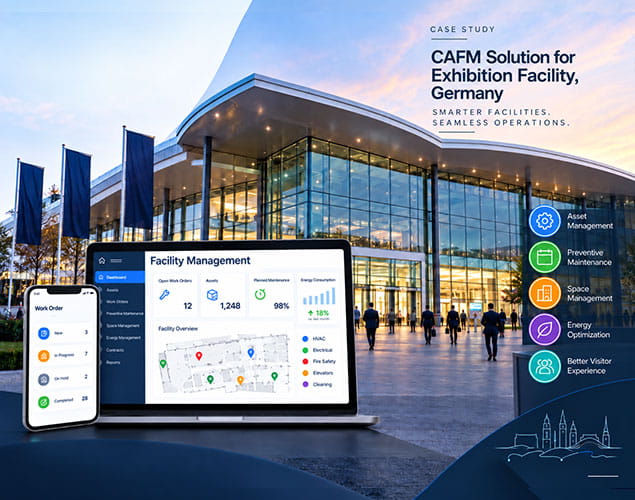
Enterprise CAFM Software for Exhibition and Congress Venues

Enterprise CAFM Software for Exhibition and Congress Venues

Case Study | Facility Management Technology

DreamzTech is developing a custom, bilingual facility management platform for a leading German exhibition and congress venue operator. The system is designed to connect buildings, technical assets, maintenance plans, work orders, incidents, subcontractors, spare parts, procurement, reporting and enterprise integrations in one operational environment. See DreamzTech's facility management software solutions for the broader service.

  • Industry: Facility Management Technology and Exhibition Venue Operations
  • Delivery model: Phased enterprise implementation with design, QA, UAT and controlled cutover
  • Platform: React, ASP.NET Core, SQL Server and Microsoft Azure
  • Languages: English and German

Discuss Your Facility Management Software Project
Enterprise CAFM Software for Exhibition and Congress Venues
Trusted By Startups, SMBs to Fortune 500 Brands

Quick Answers

Overview

Large exhibition and congress venues operate like compact cities. Buildings, halls, technical systems, event calendars, maintenance teams, vendors, inventory, safety-related incidents and financial processes must remain coordinated even as the use of each space changes from one event to the next.

The customer needed more than a standard maintenance application. The project required a configurable computer-aided facility management system that could represent the venue hierarchy, support internal and subcontracted work, connect planned and reactive maintenance, integrate with enterprise systems, and provide a controlled path from operational activity to reporting and audit evidence.

DreamzTech structured the program around a secure platform foundation and a connected building and asset model. The implementation then extends into subcontractor management, work orders, incident response, recurring maintenance, inventory and procurement, enterprise integration, reporting, localization, UAT, training and controlled go-live support.

The Challenges

The Solution DreamzTech Is Building

DreamzTech structured the program as eleven connected modules spanning platform foundation, asset management, subcontractor governance, work orders, incidents, recurring maintenance, inventory, enterprise integration, reporting, localization and controlled production cutover.

The foundation includes authentication, a central operations dashboard, user administration, configurable roles and permissions, system settings and an architectural decision record. Advanced role management adds permission matrices, custom roles, delegation, lifecycle controls and audit reporting.

A structured asset tree organizes buildings, floors, rooms, technical systems and equipment. Users can create and update asset records, group assets through classification libraries, attach documents, import structured data from Excel or CSV, view asset maps, and generate asset inventory and building summary reports.

The subcontractor module centralizes provider master data and documents, while controlled web and mobile access supports assigned work. Contract and SLA foundations connect service obligations with work-order and incident workflows. The platform records user lifecycle and access activity for operational accountability.

Users can create work orders, connect them to assets and subcontractors, apply SLA defaults, route assignments and dispatch work. Status transitions, task checklists, time capture, evidence collection and sign-off provide a consistent execution record. Dashboards and reports expose work volumes and performance indicators.

The planned incident workflow supports QR, NFC and manual capture through mobile APIs and a web fallback. Routing rules start SLA timers, trigger escalation and support a hotline channel. Confirmed incidents can be converted into work orders, while WebSocket updates keep operational dashboards current.

Versioned maintenance-plan templates drive asset-based scheduling. The scheduling engine checks for conflicts and coordinates resource availability, including vacation and absence data. Rubin calendar synchronization starts with CSV and includes a planned transition to API-based exchange. Compliance reporting shows whether scheduled work was completed as required.

The inventory scope covers a spare-parts master, stock movement across locations and replenishment. Purchase requisitions follow multi-step approval. Goods receipt and three-way matching connect purchase orders, received goods and invoices before financial posting.

A reusable connector framework supports REST, SOAP, CSV and JSON exchanges. The planned integration layer includes Rubin calendar cutover, SAP invoice and approval synchronization, Azure Logic Apps, Power Automate, Kafka topics and schemas, and validated legacy-data migration. Salesforce appears only as a future design placeholder and must not be described as an implemented integration.

The reporting plan includes self-service reports, dashboards for assets, work orders, incidents and compliance, scheduled delivery, branded PDF and spreadsheet exports, and audit-logged export activity. SLA reports reuse the timing and escalation data created by incident workflows.

The platform is planned for English and German operation across web interfaces, notifications and document templates. Locale-aware date and number formats, translation-resource management and language switching support consistent use. The final delivery stages include a WCAG 2.1 AA audit and remediation, bilingual training materials, train-the-trainer workshops and UAT.

The go-live approach covers end-to-end UAT, defect triage, automated-test hardening, production migration, go/no-go control, rollback planning, hypercare, technical handover and project closure. These remain planned stages until completion is confirmed.

How the CAFM Workflow Connects

Nine stages connect the estate model, operational requests, field execution and enterprise systems into one traceable workflow.

Architecture Summary

The mobile experience is owned by the customer — DreamzTech's field channel supplies REST APIs only, with offline-sync semantics, not a delivered mobile application:

LayerDesigned responsibility
ExperienceReact web application with English and German localization
ServicesASP.NET Core APIs for business rules, integrations and mobile consumption
DataSQL Server operational model for buildings, assets, work, inventory and governance
Field channelREST APIs for the customer-owned mobile application, including offline-sync semantics
IntegrationConnector framework, Azure Logic Apps, Power Automate and Kafka event topics
HostingAzure / IIS
QualityUnit, API, end-to-end, accessibility, migration and UAT test stages

Success Criteria and Expected Outcomes

The implementation plan defines what the system is intended to enable, but it does not contain approved post-launch results. The following are success criteria and expected operational outcomes until measured data is available. Already documented: a connected operating model spanning assets, maintenance, incidents, subcontractors, SLAs, inventory, procurement, reporting and integrations; functional breadth across daily operations and enterprise governance; a client review model with prototype sign-off, database design, QA and UAT-ready demonstrations; and enterprise-readiness foundations for GDPR, audit, role management, bilingual delivery, accessibility, migration, training, cutover and hypercare. Not yet publishable as achieved: reduced maintenance cost, downtime, response time or energy consumption; improved SLA compliance, contractor productivity, asset life or inventory accuracy; production go-live, successful migration, user adoption or completed hypercare; and SAP, Rubin API, Kafka, Salesforce, AI, IoT or predictive-maintenance capability as live unless engineering confirms it.

Asset Visibility

Consistent records for buildings, technical systems, assets and documents. Validate with: percentage of in-scope assets migrated, validated and linked to their location.

Work Control

One traceable lifecycle for requests, incidents, work orders and sign-off. Validate with: work orders completed by priority and within agreed target.

SLA Management

Automated timers, escalation and exception visibility. Validate with: SLA attainment and average time to acknowledge and resolve.

Planned Maintenance

Asset-driven schedules with resource and calendar coordination. Validate with: scheduled work completed on time; overdue preventive tasks.

Contractor Governance

Controlled access and evidence for subcontracted work. Validate with: assignments accepted, completed and approved with required evidence.

Inventory Control

Parts demand linked to stock movement and purchasing. Validate with: stockouts, emergency purchases and inventory accuracy.

Integration Reliability

Controlled exchange with calendar, SAP and workflow systems. Validate with: successful transactions, exceptions and mean time to recover.

User Adoption

Bilingual web and mobile-enabled workflows. Validate with: active users, completion by channel and training completion.

Data Governance

Audit logs, role controls and documented architecture. Validate with: access exceptions, audit completeness and unresolved control findings.

Conclusion

This enterprise CAFM program demonstrates how DreamzTech approaches complex facility-management transformation: start with a reliable estate and asset model, connect reactive and planned work, give internal and external teams controlled workflows, integrate operational data with enterprise systems, and build testing, governance, localization and adoption into the delivery plan. For exhibition and congress operators, the result is designed to be more than a digital work-order tool. It is an operational platform intended to connect buildings, people, service providers, materials, schedules and business systems around the real conditions of a changing venue estate. See also DreamzTech's CAFM software with SAP integration case study and DreamzCMMS facility management software.

Leading Global Software Company

Trusted by Industry Leaders Worldwide

Trusted by startups to Fortune 500s, including DHL, Nestlé, and Stanford — partners who rely on us for high-impact, scalable software solutions.

Book a Discovery Call

    I Consent to Receive SMS Notifications, Alerts from DreamzTech US INC. Message frequency may vary. Message & data rates may apply. Text HELP for assistance. You may reply STOP to unsubscribe at any time.
    I Consent to Receive the Occasional Marketing Messages from DreamzTech US INC. You can Reply STOP to unsubscribe at any time.
    By submitting the form, you agree to the DreamzTech Terms and Policies

    Frequently Asked Questions (FAQ)

    CAFM stands for computer-aided facility management. CAFM software organizes buildings, spaces, assets, maintenance, work orders, service providers, documents and operational reporting in one system.

    A CMMS focuses primarily on asset maintenance and work execution. CAFM usually adds broader facility context such as buildings, spaces, contractors, service processes, documents and enterprise integrations. The boundaries can overlap in modern platforms.

    Venue operations change frequently with event calendars, hall configurations, technical requirements, contractors and visitor activity. Specialized software connects those conditions with assets, maintenance, incidents, SLAs and operational evidence.

    The planned scope includes building and asset management, documents, users and roles, subcontractors, contracts, SLAs, work orders, incidents, recurring maintenance, inventory, procurement, integrations, reports, localization, UAT, training and go-live support.

    It uses a hierarchical model for buildings, floors, rooms, technical systems and equipment. Asset records can include classifications, documents, imported data, map context and operational history.

    An incident can be captured through QR, NFC, manual mobile input or a web fallback. Routing and SLA rules identify the responsible team, and an approved incident can be converted into a work order for execution and evidence capture.

    Yes. In this project, DreamzTech is responsible for mobile-facing REST APIs while the customer owns the mobile application. The planned APIs support work lists, time capture, evidence uploads, notifications and offline synchronization.

    The planned workflow maintains subcontractor records and documents, controls portal access, connects providers with contracts and SLAs, assigns work, and records status, time, evidence and sign-off.

    Yes. The planned scope includes versioned maintenance templates, asset-driven scheduling, conflict checks, resource availability, calendar synchronization and compliance reporting.

    Maintenance demand can be connected with the spare-parts master, stock movement, replenishment, purchase requisitions, approval workflows, goods receipt and three-way matching across purchase order, receipt and invoice.

    The documented plan includes Rubin calendar exchange, SAP invoice and approval synchronization, Azure Logic Apps, Power Automate, Kafka event topics and validated legacy-data migration. Each integration’s live status must be confirmed before publication.

    The planned localization framework covers English and German interfaces, notifications and document templates, with locale-aware formats, translation-resource management and language switching.
    The plan includes role-based access, advanced permission management, user lifecycle controls, GDPR and audit-logging foundations, integration controls, test evidence and architectural decision records.

    A WCAG 2.1 AA accessibility audit and remediation stage is included in the implementation plan. Compliance should be described as achieved only after the audit is completed and approved.

    Not in the supplied project scope. The data and integration architecture can support future AI use cases, but predictive maintenance was removed from the current proposal and no delivered AI module is evidenced.

    The supplied document describes an implementation in progress. Design, development, integration, QA, UAT, migration, training, go-live and hypercare activities are included in the delivery plan, but current completion status requires confirmation.

    Only after written client approval. Until then, the recommended public description is “a leading German exhibition and congress venue operator.”