







Clutch Top Healthcare CRM Development Company — USA 2024

Healthcare CRM Development Company

We build custom healthcare CRM software that unifies patient relationships, referral tracking, care coordination, and marketing automation into one HIPAA-compliant platform — patient portals, telemedicine platforms, EHR systems, medical billing software, and clinical AI applications. Every application we build passes CRM security auditstient portals, and medical billing solutions — that meet regulatory standards, integrate with your existing systems, and actually get used by clinicians.
Healthcare CRM Projects Delivered
100 +
Years in Healthcare IT
0 yrs
Client Retention Rate
0 %
Average Patient Engagement Lift
0

Compliance & Standards

Best fit if you

Trusted By Startups, SMBs to Fortune 500 Brands

Healthcare & Medical CRM Software Development

Why Healthcare Organizations Need a Custom CRM

Healthcare CRM (Customer Relationship Management) software — also known as healthcare customer relationship management — is a HIPAA-compliant platform designed specifically for managing patient relationships, referral pipelines, care coordination, and healthcare marketing. Unlike generic CRMs, healthcare CRM integrates with EHR/EMR systems via HL7 FHIR, handles PHI securely, and supports clinical workflows. The healthcare CRM market is projected to reach $28.9 billion by 2030 (Grand View Research), with 78% of health systems investing in patient engagement technology (HIMSS, 2024).d deploying digital systems for the medical and health industry. It is fundamentally different from general software development in its regulatory burden, data sensitivity, and the human consequences of failure. Every piece of software that touches patient data in the United States must comply with HIPAA (Health Insurance Portability and Accountability Act), implement the federal government'

A specialized HIPAA-compliant software development company brings not just engineering capability — it brings deep HIPAA regulatory knowledge, HIPAA-Compliant / SOC 2 certified processes, patient data architecture, and audit-ready compliance documentation from day 1. Every healthcare CRM software we build undergoes performance testing, vulnerability scanning, and compliance validation before deployment.
$ 0 B+

Healthcare CRM Projects Delivered

Our CRM for hospitals, multi-specialty clinics, health systems, and digital health startupsars

30 M+

Patient Records Managed

Patient records managed across our healthcare CRM deployments with HIPAA-compliant security

80 %

Average Patient Engagement Lift

Average improvement in patient engagement rates after CRM implementation (industry benchmark: 20-30%)

0 hrs

Client Satisfaction Rating

First-submission HIPAA compliance audit pass rate across all client applications with our 24/7 security monitoring

Healthcare CRM (Customer Relationship Management) software — also known as healthcare customer relationship management — is a HIPAA-compliant platform designed specifically for managing patient relationships, referral pipelines, care coordination, and healthcare marketing. Unlike generic CRMs, healthcare CRM integrates with EHR/EMR systems via HL7 FHIR, handles PHI securely, and supports clinical workflows. It is the specialized discipline of building healthcare applications where Protected Health Information (PHI) security is engineered into every layer — from database encryption to API authentication to user interface access controls. As a leading healthcare customer relationship management development company, DreamzTech has delivered 200+, we have delivered over 200 custom healthcare software projects — from specialty EHR systems for 5-physician practices to AI-powered hospital platforms serving 1.2 million patients annually.

  • Healthcare CRM specialists with 3+ years building patient engagement and referral management systems
  • In-house healthcare CRM software architects who map patient journeys and referral workflows before writing code
  • 80+ successful EHR integrations — Epic, Cerner, athenahealth, Allscripts, NextGen — for real-time CRM data sync
  • Patient journey UX research with physicians, front-desk staff, and marketing teams before every CRM build
  • Outcome-based CRM delivery with milestone billing — 92% of projects on or under budget
  • Post-launch support with 24/7 monitoring and guaranteed SLA response times from 2 hours

From fragmented patient data to unified healthcare CRM software — deployed in weeks

Why Choose DreamzTech for Healthcare CRM Development?

Building HIPAA-compliant software in-house requires hiring security architects, compliance officers, and developers trained in PHI handling — a 6-12 month process. With DreamzTech, you get an HIPAA-Compliant / SOC 2 certified team with 200+ healthcare projects delivered, deployed in weeks.

In-House CRM DevelopmentDreamzTech Healthcare CRM Developmenre development
12-18 months to hire CRM developers with healthcare experienceProduction-ready healthcare team deployed in 2-4 weeks
No EHR integration or healthcare workflow expertiseHIPAA, ISO 27001, SOC 2, and FDA compliance architects on every project
Limited to one CRM platform (Salesforce only)200+ healthcare CRM and EHR integrations delivered (Epic, Cerner, athenahealth, Allscripts)
No referral tracking or patient lifecycle experiencePatient journey mapping, referral analytics, and marketing automation experts on staff
Limited to off-the-shelf CRM customizationCustom CRM built on the right stack for your organization — React, Node.js, Python, or .NET
No post-launch CRM analytics or optimizationContinuous CRM optimization with patient engagement analytics, A/B testing, and ROI dashboards

Healthcare CRM Services

Healthcare CRM Development Services

From greenfield product development to modernizing complex legacy systems, our engineering teams deliver end-to-end clinical and administrative healthcare software across the full health IT spectrum.

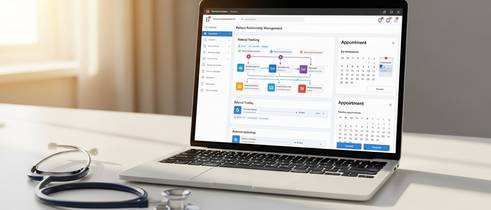
Custom Patient Relationship Management Software Development

Developing a HIPAA compliant app requires patient data protection, access controls, and audit logging from day 1. Build a healthcare CRM platform tailored to your patient workflows — referral management, care coordination, appointment scheduling, and marketing automation. compliance requirements, and integration needs — from patient management systems to clinical trial platforms.

  • Patient lifecycle management from first contact through long-term retention
  • HIPAA, HITECH, and HL7 FHIR R4B compliant architecture
  • Integration with Epic, Cerner, MEDITECH, Allscripts, and athenahealth
  • HL7 FHIR and HL7 v2 interoperability for seamless health data exchange
  • Cloud-native deployment on AWS GovCloud, Azure Healthcare, or Google Cloud

Referral Pipeline & Provider Network CRM

Track every patient from first referral through treatment, follow-up, and retention. Automated referral routing, conversion tracking, and provider network management: AES-256 encryption at rest, TLS 1.3 in transit, role-based access control (RBAC), multi-factor authentication, automatic session timeout, and comprehensive PHI audit logging. with existing EHR platforms to improve clinical documentation, care coordination, and data interoperability.

  • Custom CRM dashboards with referral pipelines, patient segments, and engagement workflows
  • Epic, Cerner, MEDITECH, and Allscripts integration and customization
  • HL7 FHIR API development for bidirectional health data exchange
  • Clinical decision support (CDS) rules engine integration
  • MIPS/MACRA quality reporting and Meaningful Use compliance

Patient Communication & Outreach Automation

HIPAA-compliant email, SMS, and push notification campaigns. Automated appointment reminders, recall campaigns, patient surveys, and review generation: Business Associate Agreements (BAAs) with all vendors, workforce training documentation, security incident response plans, and risk assessment procedures.atient monitoring, chronic care management, and seamless EHR integration for virtual care delivery.

  • Automated appointment reminders, recall campaigns, and patient satisfaction surveys
  • Patient engagement tracking (RPM) with IoT device integration and alerts
  • Chronic care management (CCM) workflows with automated check-ins
  • Asynchronous telehealth (store-and-forward) for dermatology, radiology, and pathology
  • Telehealth billing integration with CPT codes 99441-99443 and RPM codes

What Makes DreamzTech Different

Why Healthcare Organizations Need a Custom CRM

 Every healthcare application that touches patient data must comply with HIPAA. Retrofitting compliance after development costs 3-5x more than building it in from day 1. With healthcare data breaches averaging $10.93 million per incident (IBM, 2024) and HIPAA fines reaching $1.5M per violation category, with 78% of health systems investing in patient engagement technology (HIMSS, 2024).

  • Patient lifecycle mapping — from first inquiry through referral, treatment, follow-up, and long-term retention
  • EHR/EMR integration via HL7 FHIR with Epic, Cerner, Allscripts, and athenahealth for real-time patient data sync
  • Referral tracking with automated routing, provider network management, and conversion analytics
  • Healthcare marketing automation — appointment reminders, recall campaigns, patient surveys, and reputation management — built to pass HIPAA audits on first submission
  • Deploy on HIPAA-eligible cloud infrastructure — AWS GovCloud, Azure Healthcare APIs, or Google Cloud Healthcare API — with multi-AZ failover and disaster recovery
  • Provide 24/7 security monitoring, performance testing, HIPAA compliance updates, and SLA-backed incident response with guaranteed resolution windows
Our CRM for Healthcare Providers Process

How We Build CRM for Healthcare Providers

A structured, transparent five-phase process designed for regulated healthcare environments — delivering working, compliant software incrementally, with clinical stakeholders involved at every stage.

1

Discovery & Clinical Analysis

Stakeholder interviews, clinical workflow observation, compliance scoping, technical environment audit, and detailed project roadmap with milestone definitions.

2

Architecture & Security Design

HIPAA-first system architecture, clinical UX wireframes tested with end-users, API contract design, threat modeling, and infrastructure planning with BAA execution.

3

Agile, QA, Compliance & Security

HIPAA compliance audit, third-party performance testing, performance load testing, clinical UAT with real end-users, and accessibility audit against WCAG 2.1 AA.

4

Launch & Ongoing Support

Phased go-live with rollback capabilities, clinical staff training, 24/7 monitoring, SLA-backed incident response, and ongoing compliance maintenance.

Security & Compliance

HIPAA-Compliant Healthcare CRM — Secure by Design

HIPAA compliance is not a checklist we complete before launch — it is an engineering discipline embedded into our architecture, development workflow, and operational procedures from the first line of code.

All PHI encrypted with industry-standard AES-256 with automated key rotation via AWS KMS or Azure Key Vault. TLS 1.3 enforced for all data in transit.

Fine-grained RBAC with minimum-necessary-access enforcement. Tamper-proof audit logs of all PHI access, modification, and export events meeting HIPAA §164.312(b).

We execute a signed BAA before any work begins and require BAAs from all sub-processors and cloud providers handling PHI on your behalf.

Independent security assessments by CREST-certified firms with full vulnerability remediation tracking, and continuous automated SAST/DAST scanning in CI/CD pipelines.

All production deployments use AWS GovCloud, Azure Healthcare APIs, or Google Cloud Healthcare API — all operating under BAAs with full CRM technical architecture enabled.

 Documented incident response plans meeting the HIPAA Breach Notification Rule (§164.400–414) with 60-day notification SLA and HHS reporting procedures.

HIPAA-Compliant

Information security

EHR/EMR Software Development - HIPAA Compliance

HIPAA Compliant

Privacy & Security Rule

HL7 FHIR R4

ONC-compliant APIs

AICPA SOC2 Compliance

Annual audit certified

HL7 FHIR R4B

Electronic records

WCAG 2.1 AA

ADA-accessible UI

CRM Case Studies

Healthcare CRM Projects We Have Delivered

Explore how DreamzTech has built HIPAA-compliant healthcare applications that reduce admin time, improve patient outcomes, and streamline clinical operations — for hospitals, clinics, and health tech companies across the United States.

DreamzTech

Schedule a call

At DreamzTech, our success is measured by the impact we create. With award-winning innovations

Why Healthcare Organizations Trust DreamzTech for CRM

Patient Engagement, Referral Management, and Healthcare CRM Expertise

Partner with DreamzTech to accelerate your digital transformation. Our awards, partnerships, and global client success stories demonstrate our expertise in delivering enterprise AI and advanced technology solutions.

Awards & Recognition

Ratings

Talk to a Healthcare CRM Development Expert

Share your healthcare IT requirements and we will design the fastest path to a HIPAA-compliant, interoperable health IT solution using proven architectures and our healthcare accelerator platforms.

    I Consent to Receive SMS Notifications, Alerts from DreamzTech US INC. Message frequency may vary. Message & data rates may apply. Text HELP for assistance. You may reply STOP to unsubscribe at any time.
    I Consent to Receive the Occasional Marketing Messages from DreamzTech US INC. You can Reply STOP to unsubscribe at any time.
    By submitting the form, you agree to the DreamzTech Terms and Policies
    Client Testimonials

    What Healthcare Leaders Say

    Verified reviews from healthcare CIOs, CMOs, and CEOs across our active client base.

    Resources

    Related Healthcare & CRM Solutions

    Service pages, deep-dive guides, and resources across the full healthcare software topic cluster

    Explore Our Healthcare Solutions

    Healthcare & Medical CRM Software Development Cost Guide

    Detailed cost breakdown for EHR, telemedicine, patient portals, and mHealth apps

    Healthcare CRM Development

    Healthcare data security, compliance frameworks, and patient data management

    Telemedicine App Development

    HIPAA-compliant video consultations, RPM, and virtual care platforms

    Healthcare CRM Development

    Patient relationship management, referral tracking, and marketing automation

    Medical Billing Software Development

    Revenue cycle management, claim processing, and denial management

    Healthcare App Development Process

    Our 8-step compliance-embedded development methodology

    Healthcare Software Integration Services

    HL7 FHIR, EHR integration, lab interfaces, and HIE connectivity

    AI in Healthcare Software

    Clinical decision support, medical imaging AI, NLP, and predictive analytics

    EHR & EMR Development

    Custom electronic health records with HL7 FHIR

    Patient Portal Development

    HIPAA-compliant patient engagement platforms

    Healthcare CRM Development

    Custom healthcare CRMs with wearable integration

    AI-Powered Custom Patient Relationship Management Software Development

    We integrate cutting-edge AI and machine learning capabilities into every custom healthcare software development project, enabling predictive insights, clinical decision support, and intelligent automation that improves patient outcomes and operational efficiency.

    Our AI-augmented healthcare software development approach combines 15+ years of healthcare domain expertise with the latest in generative AI, NLP, and computer vision to deliver solutions that are both innovative and clinically validated.

    Healthcare CRM — Marketing Automation & Analytics

    Every custom healthcare software development project at DreamzTech is built with patient-first architecture. We implement end-to-end security controls including AES-256 encryption at rest, TLS 1.3 in transit, role-based access control (RBAC), multi-factor authentication, and comprehensive PHI audit trails.

    Our healthcare software integrates with all major EHR systems including Epic, Cerner, MEDITECH, Allscripts, and athenahealth through certified APIs and Health Information Exchange (HIE) networks.

    Flexible Engagement Models for Custom Patient Relationship Management Software Development

    Choose the engagement model that fits your healthcare software project scope, timeline, and budget.

    Dedicated CRM Dev Team

    A full-time team of healthcare software engineers, QA specialists, and a delivery lead focused solely on your product roadmap. Best for long-term healthcare platform development.

    Fixed-Price CRM Projects

    Ideal for well-defined custom healthcare software development scopes with clear timelines. We agree up front on deliverables, HIPAA compliance milestones, and schedule.

    CRM Staff Augmentation

    Quickly add senior healthcare software developers, compliance specialists, or HL7 FHIR integration experts to fill critical skill gaps on your in-house team.

    Time & Materials

    Maximum flexibility for evolving healthcare software requirements. Pay for actual development hours with full transparency and sprint-based billing.

    Engage. Retain. Grow — Healthcare CRM by DreamzTech

    Ready to Build a Healthcare CRM That Grows Your Practice?
    Last updated: April 2026

    Book a free healthcare CRM consultation with our patient engagement architects. We will map your patient journey, identify referral leakage, and recommend the fastest path to a unified healthcare CRM software platform. with our healthcare security architects. We'll review your requirements, identify compliance gaps, and recommend the fastest path to a secure, HIPAA-compliant application.. Get a clear path from requirements to production — no pressure, no sales pitch, just straight answers from engineers who have built EHR integrations, telemedicine platforms, and patient portals for healthcare organizations across the United States.

    Healthcare CRM Development FAQ

    Got questions about healthcare software development? Explore our FAQs below to learn how DreamzTech builds HIPAA-compliant, interoperable health IT solutions for healthcare organizations in the USA.

    A healthcare software development company is a technology firm that specializes in designing, building, and deploying software solutions specifically for the medical and health industry. Unlike general software agencies, healthcare software companies have deep, domain-specific expertise in HIPAA compliance, HL7 FHIR interoperability standards, clinical workflow design, and FDA medical device regulations. They build systems including Electronic Health Records (EHR/EMR), telemedicine and telehealth platforms, patient portals, AI-powered clinical decision support tools, medical billing and revenue cycle management (RCM) software, hospital management systems (HMS/HIS), healthcare data analytics platforms, and remote patient monitoring (RPM) solutions — all of which must handle protected health information (PHI) securely and in compliance with federal and state law. 

    Custom healthcare software development costs vary significantly by scope, complexity, and compliance requirements. Here are realistic US market ranges: Patient portal or single-module app: $25,000–$65,000. Telemedicine platform (MVP with core features): $65,000–$150,000. Custom specialty EHR system: $150,000–$450,000. Full hospital management system: $400,000–$1,200,000+. AI diagnostic or clinical decision support platform: $120,000–$500,000. These ranges include UX design, development, HIPAA compliance implementation, QA and security testing, and first-year maintenance. HIPAA compliance typically adds 15–25% to development cost compared to non-regulated software. We provide fixed-price proposals with milestone-based billing — you always know the full cost before we begin. 

    Healthcare software development timelines depend on scope and complexity. Typical ranges from our project history: Patient portal: 3–5 months. Telemedicine app (MVP): 4–7 months. Medical billing software: 4–8 months. Custom specialty EHR: 9–15 months. AI clinical decision support system: 7–14 months. Hospital management system: 12–22 months. These timelines include discovery, design, development, QA, compliance audits, and go-live. All engagements use 2-week agile sprints with working software delivered at every milestone — so you see progress continuously, not just at the end. Discovery and requirements documentation typically takes 4–6 weeks before core development begins.

    Healthcare software development differs from general software development in five critical, non-negotiable ways: (1) Regulatory compliance: All software handling Protected Health Information (PHI) must comply with HIPAA, HITECH, and applicable state privacy laws. Clinical software may require FDA clearance under 21 CFR Part 11. (2) Interoperability standards: Healthcare software must implement HL7 FHIR R4 (federally mandated by the ONC), HL7 v2.x, DICOM (for imaging), SNOMED CT, LOINC, and X12 EDI for claims. (3) Clinical workflow expertise: UIs must be designed for time-pressured clinical environments — a confusing interface is not just bad UX, it is a patient safety risk. (4) Data security and audit requirements: Every access to PHI must be logged immutably. Breach notification procedures must be documented and tested. BAAs must be in place with all vendors. (5) Availability requirements: Clinical systems are mission-critical. They cannot go offline for maintenance windows during care hours and must maintain 99.9%+ uptime with zero data loss guarantees.

    We implement HIPAA compliance as an engineering discipline, not a checklist. Our process: Before development: Execute a signed BAA, conduct a HIPAA compliance scoping assessment, document all PHI data flows, define access control policies, and select HIPAA-eligible cloud infrastructure. During development: AES-256 encryption for PHI at rest and TLS 1.3 in transit; RBAC with minimum-necessary access enforcement; immutable audit logging of all PHI access events; automated SAST and DAST security scanning in every CI/CD pipeline; no PHI in development or testing environments (synthetic data only). Before launch: Third-party penetration test by a CREST-certified security firm; HIPAA compliance audit by our in-house compliance officer; review of all Business Associate Agreements with sub-processors; documented compliance monitoring procedures and incident response plan. After launch: 24/7 automated security monitoring; annual penetration re-test; compliance updates as regulations evolve; employee HIPAA training for all project team members annually.

    Yes — EHR integration is one of our core competencies. We are certified partners in Epic’s App Orchard and Cerner’s Code Program, and have completed 80+ EHR integration projects. Integration methods we use: HL7 FHIR R4 APIs for modern EHRs supporting ONC-certified interoperability; SMART on FHIR for applications that launch inside EHR workflows via single sign-on; HL7 v2.x messaging (ADT, ORU, ORM, MDM) for legacy EHR connections; CDA / C-CDA document exchange for clinical summaries and transitions of care; X12 EDI 837/835/270/271 for claims and eligibility. EHR platforms we have integrated: Epic, Cerner/Oracle Health, Allscripts, athenahealth, Meditech, eClinicalWorks, NextGen, DrChrono, and Practice Fusion. A typical EHR integration takes 6–12 weeks depending on your EHR vendor’s API access policy and your IT environment.

    HL7 FHIR (Fast Healthcare Interoperability Resources) is the modern international standard for electronically exchanging healthcare information, published by Health Level Seven International. FHIR R4 (Release 4) is now federally mandated in the USA under the 21st Century Cures Act, implemented by the ONC’s Interoperability and Information Blocking Rules (effective 2021). Why it matters for your healthcare software: Legal requirement: Any software connecting to an ONC-certified EHR must support FHIR R4 APIs. Patient access rights: Patients have a federally protected right to access their health data through FHIR-enabled applications — blocking this constitutes “information blocking” and carries civil monetary penalties up to $1 million per violation. Interoperability: FHIR enables your software to exchange data with any compliant EHR, payer, pharmacy, lab, or health information exchange. Ecosystem access: The Apple Health Records, Google Health, and all major consumer health platforms use FHIR to import patient data. All healthcare software we build includes HL7 FHIR R4 APIs by default, at no additional cost.

    An EMR (Electronic Medical Record) is a digital version of a patient’s chart within a single practice or provider organization. EMRs store the medical and treatment history that one provider has captured, and they are not designed to travel outside the practice that created them. An EHR (Electronic Health Record) is a broader, interoperable system that is designed to share comprehensive patient health information across multiple providers, organizations, and care settings. EHRs include patient portals, care coordination features, population health management tools, and HL7 FHIR APIs for data exchange. All ONC-certified systems required for Medicare and Medicaid reimbursement (and the 21st Century Cures Act mandates) are EHRs. In practice, the terms are used interchangeably in vendor marketing — but if interoperability, patient data access, or federal regulatory compliance matters to your organization, you need an EHR, not just an EMR. We build both custom specialty EMR systems for single-site practices and large-scale, federally-compliant EHR platforms for health systems. 

    Yes — post-launch support is a core part of every engagement, not an optional add-on. We offer three support tiers: Essential Plan (SLA: 8-hour business hours response): Bug fixes, security patches, hosting management, and regulatory compliance updates (new ICD codes, FHIR spec changes, etc.). Ideal for smaller clinics and single-module deployments. Professional Plan (SLA: 4-hour response, extended hours): Everything in Essential plus proactive performance monitoring, quarterly HIPAA compliance reviews, and one dedicated monthly feature development sprint. Ideal for growing practices and mid-size health-tech companies. Enterprise Plan (SLA: 2-hour response, 24/7/365): Everything in Professional plus a dedicated account engineer, 24/7 NOC monitoring with automated escalation, unlimited feature development, and on-site support for major updates and compliance audits. All plans include: dedicated Slack channel, monthly reporting, and compliance update coverage at no extra charge as federal regulations evolve.

    When evaluating a healthcare software development company, verify these six criteria: 1. Healthcare specialization depth: Ask how many of their current engineers have 3+ years of health IT experience, not just how many projects they claim. Ask for references from healthcare CIOs or CMOs, not just startup founders. 2. HIPAA compliance process: A legitimate healthcare software company should be able to explain exactly how they implement the HIPAA Security Rule, what their BAA process is, and who their compliance officer is. If they cannot answer these questions in detail, walk away. 3. EHR integration credentials: For any project requiring Epic or Cerner integration, verify they are listed in Epic’s App Orchard or Cerner’s Code Program directories. 4. Contract structure: EHR-Integrated CRM with milestone billing protect you. Avoid time-and-materials contracts for regulated healthcare software where scope is predictable. 5. Verified third-party reviews: Check Clutch.co for verified reviews from actual healthcare clients — not self-published case studies. 6. Post-launch commitment: Confirm they offer SLA-backed maintenance with defined response times for critical issues. Healthcare software cannot have a 3-business-day response time for production outages. 

    Custom healthcare software development delivers solutions built specifically for your clinical workflows, compliance requirements, and integration needs. Unlike off-the-shelf products, custom software eliminates per-user licensing fees, integrates seamlessly with your existing EHR/EMR systems, and can be modified as regulations and clinical practices evolve. DreamzTech specializes in building custom solutions that provide a competitive advantage while ensuring full HIPAA compliance.
    Yes. DreamzTech has extensive experience migrating PHI and clinical data from legacy systems to modern platforms. We follow strict data migration protocols including data mapping, validation, integrity testing, and rollback procedures. Our team handles HL7 v2/FHIR format conversions, database migrations, and parallel-run testing to ensure zero data loss and minimal disruption to clinical operations.
    We provide 24/7 SLA-based support including proactive monitoring, security patching, regulatory compliance tracking, performance optimization, and EHR compatibility testing for every custom healthcare software development project. Our support tiers range from basic maintenance to full managed services with dedicated DevOps and compliance teams.
    DreamzTech builds custom healthcare software with full interoperability support including HL7 FHIR R4, HL7 v2.x, CDA/CCD, DICOM for medical imaging, X12 EDI for claims and billing, NCPDP for pharmacy, and IHE profiles. We also integrate with Health Information Exchanges (HIE) and support SMART on FHIR for third-party app integration within EHR systems.
    Our quality assurance process includes automated testing (unit, integration, regression), manual clinical workflow testing, security performance testing, HIPAA compliance audits, performance load testing, and accessibility testing (Section 508/WCAG 2.1). We follow IEC 62304 for medical device software lifecycle processes and maintain HIPAA-Compliant certification.