Mobile EHR Platform for Community Healthcare

Mobile EHR Platform for Community Healthcare

Case Study

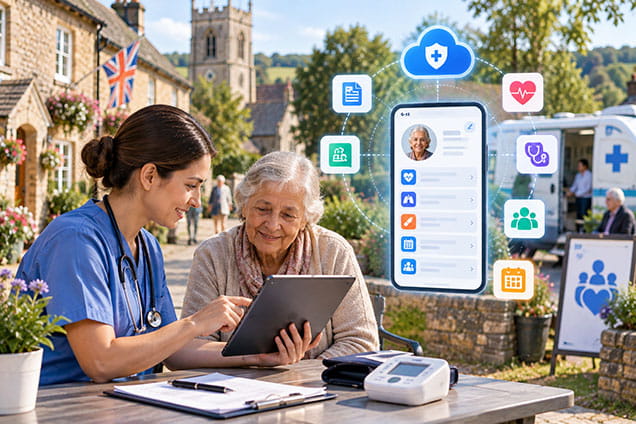
DreamzTech developed a custom mobile electronic health record platform for a U.S.-based healthcare company, giving authorized teams a clearer way to access patient information, document care and coordinate follow-up from mobile devices. The solution brought mobile workflows, centralized administration and privacy-conscious access controls into one connected experience.

  • What we built: Custom Mobile EHR Platform
  • Industry: Healthcare / Community-Based Care
  • Delivery: Discovery, Design, Engineering & Phased Rollout
Discuss Your Mobile EHR Project
Mobile EHR Platform for Community Healthcare
Trusted By Startups, SMBs to Fortune 500 Brands

Quick Answers

What Is a Mobile EHR Platform? A mobile EHR platform gives authorized healthcare users secure access to relevant electronic health record functions from smartphones or tablets. Depending on the approved scope, those functions may include patient search, demographic and clinical summaries, encounter documentation, task and follow-up management, care-team communication and data exchange with other healthcare systems. A mobile EHR does not become compliant simply because it uses encryption or a cloud service; compliance depends on the complete combination of technology, policies, risk management, contracts, user behavior and operational controls.

QuestionAnswer
What did DreamzTech build?A custom mobile EHR platform for a U.S.-based healthcare company.
Who was it designed for?Authorized clinical, community-care and administrative users who needed access to relevant patient information across mobile and office workflows.
What problem did it solve?It reduced dependence on fragmented, location-bound processes by bringing patient lookup, structured documentation, coordination and administration into a connected platform.
How was sensitive data addressed?The architecture was designed to support HIPAA-aligned operations through controlled access, secure transmission, logging, data minimization and configurable security policies.
What was the outcome?A more consistent mobile workflow for capturing and retrieving information, coordinating care and maintaining operational oversight. No numerical performance claim is published without client approval.

Overview

The client is presented publicly as a U.S.-based healthcare company to protect confidentiality. Its teams needed a mobile-first way to work with patient information beyond a fixed desktop workflow while maintaining central oversight. DreamzTech translated that need into a custom platform designed around authorized access, structured data capture, coordinated follow-up and secure communication between the mobile experience and approved back-end services — part of DreamzTech's broader healthcare software development practice.

Project DimensionPublic Description
ClientU.S.-based healthcare company
IndustryHealthcare and community-based care
EngagementCustom mobile EHR software design and development
UsersAuthorized care-team, operations and administrative users
Core objectiveMake relevant patient information and documentation workflows available at the point of care while preserving governance
Public outcome policyQualitative outcomes only until client-approved measurements are available

Challenges

Care teams needed secure, mobile access to patient information without losing consistency, oversight or governance.

Solutions Delivered

DreamzTech created a mobile-first EHR experience supported by centralized administration and secure service layers. The platform was organized around the tasks users perform during community-based care rather than reproducing a dense desktop interface on a smaller screen.

Authorized users can locate the patient or case they are working on and access the information relevant to that workflow. The interface prioritizes clear summaries and task-focused navigation so users can find what they need without moving through unrelated administrative screens.

Mobile forms and guided fields help teams capture encounter details in a consistent format. Validation, required fields and clear status indicators support completeness and reduce ambiguity before information moves into review or follow-up.

The workflow connects documentation with assignments, follow-up steps and record status. Care and operations teams can understand what has been completed, what still requires attention and which authorized user owns the next action.

Administrative capabilities support user and role management, configuration, operational review and issue follow-up. This gives the organization one place to manage access and monitor how mobile workflows are being used.

The mobile experience communicates with approved back-end services through authenticated, protected connections. Security design considerations include role-based permissions, session management, encryption, logging, data minimization and controlled handling of locally stored information. Exact controls should be validated against the deployed environment before publication.

The platform can connect mobile workflows with approved clinical, operational and reporting systems through governed interfaces. Where required by the client and ecosystem, interoperability can use standards such as HL7 FHIR; the public page should name a standard or connected vendor only after the implementation team confirms it. DreamzTech’s EHR integration services team defines the exact interfaces once the connected systems are confirmed.

How the Mobile EHR Workflow Works

From authentication to oversight, here's how the platform keeps every mobile documentation step secure and connected.

Success and Outcome

The engagement produced a connected mobile EHR foundation for community-based healthcare workflows. Instead of forcing teams to depend on fragmented or location-bound processes, the platform gives authorized users a consistent way to retrieve relevant information, document care and coordinate next steps. Central administration and auditable access help the organization govern the experience as workflows evolve.

Editorial note: These outcomes are not converted into percentages, time savings, patient counts, adoption figures or ROI statements without a client-supplied measurement definition, baseline, period, sample and written publication approval.

More Accessible Workflows

Relevant record functions are available from a mobile-first experience for authorized users.

More Consistent Documentation

Structured capture and validation support clearer, reviewable information.

Better Coordination

Status, assignments and follow-up are connected to the patient or care workflow.

Stronger Operational Control

User, role, configuration and activity oversight are centralized.

A Scalable Foundation

The architecture can support additional workflows and integrations after technical and compliance validation.

Security, Privacy and Compliance by Design

The public page should describe the solution as designed to support HIPAA-compliant operations, not as ‘HIPAA certified.’ HIPAA compliance is an organizational and operational responsibility shared among covered entities, business associates, subcontractors and users. The exact obligations depend on how the system is deployed, which data it handles, the parties' roles and the applicable contracts — the same shared-responsibility model behind DreamzTech's broader HIPAA-compliant healthcare software practice.

Compliance AreaWhat the Case Study May SayPublication Caution
HIPAA Security RuleThe design supports administrative, physical and technical safeguard objectives for ePHI.Do not claim certification; document the implemented controls and risk analysis.
HIPAA Privacy RuleRole-based access and workflow design can support appropriate use and disclosure of PHI.Minimum necessary has exceptions, including certain treatment disclosures; avoid oversimplification.
Identity and accessUse unique accounts, least-privilege roles, strong authentication, session timeout and access review.Only name MFA, SSO or biometrics if deployed.
Encryption and transportProtect ePHI in transit and, where stored, at rest using organization-approved controls.Confirm algorithms, key management and device-storage behavior before naming them.
Mobile-device safeguardsLimit local data, control sessions, manage updates and support lost-device response.Only claim MDM, remote wipe, jailbreak/root detection or offline encryption if verified.
AuditabilityLog access and relevant security events so activity can be reviewed and investigated.Confirm retention, alerting and monitoring scope.
Business associatesExecute appropriate BAAs when a vendor creates, receives, maintains or transmits PHI on behalf of a covered entity.Legal and compliance teams must determine roles and contract coverage.
Breach readinessMaintain incident response, evidence, mitigation and notification procedures for unsecured PHI.Do not promise that encryption eliminates every notification obligation.
InteroperabilityUse governed interfaces and, where required, standards such as HL7 FHIR.Do not claim ONC certification or information-blocking compliance without assessment.
Additional lawsEvaluate state health privacy laws and 42 CFR Part 2 when the data and services make them applicable.Applicability varies; obtain legal review.
AccessibilityDesign mobile and web experiences for accessible use and test against the organization's chosen WCAG target.Only publish a WCAG conformance level after testing.

Why DreamzTech

Healthcare software must make difficult workflows easier without weakening privacy, security or governance. DreamzTech combines mobile product engineering, custom EHR development, API integration and compliance-aware architecture to build solutions around the client's users, operating model and approved systems.

  • Healthcare product engineering: Mobile, web, API and data capabilities delivered as one coordinated platform.
  • Workflow-first design: Interfaces shaped around real care and operational tasks.
  • Security-conscious architecture: Access, data movement, auditability and vendor responsibilities considered throughout delivery.
  • Integration readiness: Governed interfaces designed to fit the client's healthcare ecosystem.
  • Long-term evolution: A foundation that can be extended after user, security and compliance validation.

DreamzTech's broader custom software development capability underpins this delivery model. Have questions about your own project? Contact DreamzTech to talk through your workflows and requirements.

Conclusion

DreamzTech delivered a custom mobile EHR platform that brought patient-information access, structured documentation and care coordination into a clearer mobile workflow for a U.S.-based healthcare company. The result is a practical foundation for community-based care teams that need mobility without losing control of sensitive health information. Planning a mobile EHR, healthcare app or EHR integration project? Talk with DreamzTech about your users, workflows, interoperability needs and compliance requirements.

Leading Global Software Company

Trusted by Industry Leaders Worldwide

Trusted by startups to Fortune 500s, including DHL, Nestlé, and Stanford — partners who rely on us for high-impact, scalable software solutions.

Book a Discovery Call

    By submitting the form, you agree to the DreamzTech Terms and Policies

    Frequently Asked Questions (FAQ)

    A mobile EHR is a smartphone- or tablet-accessible electronic health record experience that gives authorized users access to approved clinical and operational functions. The available features depend on the organization, user role, connected systems and security policies.

    DreamzTech built a custom mobile EHR platform for a U.S.-based healthcare company. It brought patient-information access, structured documentation, follow-up workflows and centralized administration into a connected mobile-first experience.

    Mobile EHR software can support authorized clinicians, community-care teams, care coordinators, operations staff and administrators. Each user’s access should be limited according to role, purpose and organizational policy.

    It can make relevant patient information and documentation workflows available closer to where care is delivered. It can also connect mobile activity with assignments, status and follow-up for approved users.

    The terms overlap, but an EHR generally emphasizes a broader longitudinal record and exchange across care settings, while EMR often refers to a record used within one practice. Actual product capabilities matter more than the label.

    The platform was designed to support HIPAA-compliant operations. Compliance is not a one-time software certification; it depends on the implemented safeguards, risk analysis, contracts, configuration, policies, training and day-to-day use by covered entities and business associates.

    Controls commonly include unique user identities, role-based permissions, strong authentication, session controls, protected data transmission, appropriate encryption, audit logging, data minimization, secure configuration, backup and incident-response procedures. The exact control set should follow a documented risk analysis.

    That depends on the architecture and approved workflow. A security-conscious design minimizes local ePHI, protects any authorized storage, controls cached data and includes procedures for lost, stolen or compromised devices.

    Offline workflows are possible, but they introduce additional risks involving local storage, synchronization, conflict handling and lost devices. This case study should claim offline capability only if the deployed solution and its safeguards are confirmed.

    Yes, a custom mobile application can connect with approved EHR and operational systems through governed APIs and integration services. The exact method depends on vendor access, data models, supported interfaces and security requirements.

    DreamzTech can implement standards-based healthcare integrations, including HL7 FHIR where the use case and connected systems support it. The public case study should identify FHIR as a project feature only after technical confirmation.

    Start with user roles, care workflows, data ownership, system-of-record decisions, integration constraints, reporting needs, risk analysis and compliance responsibilities. These inputs shape the product scope and architecture.

    Timing depends on workflow complexity, integrations, platform coverage, validation, security review and deployment requirements. DreamzTech defines a phased plan after discovery rather than publishing an unverified generic timeline.

    It may be adapted for a Federally Qualified Health Center, but FQHC workflows, reporting, billing, certification and program requirements must be evaluated separately. Do not describe the anonymous client as an FQHC unless that status is confirmed.

    The healthcare organization, software vendor, cloud and integration providers, subcontractors and users may each have responsibilities. Roles should be documented, appropriate BAAs executed, access configured, staff trained and incident procedures maintained.

    This version uses qualitative outcomes and clearly marks capabilities that require confirmation. Numerical results, certifications, named integrations and exact security controls should be published only after evidence and written approval.