White-Label Payment Gateway & Merchant Management Platform Case Study

White-Label Payment Gateway & Merchant Management Platform Case Study

Case Study

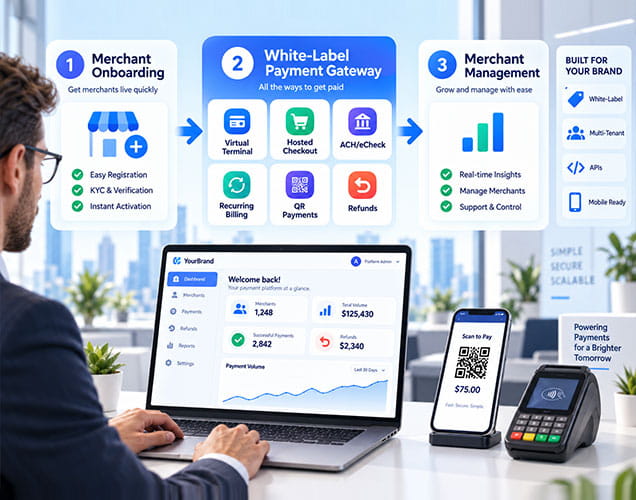
DreamzTech built a multi-tenant, white-label payment gateway and merchant management platform for a US-based payment processing company. The solution connects merchant onboarding, virtual terminal payments, hosted checkout, ACH/eCheck, recurring billing, QR payments, refunds, pricing controls and transaction monitoring through a deeply integrated payment-processing workflow.

  • What we built: White-label payment gateway and merchant operations platform
  • Industry: Fintech, payment processing and merchant services
  • Delivery: Merchant portal, management portal, APIs and mobile-payment enablement
Discuss Your Payment Platform Project
White-Label Payment Gateway & Merchant Management Platform Case Study
Trusted By Startups, SMBs to Fortune 500 Brands

Quick Answers

  • What we built: A white-label payment gateway with separate merchant and platform-administration experiences.
  • Who it serves: A US-based payment processing company supporting ISOs, affiliates and merchants.
  • Payment channels: Virtual terminal, hosted checkout, cards, ACH/eCheck, digital wallets, subscriptions and QR payments.
  • Merchant operations: Onboarding, feature provisioning, pricing, branding, roles, refunds, monitoring and reporting.
  • Outcome: One scalable platform for branded merchant experiences and centralized payment operations.

Overview

A US-based payment processing company needed more than a checkout screen. It required a configurable platform where merchants could accept payments under their own branding while the platform team governed onboarding, pricing, permissions, transaction activity and processor synchronization from a central operating layer.

DreamzTech designed and developed a multi-tenant payment processing platform integrated with a third-party payment processor. The solution combines merchant-facing payment tools with an administrative portal for ISOs, agents, affiliates and internal users. It supports credit and debit cards, ACH/eCheck, contactless wallet flows, recurring billing, hosted checkout, QR payments, refunds and reporting while keeping merchant data and settings separated by tenant.

Delivery Challenges

  • Create branded, isolated merchant experiences on one shared platform
  • Unify cards, ACH, wallets, recurring billing, QR and hosted checkout workflows
  • Synchronize onboarding and transactions with an external processor in real time
  • Give ISOs and administrators granular control over pricing, features and users
  • Maintain clear visibility across refunds, voids, returns, risk signals and webhooks

How the Platform Works

The platform coordinates merchant onboarding, payment acceptance and operational control through five connected stages.

Solutions Delivered

DreamzTech delivered a fully custom white-label payment gateway and merchant management platform connecting onboarding, payment acceptance, pricing control, security and analytics:

  • Step-by-step merchant onboarding with business, contact, banking and ownership data
  • Processor synchronization for merchant IDs and account activation
  • Merchant-specific subdomains with automated SSL provisioning
  • Configurable logos, colors, contact details, checkout pages, receipts and email/SMS templates
  • Secure manual card entry with amount, tax, tip, notes and receipt delivery
  • Processor tokenization before transaction submission
  • Full or partial refunds with searchable transaction history
  • Real-time status updates for refunds, voids and reversals
  • Weekly, monthly, annual and custom recurring plan intervals
  • Tokenized card or ACH payment methods linked to customers
  • Plan-based discounts and renewal, cancellation and failure alerts
  • ACH return-code tracking, reference numbers and recurring ACH support
  • Branded hosted payment pages with custom fields and theme previews
  • Embeddable links or iframe code for websites and service-payment scenarios
  • JavaScript buttons or WooCommerce-oriented shopping-cart integration
  • Dynamic QR codes with scan and payment-status tracking
  • Barcode scanning to populate product or invoice-linked amount, tax and description data
  • Central dashboard for recent transactions, volume and merchant comparisons
  • Merchant search by MID, merchant name, agent or ISO
  • Agent and affiliate profiles with assigned merchant portfolios
  • Merchant-level feature toggles for terminal, hosted checkout and QR payments
  • Retry controls for failed synchronization or webhook callbacks
  • Interchange Plus, tiered, flat-rate or custom pricing based on processor support
  • Reusable pricing templates assigned to merchants or merchant groups
  • Fees by transaction class, including card-present, card-not-present, ACH, refunds and chargebacks
  • Version history and effective dates for fee changes
  • Owner, manager and agent roles with screen- and action-level permissions
  • MFA, login history, forced logout and read/write/delete controls
  • JWT-based access, encryption, password hashing and processor tokenization
  • Transaction search by MID, merchant, card type, status, amount and date
  • Masked card details, AVS result, authorization code, risk score and exportable reports
  • Language packs with browser detection and manual language selection
  • Trend analysis across sales, refunds and chargebacks
  • Predictive insights for product performance, customer behavior and churn risk
  • Merchant suggestions and administrative alerts for risk, performance and onboarding bottlenecks

Success and Outcomes

Unified Merchant Operations

Merchant onboarding, branding, payments, refunds, subscriptions, users and reporting work through connected tenant and management experiences.

Multi-Channel Payment Acceptance

Virtual terminal, hosted checkout, cards, ACH/eCheck, recurring billing, wallets, QR and shopping-cart flows support varied merchant use cases.

Centralized Commercial Control

Pricing templates, transaction-class fees, feature toggles, agents, affiliates and merchant assignments are managed from one administrative layer.

Real-Time Operational Visibility

Transaction filters, status updates, ACH return codes, webhook logs, risk indicators, charts and exports help teams understand current activity.

White-Label Merchant Growth

Branded subdomains, checkout pages, receipts and communication templates create a repeatable foundation for onboarding additional merchants.

Actionable Payment Intelligence

Merchant dashboards and AI-assisted insights surface trends, anomalies, customer behavior, risk signals and performance opportunities.

Conclusion

This white-label payment gateway case study demonstrates how DreamzTech can combine payment processing integration with the operational software required to run a merchant services business. The delivered platform connects merchant onboarding, virtual terminals, hosted checkout, ACH/eCheck, recurring billing, QR payments, refunds, pricing, access controls, monitoring and analytics in one multi-tenant environment. If your fintech company, ISO, payment facilitator or software platform needs custom payment gateway software development, DreamzTech can help design the merchant experience, administrative controls, processor integrations and scalable architecture around your business model.

Leading Global Software Company

Trusted by Industry Leaders Worldwide

Trusted by startups to Fortune 500s, including DHL, Nestlé, and Stanford — partners who rely on us for high-impact, scalable software solutions.

Book a Discovery Call

    I Consent to Receive SMS Notifications, Alerts from DreamzTech US INC. Message frequency may vary. Message & data rates may apply. Text HELP for assistance. You may reply STOP to unsubscribe at any time.
    I Consent to Receive the Occasional Marketing Messages from DreamzTech US INC. You can Reply STOP to unsubscribe at any time.
    By submitting the form, you agree to the DreamzTech Terms and Policies

    Frequently Asked Questions (FAQ)

    A white-label payment gateway lets a fintech company or payment provider offer payment acceptance under its own brand. The provider can customize merchant portals, hosted checkout pages, receipts, communication templates and domains while using integrated processing infrastructure for transaction authorization, tokenization and settlement workflows.

    DreamzTech built a multi-tenant gateway and merchant management platform for a US-based payment processing company. It includes merchant onboarding, virtual terminals, hosted checkout, recurring billing, ACH/eCheck, QR payments, refunds, branding, pricing controls, roles, transaction monitoring, multilingual interfaces and AI-assisted analytics.

    A hosted payment page is a secure checkout page served through the payment platform rather than built entirely inside the merchant’s website. In this solution, merchants can configure branding and custom fields, generate a shareable URL or iframe code and route payment data through processor tokenization.

    A virtual terminal is used by an authorized merchant user to enter payment details and initiate a charge. A hosted payment page is customer-facing and allows the payer to complete checkout through a branded link or embedded form. Both workflows can use the same processor integration and reporting layer.

    The documented scope covers credit and debit cards, ACH/eCheck, recurring card or ACH billing, hosted checkout, QR payments and contactless wallets such as Apple Pay and Google Pay through supported processor capabilities. Tap to Pay should be treated as processor- and device-dependent until availability is confirmed.

    Each merchant operates in a separated tenant with its own subdomain, branding, users, payment features and configuration. Central administrators can onboard merchants, assign agents or affiliates, configure pricing, toggle services, monitor transactions and manage synchronization without exposing one merchant’s settings to another.

    The architecture uses processor tokenization, masked payment details, encrypted data, password hashing, JWT-based access, granular permissions and MFA. These controls support PCI-aligned workflows, but an organization’s final PCI DSS scope and compliance status depend on its processor integration, deployment, policies and validated assessment.

    Yes. The management portal can create agent or affiliate profiles, assign merchants, restrict dashboard scope, search merchants by agent or ISO and apply pricing or feature configurations. This gives the payment company a central view while preserving controlled access for different partner roles.