Sage Intacct Integration for Facility Management Software Case Study

Sage Intacct Integration for Facility Management Software Case Study

Case Study

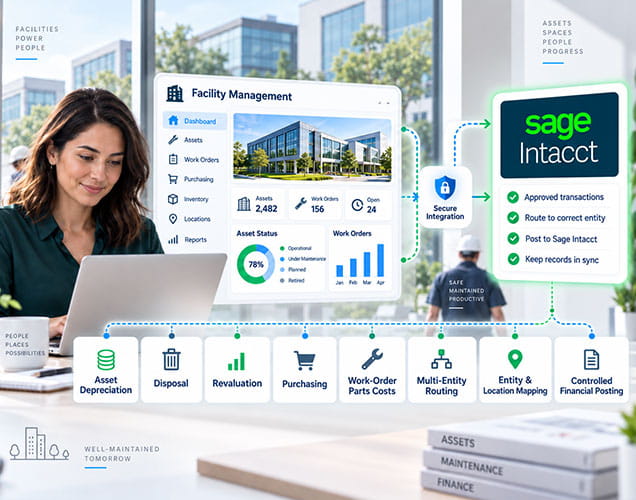
DreamzTech, a Sage Intacct integration partner, connected a multi-entity maintenance and facility management platform with Sage Intacct, creating a controlled financial data flow for asset depreciation, disposal, revaluation, purchasing and work-order parts costs. Facility-based routing automatically directed each approved transaction to the correct Sage Intacct entity and location.

  • What we built: Multi-entity Sage Intacct integration for maintenance operations
  • Industry: Fintech enablement for asset-intensive facility operations
  • Delivery: Entity-aware financial posting, secure configuration and integration controls
  • Partner status: Sage Intacct Integration Partner
Discuss Your Sage Intacct Integration
Sage Intacct Integration for Facility Management Software Case Study
Trusted By Startups, SMBs to Fortune 500 Brands

Quick Answers

  • What was integrated: A custom CMMS and facility management platform with Sage Intacct, plus a supporting Bill.com AP connection.
  • Financial processes connected: Asset depreciation, revaluation, disposal, asset receipts, work-order parts costs, general-ledger posting and purchase-receipt workflows.
  • Multi-entity routing: The platform resolved the facility on each transaction, mapped it to the configured Sage Intacct LocationID and used the corresponding entity credentials at posting time.
  • System of record: Sage Intacct. The maintenance platform remained the operational record for assets, work orders, parts, facilities and maintenance activity.
  • What changed for users: Entity selection did not need to become an extra manual step; routing was derived from the facility already associated with the transaction.

Overview

The client operates multiple legal entities and facilities in an asset-intensive environment. Its facility management software already managed work orders, assets, preventive maintenance, spare-parts inventory and purchasing. Sage Intacct handled accounting and fixed-asset financial records, while Bill.com supported accounts-payable workflows.

The original integration was designed for a single financial configuration. As the organization expanded, the same maintenance event could no longer be sent through one global set of credentials and one fixed location. The client needed an integration that could determine the correct financial destination from the facility already associated with the asset, work order, purchase order or receipt - without asking operational users to choose an accounting entity manually.

The Challenges

  • One global financial configuration could not support multiple legal entities.
  • Maintenance transactions needed the correct Sage Intacct LocationID and credentials.
  • Asset and work-order financial events followed different posting paths.
  • Existing live maintenance workflows had to remain unchanged.
  • Credentials, failures and posting history required stronger control and traceability.

Responsibility Boundary

The maintenance platform supplies operational facts and triggers. Sage Intacct remains responsible for the accounting ledger and financial reporting. The integration connects the records; it does not turn the CMMS into a replacement ERP.

How the Sage Intacct Integration Works

The integration uses a controlled posting pipeline in which facility context, entity configuration and Sage Intacct integration each have a defined role, extending the platform's existing CMMS ERP integration approach.

Solutions Delivered

As a Sage Intacct integration partner, DreamzTech combines financial-integration experience with hands-on knowledge of maintenance, facility, asset, inventory and purchasing workflows. DreamzTech delivered six connected components covering entity configuration, entity-aware posting, fixed-asset integration, maintenance cost posting, purchasing/AP connectivity and security controls:

Each financial entity is configured once and reused across the platform’s existing facility structure.

  • Per-entity configuration for company and Web Services credentials, Sage LocationID, status and facility assignments.
  • Facility-to-entity relationships reused the operational structure already present in the platform.
  • Administrators could add, edit, deactivate and test one entity without disrupting other active configurations.

Posting services resolve the correct financial destination at runtime instead of relying on a single global configuration.

  • Posting services resolve the correct entity at runtime from the facility on the source transaction.
  • Global and hard-coded location values were replaced with dynamic mapping.
  • A controlled fallback and exception path prevents silent routing when facility configuration is incomplete.

Depreciation, revaluation and disposal each connect the operational asset record to its mapped Sage accounts.

  • Depreciation postings connect maintenance-side purchase cost, commissioning date, asset group, useful life and method configuration with the mapped Sage accounts.
  • Asset revaluation updates the operational schedule and sends the related financial entry through the mapped entity context.
  • Disposal workflows support mapped financial treatment and record the resulting Sage reference.

Parts cost from completed work orders reaches the general ledger without changing how maintenance teams work.

  • Parts consumed on completed work orders are translated into the configured GL journal structure.
  • The asset facility determines the financial entity and Sage LocationID.
  • Maintenance teams continue using the same work-order flow while finance receives the approved cost event.

Asset and inventory purchase receipts are routed using the same facility-based model as maintenance events.

  • Asset purchase receipts and inventory/parts receipts are routed using the facility on the purchase order.
  • Financial code, location and account configuration moves from deployment-level settings into managed entity/facility configuration.
  • Bill.com supports the related AP bill workflow as a secondary integration, with per-facility account resolution.

Credential handling and posting visibility were hardened alongside the routing logic itself.

  • Plaintext and hard-coded credentials were removed from application code and deployment configuration.
  • Credentials are stored using encrypted database fields or an approved secrets-management approach.
  • Connection tests, posting logs, status records and error details improve supportability and audit review.

Success and Outcome

The delivered Sage Intacct integration created a reliable bridge between maintenance execution and financial control. Asset and work-order events could carry their facility context into the accounting workflow, enabling the integration layer to select the correct entity, location and financial mapping automatically.

This gave operations and finance a clearer division of responsibility. Maintenance teams continued to manage assets, work orders, parts and receipts in the facility platform. Sage Intacct remained the financial system of record for general-ledger and fixed-asset accounting. The integration reduced dependency on global configuration and manual entity selection while improving security, traceability and readiness for additional entities - the same discipline behind DreamzTech's broader fintech software development practice.

Entity-Aware Posting

Maintenance and purchasing transactions are automatically directed to the Sage Intacct configuration associated with their facility.

Connected Asset Lifecycle

Acquisition-related receipts, depreciation, revaluation and disposal remain linked from the operational asset record to the financial posting.

Maintenance Cost to GL

Parts consumed on completed work orders can be translated into the correct general-ledger and location context.

No Manual Entity Choice

Operational users continue working with the facility already on the record instead of selecting an accounting entity for every transaction.

Stronger Credential Control

Entity credentials are removed from hard-coded application paths and managed through protected configuration.

Auditable Integration

Posting status, entity, transaction type, timestamp, Sage reference and error context support reconciliation and troubleshooting.

Conclusion

For asset-intensive organizations, maintenance software and accounting software answer different questions. A CMMS explains what happened to the asset, where the work was performed and which parts were used. Sage Intacct records the financial effect. The integration must preserve that distinction while connecting both sides with dependable mappings and audit trails. DreamzTech's Sage Intacct integration joined facility, asset, work-order and purchasing context with entity-aware financial posting - a more scalable pattern for managing depreciation, disposal, revaluation, maintenance cost and purchase receipts across multiple facilities and legal entities.

Leading Global Software Company

Trusted by Industry Leaders Worldwide

Trusted by startups to Fortune 500s, including DHL, Nestlé, and Stanford — partners who rely on us for high-impact, scalable software solutions.

Book a Discovery Call

    I Consent to Receive SMS Notifications, Alerts from DreamzTech US INC. Message frequency may vary. Message & data rates may apply. Text HELP for assistance. You may reply STOP to unsubscribe at any time.
    I Consent to Receive the Occasional Marketing Messages from DreamzTech US INC. You can Reply STOP to unsubscribe at any time.
    By submitting the form, you agree to the DreamzTech Terms and Policies

    Frequently Asked Questions (FAQ)

    A Sage Intacct CMMS integration connects maintenance and asset operations with accounting. The CMMS manages facilities, assets, work orders, parts and maintenance activity, while Sage Intacct remains the financial system of record for general-ledger and fixed-asset accounting.

    The maintenance platform maintains operational asset context such as purchase cost, commissioning date, asset group, useful life and depreciation configuration. The integration maps the approved depreciation entry to the correct Sage Intacct accounts, entity and LocationID and stores the returned reference.

    Yes. The delivered workflow covered revaluation and disposal posting paths as well as depreciation. Each event uses the asset’s facility and configured mappings to select the appropriate Sage Intacct destination.

    When a work order reaches the approved posting point, the integration collects the parts cost and related asset or facility context, maps it to the configured GL structure and posts it using the Sage Intacct entity and location associated with that facility.

    Each facility is mapped to a Sage Intacct entity configuration and LocationID. At runtime, the integration reads the facility on the transaction, selects the corresponding credentials and financial settings, and posts without requiring the operational user to choose an entity manually.

    No. The integration connects operational asset and maintenance activity with the financial system. Sage Intacct remains responsible for the accounting ledger and financial reporting. The exact ownership of depreciation calculation and fixed-asset records should be defined for each implementation.

    The integration should not silently guess. Missing mappings are handled as exceptions, recorded with transaction context and presented for administrative correction or controlled fallback according to the approved design.

    The delivered enhancement removed hard-coded credentials from application paths and placed entity configuration in protected storage. The implementation can use encrypted database fields or an approved secrets-management service, supported by restricted administrative access and connection testing.

    Yes. Asset and inventory purchase receipts are part of the connected financial flow. The documented solution also includes a supporting Bill.com integration that selects the correct AP account and financial codes from the purchase order’s facility.

    The documented integration uses Sage Intacct XML Web Services over HTTPS POST. Requests include Web Services and company authentication, while transaction and location context are added through the mapped posting payload.

    Yes. The configuration-led model allows authorized administrators to add or deactivate entity configurations, assign facilities and test connections. New entities still require valid Sage Intacct setup, credentials, mappings and end-to-end validation.

    DreamzTech is a Sage Intacct integration partner with experience across maintenance, assets, inventory, purchasing, general-ledger posting and accounts-payable workflows. The team can design the operational data flow and the financial mapping together instead of treating the accounting API as an isolated connector.

    Yes. DreamzTech is a Sage Intacct integration partner, combining financial-integration experience with hands-on knowledge of maintenance, facility, asset, inventory and purchasing workflows. This project was delivered by that same Sage Intacct integration team.