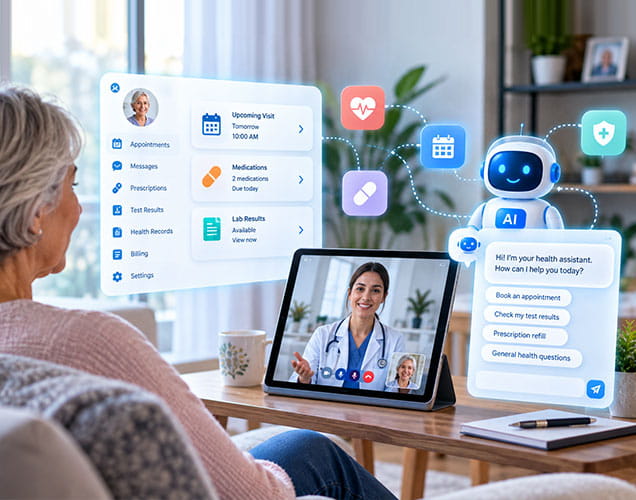
Telehealth Patient Portal with AI Chatbot for Digital Patient Engagement

Telehealth Patient Portal with AI Chatbot for Digital Patient Engagement

Healthcare Case Study

How DreamzTech built a secure digital patient-engagement platform for a U.S.-based healthcare organization, bringing patient self-service, virtual-care workflows, approved information and human-assisted support into one connected experience.

  • What we built: Telehealth patient portal with governed AI healthcare chatbot
  • Industry: Healthcare and digital health
  • Users: Patients, care teams, administrators and authorized support staff
Discuss Your Telehealth Platform
Telehealth Patient Portal with AI Chatbot for Digital Patient Engagement
Trusted By Startups, SMBs to Fortune 500 Brands

Quick Answers

DreamzTech built a secure telehealth patient portal with a governed AI healthcare chatbot for a U.S.-based healthcare organization that needed a more connected way for patients to reach virtual-care services and routine support. The platform brings appointments, forms, secure messages and approved information into one permission-aware experience.

What is a telehealth patient portal? A telehealth patient portal is a secure digital entry point where patients can access virtual-care services and approved self-service functions such as appointments, forms, messages, documents, visit preparation and follow-up tasks.

Project SnapshotDetails
ClientU.S.-based healthcare organization; name withheld under NDA
IndustryHealthcare and digital health
SolutionTelehealth patient portal with governed AI healthcare chatbot
UsersPatients, care teams, administrators and authorized support staff
Core focusPatient access, virtual-care coordination, secure communication, self-service and controlled AI assistance
Outcome approachQualitative outcomes only until client-approved measurements are available

Overview

A U.S.-based healthcare organization needed a more connected way for patients to access virtual-care services and routine support. Existing processes required patients and staff to move between separate channels for appointment requests, forms, information, messages and care-team follow-up. DreamzTech designed and developed a custom telehealth patient portal with a governed AI chatbot that makes common tasks easier to find while keeping sensitive workflows permission-aware and connected to human support.

The solution acts as a digital front door—not a replacement for clinicians. Patients can authenticate, complete approved self-service tasks, prepare for virtual visits and receive administrative guidance. The AI layer answers within an approved knowledge boundary, communicates its limitations and escalates situations that require staff, clinical or emergency attention. This work reflects DreamzTech's broader custom healthcare software development practice.

The Challenge

Delivering connected virtual care meant solving fragmentation, safety boundaries and compliance together.

The Solution

DreamzTech delivered a modular telehealth patient portal that combines secure patient access, configurable virtual-care workflows, governed conversational assistance, approved integrations and administrative oversight. The platform can evolve by workflow and service line without making the AI chatbot the system of record or a clinical decision-maker.

  • Supports identity-aware registration, authentication, consent capture and role-appropriate access.
  • Creates a controlled entry point for sensitive patient workflows.
  • Brings appointments, forms, documents, messages and approved information into one portal experience.
  • Reduces navigation friction and avoidable administrative contacts.
  • Supports configurable pre-visit steps, reminders, waiting-room flow, virtual consultation access and follow-up tasks.
  • Makes the virtual-care journey easier to understand and manage.
  • Answers approved administrative questions, guides navigation, collects limited workflow context and routes requests.
  • Provides consistent support without representing AI as a clinician.
  • Approved scope: Focuses on navigation, FAQs, appointment support, preparation guidance and approved patient education.
  • Knowledge grounding: Retrieves from reviewed content and approved data sources instead of relying only on unrestricted model memory.
  • Permission awareness: Uses only the minimum data required for the permitted workflow and authenticated user context.
  • Transparent limits: Tells users it is an automated assistant and does not replace professional medical advice, diagnosis or emergency services.
  • Escalation rules: Routes clinical, ambiguous, sensitive, urgent or unresolved requests to the correct human channel.
  • Operational governance: Supports versioned content, response evaluation, audit logging, monitoring and change approval.
  • LLM-agnostic design: Keeps business rules, knowledge, security and orchestration separable from a single model provider where architecture permits.
  • Transfers unresolved, sensitive, clinical or high-risk interactions to the appropriate staff path with available context.
  • Keeps people accountable for decisions requiring judgment.
  • Connects approved systems through APIs and, where applicable, healthcare interoperability standards.
  • Reduces duplicate entry and supports connected workflows.
  • Validates identity, authorization and purpose before exchanging data.
  • Maps and validates required fields instead of transferring unnecessary data.
  • Handles errors, retries, reconciliation and duplicate events explicitly.
  • Logs integration events without exposing sensitive payloads to unauthorized users.
  • Separates operational analytics from clinical source-of-truth records.
  • Manages content, intents, permissions, routing, configuration, audit events and operational reporting.
  • Gives the organization governance and visibility.

Security, Privacy, Compliance and AI Governance

The platform was designed to support HIPAA-compliant operations through configurable administrative, technical and organizational safeguards. DreamzTech does not describe the platform, chatbot or organization as “HIPAA certified,” “guaranteed compliant” or “the AI is HIPAA compliant.” HIPAA compliance depends on the covered entity or business associate, the actual configuration, policies, workforce practices, contracts, vendors, data flows and ongoing risk management—not software features alone.

AreaRecommended Language
HIPAA Privacy and SecuritySupports access control, minimum-necessary workflows, auditability and safeguards for ePHI.
Business associatesThird parties handling PHI are subject to vendor review and appropriate agreements.
Breach readinessLogging, incident procedures and notification responsibilities support response planning.
Telehealth privacyRemote-care workflows include privacy notices, secure access and patient education considerations.
InteroperabilityApproved data exchange can use APIs and healthcare standards where confirmed.
AccessibilityThe experience should target WCAG 2.2 AA and applicable accessibility obligations.
NondiscriminationLanguage access and accessible communication are considered based on population and obligations.
Consumer health dataNon-HIPAA data flows are assessed for FTC and state-law obligations as applicable.

Security and Privacy Safeguards

  • Identity and access: Strong authentication, role-based authorization, session controls and privileged-access review.
  • Encryption: Protect data in transit and at rest with managed keys and controlled secrets.
  • Minimum necessary: Limit collection, retrieval, model context, disclosure and retention to the permitted purpose.
  • Auditability: Record authentication, access, configuration, content, escalation and integration events with protected logs.
  • Data lifecycle: Define retention, deletion, export, backup and legal-hold requirements by data class.
  • Vendor governance: Evaluate cloud, communications, analytics and AI vendors; execute appropriate agreements before PHI use.
  • Secure engineering: Use threat modeling, dependency management, code review, vulnerability testing and release controls.
  • Incident readiness: Maintain detection, containment, evidence preservation, escalation and notification procedures.
  • Tracking controls: Do not disclose PHI through pixels, session replay, analytics or advertising technologies without a lawful, reviewed basis.

AI-Specific Safeguards

  • Scope control: Restrict the assistant to approved tasks; clinical decision support requires separate validation and governance.
  • Emergency handling: Display emergency limitations and route urgent or crisis language to approved resources and human workflows.
  • Human oversight: Keep accountable people in the loop for clinical, coverage, treatment, safety and exception decisions.
  • Grounding and provenance: Use reviewed knowledge, source attribution where helpful and version-controlled content.
  • Evaluation: Test factuality, refusal behavior, escalation, bias, multilingual quality and accessibility before and after release.
  • Adversarial protection: Test prompt injection, data exfiltration, cross-user leakage, unsafe tool use and malicious attachments.
  • Monitoring: Track unanswered intents, overrides, complaints, safety triggers and model or content changes.
  • Disclosure and consent: Explain automated assistance, data use and escalation in clear patient-facing language.

Telehealth licensure, informed consent, prescribing, reimbursement, record retention and scope-of-practice requirements vary by jurisdiction and service. Specialized legal, clinical and security review is completed before publishing or deploying claims related to controlled-substance prescribing, clinical triage, medical-device functions or automated recommendations.

How the Platform Works

From secure entry to human follow-up, here's how patients and staff move through the telehealth portal.

Success and Outcomes

The new platform created a clearer digital front door for virtual care. Patients gained a more consistent way to find approved information, complete routine tasks and reach the right support channel. Care and administrative teams gained configurable workflows, governed content, escalation paths and better operational visibility. The modular architecture also created a foundation for adding services and integrations without rebuilding the patient experience around a single vendor or model.

Patient Access

Simplified navigation across common virtual-care and self-service tasks.

Support Consistency

Centralized approved answers and routing logic for routine administrative questions.

Staff Focus

Reduced avoidable manual touchpoints where patients could complete approved self-service actions.

Safety

Created explicit boundaries, notices and escalation routes for clinical, urgent and unresolved requests.

Governance

Improved control over content, permissions, workflow configuration and audit visibility.

Scalability

Established a modular foundation for new service lines, integrations and AI capabilities.

Why DreamzTech

DreamzTech combines custom healthcare software engineering, patient-experience design, systems integration and practical AI governance. We build modular platforms around the organization's workflows, users and risk boundaries—then design for secure integration, human accountability and future change from the beginning.

Planning a patient portal, telehealth workflow or governed healthcare chatbot? Contact DreamzTech to talk through your architecture, integration, privacy and AI-safety requirements.

Build a Secure Telehealth and Patient Engagement Platform

Planning a patient portal, telehealth workflow or governed healthcare chatbot? Talk with DreamzTech about the architecture, integration, privacy and AI-safety requirements for your use case.

Leading Global Software Company

Trusted by Industry Leaders Worldwide

Trusted by startups to Fortune 500s, including DHL, Nestlé, and Stanford — partners who rely on us for high-impact, scalable software solutions.

Book a Discovery Call

    By submitting the form, you agree to the DreamzTech Terms and Policies

    Frequently Asked Questions (FAQ)

    DreamzTech built a custom telehealth patient portal with patient self-service, virtual-care workflows, secure communication, administrative controls, approved integrations and a governed AI healthcare chatbot for a U.S.-based healthcare organization.

    A telehealth patient portal is a secure digital entry point where patients can access virtual-care services and approved self-service functions such as appointments, forms, messages, documents, visit preparation and follow-up tasks.

    The chatbot supports approved administrative tasks such as navigation, common questions, appointment guidance, preparation instructions and routing. It works within defined knowledge, permission and escalation rules.

    No. In this case-study positioning, the chatbot is not presented as a clinician and does not independently diagnose, prescribe or make treatment decisions. Clinical and safety-sensitive questions are routed to qualified people or approved emergency pathways.

    No chatbot is automatically HIPAA compliant. Compliance depends on the organization, use case, configuration, policies, access controls, data handling, vendor relationships, business associate agreements, risk management and ongoing operations. The platform can be designed to support HIPAA-compliant workflows.

    The design can apply strong authentication, role-based access, encryption, minimum-necessary data use, audit logging, retention controls, secure integration and incident-response processes. The deployed safeguards must be validated against actual data flows.

    A business associate agreement may be required when a vendor creates, receives, maintains or transmits PHI on behalf of a covered entity or another business associate. Each vendor and subcontractor relationship should be reviewed before PHI is introduced.

    It should clearly state that it is not an emergency service, detect defined urgent or crisis signals, provide approved instructions and escalate to an appropriate human or emergency pathway. Final behavior must be reviewed by the healthcare organization.

    Yes. A portal can connect with approved EHR and clinical systems through APIs and, where appropriate, HL7 or FHIR. The exact data, direction, standard, version and source-of-truth rules depend on the confirmed integration scope.

    Yes. Configurable scheduling, appointment requests, reminders, pre-visit forms and visit-preparation workflows can be included, subject to integration and operational requirements.

    The platform can support translated content, language-aware workflows and accessible interaction patterns. Teams should test with target users and assistive technologies and avoid claiming conformance until the evidence supports it.

    Approved source content should be reviewed, versioned and assigned owners. Retrieval, response evaluation, escalation, feedback and monitoring help teams identify outdated information or unsupported answers.

    The platform uses configured intent, risk, confidence and workflow rules to route unresolved, clinical, sensitive or urgent interactions to an authorized team. Relevant context can be transferred within permission and minimum-necessary limits.

    Analytics, pixels, session replay and advertising tools can create privacy risk when they receive health information. Organizations should map every disclosure and review HHS, FTC and applicable state requirements before enabling tracking.

    It can be designed to be LLM-agnostic by separating business rules, approved knowledge, orchestration, security and evaluation from the underlying model. Actual portability depends on the final architecture and vendor capabilities.

    Useful measures include activation, task completion, appointment outcomes, approved-intent containment, escalation quality, staff handling time, patient feedback, accessibility findings, integration reliability and security events. Definitions and baselines should be agreed before reporting results.