Sports Sponsorship, Fundraising & NFT Fintech Platform Case Study

Sports Sponsorship, Fundraising & NFT Fintech Platform Case Study

Fintech Case Study

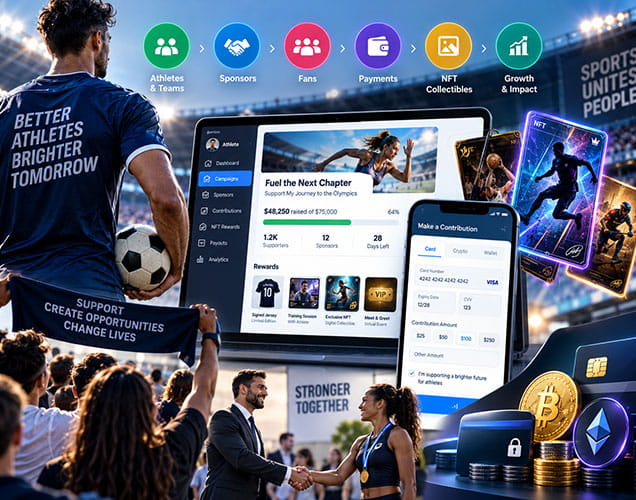
DreamzTech delivered a production sports fintech platform where athletes and teams can raise funds, sponsors can commit through milestone-based wallet payments, fans can contribute by card or cryptocurrency, and verified digital collectibles can be imported, traded and attached to campaigns as rewards.

  • What we built: A unified sponsorship, fundraising, payments and NFT marketplace platform
  • Who it serves: Athletes and teams, sponsors, fans and platform administrators
  • Where it runs: Responsive web, iOS and Android applications
  • Fintech foundation: Prefunded wallet balances, holds and captures, tokenized card payments, verified crypto contributions and controlled payout workflows
Discuss Your Fintech Platform
Sports Sponsorship, Fundraising & NFT Fintech Platform Case Study
Trusted By Startups, SMBs to Fortune 500 Brands

Quick Answers

  • What problem did the platform solve? It brought fragmented campaign, sponsor, payment, NFT and community workflows into one governed product.
  • How were long-term sponsorship commitments funded? Sponsors topped up a platform wallet; each commitment placed funds on hold and released them at defined milestones.
  • Which payment methods were supported? Tokenized card payments, a signed redirect gateway, independently verified on-chain crypto contributions and bank batch exports for payouts.
  • How did NFT trading work? Users discovered assets from connected wallets, imported verified inventory, created fixed-price listings and completed eligible purchases through a Solidity marketplace contract or a retained legacy path.
  • What was delivered? A production platform spanning web, iOS and Android, with role-based administration, trust controls, marketplace integrity safeguards and full JSON APIs.

Overview

The client needed more than a sports crowdfunding platform. The product had to coordinate three connected economies: fundraising from fans, milestone-based sponsorship commitments and a digital-collectibles marketplace. Each economy had its own payment state, ownership rules, exceptions and administrative controls, yet users expected one clear experience.

DreamzTech designed and delivered a production platform that unified those workflows without collapsing their financial boundaries. Campaign contributions, sponsor wallet holds and NFT purchases remain distinct transactions, while shared identity, moderation, messaging, master data and administration connect the experience across web and mobile.

The Challenges

  • Long-duration sponsor commitments.
  • Card, crypto and payout rails.
  • Real-wallet NFT discovery.
  • Marketplace settlement and concurrency.
  • Campaign reward flexibility.
  • Trust across four user roles.

The Solution DreamzTech Delivered

DreamzTech delivered eight connected components spanning fundraising, sponsorship, payments, NFT inventory, marketplace settlement, campaign rewards, administration and security hardening:

Athletes and teams can create public or private campaigns with a goal, category, location and a transparent allocation plan. Training, equipment and player-pool allocations must total 100% before launch. Campaigns can accept card payments, cryptocurrency or both, while administrators can review transactions and prepare payout batches.

Sponsors fund a wallet once and use its available balance to make offers. When a sponsorship is approved, the committed amount moves to an on-hold balance. A milestone release captures the relevant amount, a failed milestone returns it to available funds, and the beneficiary balance becomes eligible for withdrawal. This architecture supports longer commitments without relying on expiring card authorizations.

Offers move through a defined state model – Pending, Submitted and Approved – with explicit Dispute, Failed and Cancelled branches. An activity log records transitions, and administrators hold final authority for disputes and payouts.

  • Tokenized card gateway: Saved customer profiles are used so raw card data does not reach the platform application.
  • Signed redirect gateway: JWT-signed requests reduce tampering risk, while the gateway webhook remains the transaction source of truth.
  • Direct crypto contributions: The platform checks the submitted transaction against blockchain RPC nodes before recording the donation.
  • Payout operations: Approved withdrawals are organized into the bank’s required batch format with configured reference masters.

The platform scans a connected wallet through Rarible, with OpenSea v2 as a fallback, across six supported EVM networks and test environments. Users can bulk-import discovered assets or add a contract address and token ID manually. The inventory captures contract, token ID, collection, image, chain, token standard, royalty and creator-wallet details.

At import, direct JSON-RPC reads check ERC-721 ownership with ownerOf or ERC-1155 balances with balanceOf. A composite duplicate rule prevents an active asset from being imported twice by the same user. RPC failures are logged and currently follow an availability-first, fail-open policy; that boundary should remain visible in technical documentation.

The marketplace provides public browsing, search, filters, sorting and listing details. Sellers select an inventory NFT, a supported listing currency and administrator-managed category and rarity values. Creator identity and wallet details are retained from the first listing so eligible secondary-sale royalties can be calculated consistently.

For on-chain listings, the Solidity contract exposes list, buy and delist functions. A buy settles the seller amount, secondary-sale royalty and platform fee atomically. The default platform fee is 2.5% and administrators can adjust it up to a 10% hard limit; royalties are constrained to 0-10%. Non-reentrant purchase logic, emergency pause capability and server-side row locking reduce contract and concurrency risk.

The platform retains a legacy direct-transfer path for older listings. Its server record uses a submitted transaction hash without independently validating mining and transfer validity at purchase time. This known gap should be closed before the next high-volume marketplace release and must not be described as fully verified.

Campaigns can use two distinct reward models. A reward tier represents a future instant- or lazy-mint promise with price, quantity, royalty, blockchain and notes. An attached inventory reward represents a specific NFT already owned by the campaign creator; authorization is checked and a campaign can attach up to 50 inventory items. A campaign may use either model, both or neither.

Administrators manage user approvals, identity-document review, sensitive profile changes, master data, role permissions, content moderation, disputes, payout batches and transaction oversight. Text moderation first checks a configurable dictionary and then uses Azure OpenAI. If the AI service is unavailable, messaging continues with reduced moderation quality – an intentional fail-open choice that should be monitored operationally.

DreamzTech used written product requirements, API contracts, weekly status reporting and a four-gate delivery model: Investigate, Plan, Execute and Verify. An independent code review identified critical, high and medium findings. Remediation included reentrancy protection, emergency pause capability, row locking, direct ownership reads, royalty limits, route ownership checks, fail-closed permissions, recursive log masking, key rotation, token invalidation and dependency triage.

How the Platform Works

Five workflows carry a transaction from user action to a recorded, auditable result.

Technology Architecture

The delivered platform is a JSON-API-first system spanning application, data, blockchain and payment layers:

LayerDelivered Technology and Responsibility
ExperienceResponsive web application, native iOS experience and Android application
Application/APILaravel / PHP services with a JSON API mirrored across web and mobile clients
DataMySQL for users, campaigns, sponsorship states, wallet ledger, inventory, listings and administration
BlockchainSolidity marketplace contract, Hardhat toolchain and JSON-RPC ownership/transaction reads
NFT DiscoveryRarible API with OpenSea v2 fallback
PaymentsTokenized card gateway, signed JWT redirect integration, webhooks, direct-chain verification and bank batch export
Cloud/AIAzure services and Azure OpenAI-assisted moderation

Responsibility and Integrity Boundaries

The maintenance platform supplies operational facts and triggers; here is what should - and should not - be claimed about each area publicly:

AreaSystem BehaviorBoundary to State Publicly
Sponsor moneyPrefunded balance with available, on-hold and released statesNot a recurring subscription and should not be called regulated escrow without legal confirmation.
Card paymentsTokenized gateway; webhook is source of truthDo not claim raw card handling or PCI scope beyond the documented tokenized flow.
Crypto contributionsRPC verification before donation recordVerification depends on supported networks and configured nodes.
NFT ownership importDirect ERC-721/ERC-1155 readRPC error currently fails open after logging.
Smart-contract saleAtomic transfer and settlement for contract listingsConfirm hardened-contract redeployment status before claiming the remediated contract is live.
Legacy NFT saleWallet-to-wallet path for older listingsSubmitted transaction hash is not independently verified at purchase time.

Success and Outcomes

The engagement produced a production platform and a reusable fintech architecture for sports sponsorship, fundraising and digital collectibles. Because no approved commercial KPIs were supplied, the outcomes below are documented capabilities - not estimates of revenue, adoption or ROI.

Production Web, iOS and Android Platform

Athletes, sponsors, fans and administrators can use role-appropriate journeys across channels.

Three Integrated NFT Subsystems

Wallet inventory, marketplace trading and campaign rewards operate as connected but distinct capabilities.

Six EVM Networks Plus Testnets

Wallet discovery and import can serve a multi-chain audience within the documented EVM scope.

Milestone Sponsor Wallet

Long-term commitments can reserve and release prefunded balances without depending on expiring card holds.

Card and Verified Crypto Contributions

Campaigns can accept familiar and blockchain-native payment methods with different verification paths.

Configurable Marketplace Economics

A default 2.5% platform fee, 10% hard fee cap and constrained secondary royalties create explicit settlement rules.

Security Review and Remediation Program

Critical payment, contract, authorization, logging and dependency risks were identified and addressed through a documented hardening process.

Closing Thoughts

This case study shows how DreamzTech can engineer a fintech product where sponsorship commitments, fundraising payments, crypto verification, marketplace settlement and digital rewards share one experience without losing their operational boundaries. The result is a clearer platform for sports communities and a stronger control model for administrators. Planning a sports fintech, Web3 marketplace or NFT marketplace development project? DreamzTech can help define the money flow, ownership model, smart-contract boundary, user journeys and operational controls before development begins.

Leading Global Software Company

Trusted by Industry Leaders Worldwide

Trusted by startups to Fortune 500s, including DHL, Nestlé, and Stanford — partners who rely on us for high-impact, scalable software solutions.

Book a Discovery Call

    By submitting the form, you agree to the DreamzTech Terms and Policies

    Frequently Asked Questions (FAQ)

    It is a digital platform that combines sports fundraising or sponsorship workflows with payment infrastructure and digital-collectible capabilities. In this project, the product connected athlete campaigns, sponsor wallet commitments, card and crypto contributions, NFT inventory, fixed-price trading and campaign rewards.

    A sponsor funds a platform wallet, then an approved sponsorship places the committed amount on hold. Each milestone release captures the relevant amount for the beneficiary. If a milestone fails, the held amount can return to the sponsor’s available balance. These are discrete milestone payments, not recurring subscription charges.

    Card authorization holds typically expire within days, while sports sponsorships can last for months. A prefunded wallet lets the platform track available, held and released balances over the commitment period without depending on an expiring authorization.

    Yes. The delivered platform supports tokenized card payments and direct on-chain cryptocurrency contributions. Card results rely on gateway webhooks, while crypto contributions are checked against configured RPC nodes before the donation is recorded.

    The platform scans supported EVM networks through Rarible with an OpenSea v2 fallback, then lets the user choose assets to import. It records metadata and performs ERC-721 ownerOf or ERC-1155 balanceOf reads. Import creates an inventory record; it does not transfer custody of the NFT.

    For contract-based listings, the Solidity contract lists, sells and delists NFTs. Its purchase flow transfers the NFT and distributes seller proceeds, an eligible creator royalty and the platform fee atomically. The contract also includes non-reentrant purchase logic and emergency pause capability.

    The documented default marketplace fee is 2.5%, adjustable by an administrator up to a 10% hard cap. Creator royalties are constrained to 0-10% and apply only to eligible secondary sales. The platform records the item price, fee, royalty and seller net for each completed sale.

    A campaign can offer a future instant- or lazy-mint reward tier, attach a specific NFT already owned by the creator, use both models, or use neither. Inventory-backed rewards enforce ownership and attachment rules; mint promises remain a separate future-delivery model.

    The production platform provides distinct journeys for athletes and teams, sponsors, fans and administrators. It is available through a responsive web experience plus iOS and Android applications.

    Administrators review identity documents and sensitive profile changes, manage role permissions and master data, and hold final authority over sponsorship disputes and payouts. Messaging uses a configurable dictionary followed by Azure OpenAI-assisted moderation, with a documented fail-open behavior if the AI service is unavailable.

    The hardening program included non-reentrant contract logic, emergency pause capability, database row locking, direct ownership reads, royalty clamps, route ownership restrictions, fail-closed permissions, recursive log masking, key rotation, token invalidation and dependency triage.

    The marketplace supports fixed-price sales on EVM-family networks. The documented scope does not include auctions, offers, watchlists, bundles, collection pages, price history, stablecoin checkout or a fiat on-ramp for NFT purchases. A legacy direct-transfer path also needs independent transaction verification before a higher-volume release.

    Yes. The reusable parts include wallet-ledger states, milestone holds and releases, tokenized and on-chain payment rails, NFT inventory rules, marketplace settlement, role-based administration and audit controls. The final design should be tailored to the target jurisdictions, custody model, payment providers and blockchain networks.