AI-Powered Retail POS System with FinTech Integration

AI-Powered Retail POS System with FinTech Integration

Case Study

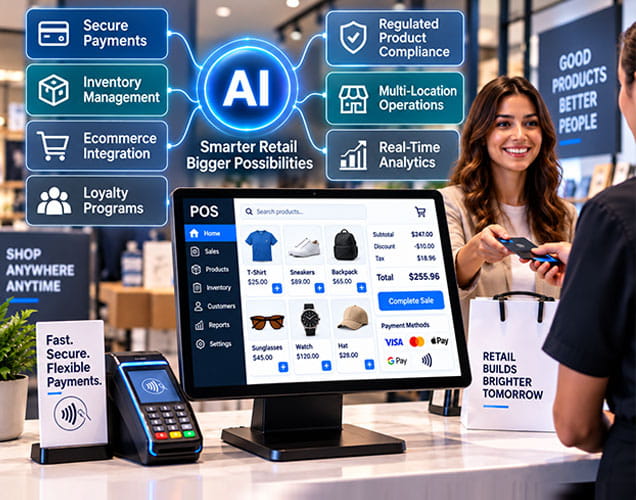
DreamzTech built a cloud-based retail POS platform for a US-based merchant technology company. The system connects checkout, embedded payments, inventory, ecommerce, loyalty, regulated-product compliance and multi-location operations, with AI-assisted analytics and automation for faster, better-informed retail decisions. The platform complements DreamzTech's restaurant POS system case study, built for a different set of operating workflows.

  • What we built: AI-powered retail POS and FinTech platform
  • Industry: FinTech, retail technology and commerce enablement
  • Delivery: Checkout, payments, inventory, ecommerce, compliance and AI-assisted operations
Discuss Your Retail POS Project
AI-Powered Retail POS System with FinTech Integration
Trusted By Startups, SMBs to Fortune 500 Brands

Quick Answers

  • Platform: A unified retail POS system connecting sales, payments, inventory, customers, compliance and online commerce.
  • Retail formats: Convenience, liquor, smoke and vape, grocery, apparel and general merchandise.
  • Operating model: Cloud-based control across single stores, multi-location retailers and franchise networks.
  • FinTech scope: Processor-agnostic payment integration, EMV/NFC/contactless workflows, split tender, refunds, gift cards, reconciliation and accounting export.
  • AI scope: Six named modules for business intelligence, inventory, marketing creative, social automation, sentiment analysis and workforce optimization.
  • Control model: Human approval, explainable recommendations, override tracking and responsible-AI safeguards are included in the documented design.

Overview

A US-based merchant technology company needed one retail commerce platform that could adapt to very different operating models. A convenience store prioritizes speed and lottery reconciliation; a liquor or smoke shop requires age-control workflows; a grocery business needs weighed items, batch and expiry management; and an apparel retailer depends on variants, returns and customer history.

DreamzTech designed a modular retail point of sale platform spanning 27 functional modules and more than 237 documented capabilities. It synchronizes data across the POS, Merchant Admin, a merchant mobile app and an online storefront, while supporting location-specific policies and centralized enterprise control.

The solution is also a FinTech platform. Payments, refunds, store credit, loyalty value, gift cards, tax, end-of-day reconciliation and accounting exports are designed as connected financial workflows instead of isolated checkout features - the same discipline behind DreamzTech's broader FinTech software development practice.

Challenges

  • Fragmented checkout, inventory, ecommerce, customer and accounting workflows made store operations harder to control.
  • Different retail verticals required different product, pricing, fulfillment and regulatory rules without maintaining separate platforms.
  • Multi-location operators needed central catalog and brand governance while preserving store-level pricing, inventory, tax and operating independence.
  • Complex product data - variants, packs, cases, weighed items, serial numbers, age restrictions and supplier relationships - had to remain usable at checkout.
  • Retail payments required flexible tendering, digital wallets, refunds, deposits, gift cards, loyalty redemption and reliable reconciliation.
  • Regulated products required age verification, restricted selling hours, quantity rules, audit trails and controlled overrides.
  • Retail teams needed usable insight from sales, inventory, margin, customer and feedback data rather than more disconnected reports.
  • AI recommendations required human review, explainability, confidence visibility and safeguards before operational action.

How the Retail POS Platform Works

The platform coordinates retail operations through six connected stages.

Solutions Delivered

DreamzTech delivered eight connected components covering checkout, payments, inventory, omnichannel commerce, loyalty, regulated retail, multi-location management and reporting:

The checkout and catalog model adapts to multiple retail formats without fragmenting the platform.

  • Barcode scan, search, favorites and Quick Sale workflows for faster item entry.
  • Standard, variant, bundle, digital, service, weighed and serialized product types.
  • Size, color, flavor and other matrix attributes for apparel and specialty retail.
  • Multi-barcode, UPC, SKU, PLU and pack/case unit-of-measure support.
  • Hold and recall, multiple carts, returns, exchanges, quotes, layaway and special orders.
  • Receipt delivery by print, SMS, email or digital channel.

Financial workflows are connected to the sale, customer record, reconciliation process and accounting handoff.

  • Cash, credit/debit, mobile wallet, gift card, store credit and loyalty tender support, with EBT/SNAP and BNPL where applicable.
  • EMV, NFC and contactless terminal integration through a processor-agnostic approach.
  • Split tender, multiple cards, partial payments, deposits, refunds, cash-back and applicable tips.
  • Physical and electronic gift-card issuance, activation, reload, redemption and liability reporting.
  • Offline transaction handling with synchronization after connectivity returns.
  • X/Z reports, cash-drawer balancing, card-batch totals and variance reporting for end-of-day reconciliation.
  • QuickBooks export and optional multi-currency or crypto/token payment workflows.
  • The architecture supports secure, PCI-aligned payment workflows; certification scope is verified per processor and terminal combination before any certification claim is published.

The inventory layer connects product movement, replenishment and financial visibility across stores and storage areas.

  • Real-time stock by location and storage type, including backroom, shelf and cooler.
  • Manual and low-stock-triggered purchase orders, full or partial receiving and landed-cost support.
  • Two-step transfers with dispatch, in-transit and receiving status.
  • Cycle counts, full stocktakes and barcode-supported receiving, counting and transfers.
  • Batch/lot, serial, expiry and shelf-life tracking with FIFO, FEFO, LIFO, weighted-average and manual strategies.
  • Low-stock, reorder, near-expiry, wastage and shrinkage monitoring with role-based adjustment approval.

The POS, online storefront and order-management dashboard share commerce data instead of operating as separate systems.

  • Synchronized online catalog, price, promotion and inventory information.
  • Online payment and order capture with buy online/pick up in store, curbside, shipping and local delivery workflows.
  • Order status, customer notifications and fulfillment control across locations.
  • SEO-friendly product and category page support for the integrated storefront.
  • Channel-level pricing and reporting with a unified view of in-store and online performance.

Retailers can manage value, promotions and communications from a connected customer and transaction history.

  • Spend-, visit-, product- and category-based loyalty programs with tiers and customer groups.
  • Points, free items, item discounts, birthday rewards and anniversary offers.
  • Base, location, channel, wholesale and dual-pricing rules.
  • BOGO, bundles, mix-and-match, quantity breaks, coupons, scheduled promotions and manager markdowns.
  • Customer profiles, purchase history, house accounts, store credit and recommendations.
  • Consent-controlled SMS and email campaigns, with Twilio 10DLC-oriented workflows documented in the specification.

Liquor, smoke/vape and other age-restricted workflows are built into checkout and fulfillment.

  • Driver-license PDF417 scan with date-of-birth parsing and automatic age calculation.
  • Manual date-of-birth fallback, ID validity/expiry checks and configurable minimum-age rules.
  • Restricted selling hours, quantity limits and block/override behavior with reason capture.
  • Age verification at delivery or curbside handoff.
  • Lottery ticket/book activation, sales, payouts, settlement, commission and daily reconciliation.
  • Role-based access, user activity logs and audit trails for voids, refunds, discounts and adjustments.

Central teams gain visibility and governance while stores retain approved operational independence.

  • Central catalog and brand control with product-to-location assignment and catalog push.
  • Per-location inventory, prices, taxes, operating hours, receipt templates and device configuration.
  • Location grouping, cross-location permissions, royalty/fee support and consolidated reporting.
  • Native iOS/Android merchant mobile app for dashboards, stock, products, reports, alerts and mobile approvals.
  • Multi-location switch, consolidated view and push notifications for stock and sales events.
  • Multi-language POS, admin and storefront workflows with offline language cache and location defaults.

Operational and financial data is organized into role-appropriate dashboards and reports.

  • Sales analysis by product, category, cashier, register, location and time period.
  • Stock on hand, valuation, movement, aging, wastage and shrinkage reporting.
  • Tax, dual-pricing, margin, promotion, loyalty and reconciliation reporting.
  • Store-to-store and channel-to-channel comparisons for multi-location operators.
  • Custom and scheduled exports to CSV, Excel and PDF.
  • Integrations for payments, accounting, tax, hardware, ecommerce, messaging and social workflows.

AI-Powered Retail Intelligence

The documented platform adds AI as a decision and workflow layer above the connected retail data model. Recommendations remain reviewable and controllable by authorized users. DreamzTech's AI software development team designs each module with an explicit human-control point, the same approach behind DreamzTech's AI-enabled inventory management work.

Success and Outcomes

The custom retail POS system gives store teams a single operational model for sales, inventory, customers, offers and financial workflows. It reduces the structural gaps created when checkout, ecommerce, loyalty and back-office systems are managed as unrelated tools.

Unified Retail Operations

Checkout, product, inventory, customer, payment and online-order workflows operate on one connected platform.

Faster Store Execution

Barcode-supported checkout, receiving, counting and transfers reduce manual handoffs across daily retail tasks.

Inventory Visibility

Location, storage, batch, serial, expiry, purchase and transfer records create a traceable stock position.

Flexible Retail FinTech

Multiple tenders, refunds, gift cards, store credit, offline handling and reconciliation support varied payment journeys.

Omnichannel Consistency

Shared catalog, inventory, pricing, promotion and order data connect in-store and online sales.

Regulatory Control

Age prompts, ID validation, selling rules, audit trails and override reasons support controlled restricted-product sales.

Multi-Location Governance

Central catalog and reporting coexist with authorized local pricing, stock, tax and operating control.

Actionable Intelligence

Dashboards and human-controlled AI turn connected retail data into forecasts, alerts, recommendations and content workflows.

Conclusion

This retail POS case study demonstrates DreamzTech's ability to combine commerce operations and FinTech workflows in one custom platform. The solution supports multiple retail verticals, connected payments, real-time inventory, omnichannel fulfillment, loyalty, regulated-product controls, enterprise reporting and AI-assisted decision support without removing human oversight. For retailers and merchant technology providers, the result is a modular foundation that can adapt to new locations, channels, payment partners, product categories and intelligent workflows as the business grows. DreamzTech can build custom retail software around a retailer's store model, payment relationships, ecommerce stack, compliance requirements and AI roadmap, drawing on the same custom software development practice behind this platform.

Leading Global Software Company

Trusted by Industry Leaders Worldwide

Trusted by startups to Fortune 500s, including DHL, Nestlé, and Stanford — partners who rely on us for high-impact, scalable software solutions.

Book a Discovery Call

    I Consent to Receive SMS Notifications, Alerts from DreamzTech US INC. Message frequency may vary. Message & data rates may apply. Text HELP for assistance. You may reply STOP to unsubscribe at any time.
    I Consent to Receive the Occasional Marketing Messages from DreamzTech US INC. You can Reply STOP to unsubscribe at any time.
    By submitting the form, you agree to the DreamzTech Terms and Policies

    Frequently Asked Questions (FAQ)

    A retail POS system connects checkout with products, prices, inventory, payments, customers, returns and reporting. This custom platform also connects ecommerce, regulated-product controls, gift cards, loyalty and multi-location management.

    Barcode workflows support item lookup at checkout and can also be used for receiving, inventory counts, stock transfers and serialized products. This reduces duplicate entry while keeping product movement tied to the central inventory record.

    Central teams can control the catalog, roles and consolidated reporting, while each location can maintain approved prices, inventory, taxes, hours, devices and fulfillment settings. The merchant mobile app provides location switching and a consolidated view.

    The documented platform supports offline and suspended-sale workflows, including store-and-forward handling for supported payment configurations. Data synchronizes after connectivity returns; the exact payment behavior depends on the processor and certified terminal setup.

    Yes. The platform includes age-restricted product flags, ID scanning, date-of-birth calculation, expired-ID and underage blocking, restricted hours, quantity rules, delivery handoff verification and compliance logs.

    It connects tender capture, split payments, refunds, gift cards, loyalty value, cash drawers, card batches, tax and variance reporting. Accounting data can be exported to QuickBooks, subject to the configured integration.

    The POS and online storefront share catalog, inventory, pricing, promotions, payments, customers and order status. Retailers can support pickup, curbside, shipping and local delivery while managing fulfillment from a connected dashboard.

    AI can forecast demand by product and location, recommend reorder points, identify stock-out or overstock risk, detect anomalies and propose replenishment timing. Purchase orders and stock adjustments remain subject to human approval.

    The specification defines six named AI modules: business analytics, inventory management, marketing creative, social media automation, feedback and sentiment analysis, and staff scheduling and training. Each includes human review or approval controls.

    Yes. The modular architecture supports different product structures, tenders, pricing rules, devices, locations, integrations and compliance workflows. Final scope depends on the retailer, payment partners, jurisdictions and operational requirements.

    The specification includes PCI-oriented security controls, tokenization and P2PE-related workflows. Certification must be verified for the exact solution scope, processor, gateway and terminal environment before a public certification claim is made.