Your company is already using AI. You have a chatbot that answers customer questions, a model that scores leads, maybe a dashboard that surfaces anomalies before your ops team even notices them. And yet, the business still runs on human handoffs. Someone still has to read the AI’s output, decide what to do, open another system, and execute. That gap — between AI that advises and AI that acts — is costing you more than you think. McKinsey estimates that generative AI and related automation technologies could unlock $4.4 trillion in annual productivity value globally — but only when AI moves beyond generating text into actually completing work. That shift has a name: agentic AI.
This guide is for CTOs, VPs of Engineering, and senior business leaders who are evaluating whether agentic AI belongs in their roadmap — and what it actually takes to build and deploy it at enterprise scale.
Let’s get into it.
Quick answer — What is Agentic AI Development?
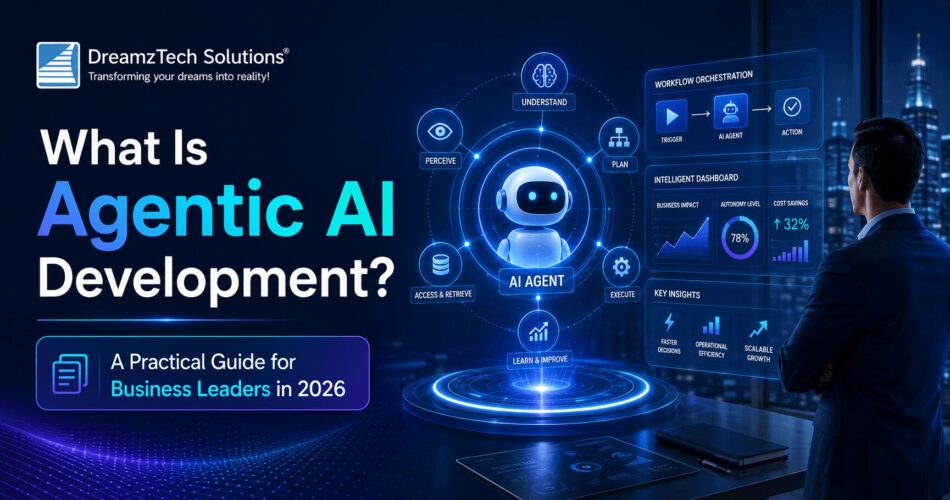
Agentic AI development is the discipline of engineering autonomous AI systems that don’t just answer questions — they plan, reason, invoke external tools, remember prior context, and complete multi-step business tasks on their own. Unlike a traditional chatbot or a standard generative AI assistant, an agentic system perceives, decides, and acts across your enterprise stack — from CRM to ERP to your data warehouse. According to Precedence Research, the global AI agents market is projected to grow from ~$11B in 2026 to $294B by 2035 at a 43.6% CAGR, and Gartner has flagged agentic AI as the top strategic technology trend for 2025-2026. Enterprises that partner with a specialist agentic AI development company typically ship a first production agent in 12–16 weeks and deliver 30–60% task-throughput uplift within the first year.
What Is Agentic AI? (And Why It’s Different From Everything You’ve Used Before)
Agentic AI refers to AI systems that can autonomously plan, reason, take multi-step actions, and pursue goals without requiring human intervention at every step. Unlike a standard large language model (LLM) that responds to a single prompt and stops, an AI agent perceives its environment, breaks down a complex objective, decides which tools and APIs to invoke, executes a sequence of actions, evaluates the results, and adapts — all in a loop.
Think of it this way: if a traditional AI assistant is a calculator that gives you the answer when you punch in the equation, an AI agent is a junior analyst you brief once who then goes off, pulls the data, runs the numbers, flags the anomalies, drafts the report, and routes it to the right people — asking for human input only when it hits a genuinely ambiguous decision point.
The Four Characteristics That Define an AI Agent
Not every tool that calls an LLM is an agent. Genuine agentic AI systems share four distinguishing properties:
- Goal-directed autonomy — The agent receives a high-level objective and decomposes it into sub-tasks without being told exactly how to proceed step by step.
- Tool use and environment interaction — Agents connect to external systems: APIs, databases, browsers, code interpreters, file systems, and SaaS platforms. They don’t just generate text — they trigger actions.
- Memory and context persistence — Agents maintain short-term working memory (within a task) and can access long-term memory stores (vector databases, knowledge graphs) to build on prior interactions.
- Feedback loops and self-correction — When an action produces an unexpected result, the agent evaluates the outcome and revises its approach. This is the leap from reactive to adaptive intelligence.
Agentic AI vs. Traditional Automation vs. Standard GenAI
The landscape can feel confusing when vendors use these terms interchangeably. Here’s the honest breakdown. Traditional RPA bots follow deterministic rules — they break the moment a UI changes or an edge case appears. Standard generative AI (think ChatGPT in its basic form) produces outputs but has no mechanism to take real-world actions or sustain a goal over time. Agentic AI combines the reasoning power of LLMs with the execution capability of automation — but adds the critical layer of autonomous planning and self-correction that neither predecessor had.
Gartner identifies agentic AI as the most significant evolution in enterprise AI for 2025–2026, predicting that by 2028, at least 15% of day-to-day work decisions will be made autonomously by AI agents — up from near zero today. That’s not a gradual trend. That’s a cliff edge for companies that wait.

Figure 1: Before and after comparison for What Is Agentic AI Development? A Practical Guide for Business Leaders in 2026
Why Agentic AI Is Happening Right Now: The Market Forces You Can’t Ignore
Agentic AI isn’t emerging because researchers suddenly had a breakthrough idea. It’s emerging because four converging forces have made it technically viable and economically unavoidable at the same time.
1. Foundation Models Crossed the Reasoning Threshold
GPT-4, Claude 3.5, Gemini 1.5 Pro, and their successors aren’t just better at writing — they are capable of multi-step logical reasoning, code generation, and planning in ways that earlier models were not. That reasoning capability is the substrate on which agents are built. Without it, you have an automation script. With it, you have a system that can handle genuine ambiguity — which is what real enterprise workflows are full of.
2. The Tooling Ecosystem Matured Overnight
Two years ago, building an AI agent meant stitching together brittle custom integrations from scratch. Today, frameworks like LangChain, LlamaIndex, AutoGen, and CrewAI give engineering teams production-ready scaffolding for agent orchestration. Cloud providers have followed: AWS Bedrock Agents, Azure AI Agent Service, and Google Vertex AI Agent Builder now offer managed agent infrastructure that reduces the time to a production-ready MVP from months to weeks.
3. Labor Economics Have Changed the ROI Math
Post-pandemic wage inflation, ongoing talent shortages in knowledge work, and the rising cost of skilled operations staff have made the ROI calculation for agentic AI dramatically more favorable. When a single AI agent can handle work that previously required two or three FTEs — and do it 24/7 with no PTO, onboarding time, or attrition risk — the business case practically writes itself.
4. The Market Is Pricing In the Shift
Grand View Research projects the global AI agents market will reach $47.1 billion by 2030, growing at a CAGR of 44.8% from 2024. That’s not speculative froth — it reflects enterprise procurement decisions happening right now, as finance, healthcare, logistics, and professional services firms commit budget to agentic infrastructure. Companies that establish agentic capabilities in 2025–2026 will have compounding advantages over those that start in 2028.

Figure 2: What Is Agentic AI Development? A Practical Guide for Business Leaders in 2026 market growth 2024-2030
How Agentic AI Development Works: The Technical Architecture
Understanding the architecture is essential if you’re evaluating vendors, setting scope for an internal build, or trying to separate genuine capability from marketing noise. Every production-grade agentic AI system comprises four layers working in concert.
Layer 1: The Reasoning Core (LLM)
The foundation model is the brain. It receives the goal, reasons about how to achieve it, decides what tools to invoke, interprets the results, and determines next steps. The choice of model matters enormously: it affects reasoning quality, context window size (which determines how much information the agent can hold in working memory), speed, and cost per inference. Enterprise deployments typically use fine-tuned or retrieval-augmented versions of frontier models rather than vanilla APIs, to ensure domain accuracy and data security.
Layer 2: The Memory System
Human analysts remember what they did yesterday, what the client said last quarter, and what the standard operating procedure is for edge cases. AI agents need equivalent structures. Memory in agentic systems comes in three forms:
- In-context memory — the agent’s current working window; fast but limited by context length
- External memory — vector databases (Pinecone, Weaviate, pgvector) that store and retrieve embeddings of prior interactions, documents, and domain knowledge
- Episodic memory — structured logs of past agent runs that inform future planning decisions
Layer 3: The Tool Layer
This is where agents stop being chatbots and start being co-workers. The tool layer is a curated set of functions the agent can call: REST APIs, database queries, code execution environments, web search, file read/write, calendar and email integrations, and custom enterprise system connectors. The quality and breadth of your tool library directly determines what your agent can accomplish. A well-designed tool layer gives the agent precise, safe primitives — rather than broad, unconstrained access that creates security exposure.
Layer 4: The Orchestration and Safety Layer
Orchestration manages how agents plan, sequence tool calls, handle failures, and escalate to humans when needed. This is where frameworks like LangGraph or AutoGen’s group chat model come in. Safety controls — guardrails, input/output filters, permission scoping, audit logging — sit here too. Deloitte’s research on enterprise AI deployments consistently identifies orchestration and governance as the layers where most production failures occur — not in the model itself. Any experienced agentic AI development company will treat orchestration architecture as the hardest problem, not an afterthought.

Figure 3: How What Is Agentic AI Development? A Practical Guide for Business Leaders in 2026 works step by step
Multi-Agent Systems: When One Agent Isn’t Enough
Single-agent architectures handle well-scoped tasks elegantly. But most real enterprise workflows are too complex, too long, or too parallelizable for a single agent to manage alone. Multi-agent systems — where specialized agents collaborate, delegate, and check each other’s work — are how enterprises are tackling their most complex automation challenges.
Common Multi-Agent Patterns
Three patterns dominate production multi-agent deployments today:
- Supervisor / worker — An orchestrator agent decomposes the goal and delegates sub-tasks to specialized worker agents (a research agent, a writing agent, a validation agent). The supervisor synthesizes results and handles escalation.
- Parallel execution — Multiple agents work simultaneously on independent sub-tasks, with results merged at a checkpoint. Dramatically reduces latency for complex research or analysis tasks.
- Debate / review loops — Two agents independently produce outputs, a third evaluates and reconciles them. Significantly improves output quality for high-stakes decisions like contract review or financial modeling.
Where Multi-Agent Architecture Delivers the Most Value
Multi-agent systems shine in scenarios with long time horizons, diverse tool requirements, or where accuracy is non-negotiable. Software development pipelines (plan → code → test → review → deploy), complex research and due diligence workflows, and end-to-end customer lifecycle management are three domains where single agents hit the wall and multi-agent architectures unlock step-change productivity gains.
Industry Use Cases: What Agentic AI Is Doing Right Now
Agentic AI isn’t a future promise — it’s in production across industries today. Here’s where it’s delivering measurable impact in 2025–2026.
Financial Services: From Days to Minutes on KYC and Credit
Banks and insurance companies are deploying agentic AI to handle Know Your Customer (KYC) onboarding, credit decisioning, and claims processing. An agent can pull applicant data from multiple sources, cross-reference against sanctions databases, score risk, generate a structured recommendation, and flag only the genuinely borderline cases for human review — all in under three minutes, for a process that previously took two to five days. McKinsey’s banking AI research puts the potential annual value of AI in financial services at $200–$340 billion — with agentic automation of high-volume, rules-adjacent decisions as the primary driver.
Healthcare: Clinical Documentation and Prior Authorization
The administrative burden in healthcare is staggering — Deloitte estimates that administrative costs consume 34% of total healthcare spending in the US. Agentic AI is attacking this directly. Agents integrated with EHR systems (Epic, Cerner) can draft clinical notes from ambient audio, pull relevant patient history, populate prior authorization forms, submit to payer portals, track status, and manage appeals — with a physician reviewing and approving, not doing the paperwork. That’s not a modest efficiency gain. That’s giving clinicians back hours every day.
Software Development: The AI Engineer Is Here
GitHub Copilot was the first wave — AI that autocompletes code. Agentic AI is the second wave — systems that receive a feature specification, write the implementation, run tests, fix failing tests, update documentation, and open a pull request. Tools built on agentic frameworks are already reducing development cycle times by 30–50% for well-scoped features. Our AI development services team uses agentic pipelines internally to accelerate client delivery on exactly this basis.
Supply Chain and Operations: Autonomous Exception Management
Supply chain operations are exception-management businesses — most of the work is handling the things that didn’t go according to plan. Agentic AI handles this naturally: monitor inventory levels, detect anomalies (demand spikes, supplier delays, logistics disruptions), evaluate alternative suppliers or routing options, generate and send purchase orders within pre-approved parameters, and escalate only when authorization limits are exceeded. What used to require a team of supply chain analysts working in shifts can run largely autonomously, 24/7.
Legal and Compliance: Due Diligence at Scale
M&A due diligence, contract review, and regulatory compliance monitoring are high-value, high-volume document tasks — exactly where agentic AI thrives. An agent can ingest thousands of contracts, extract key provisions, flag deviations from standard terms, identify compliance risks, and produce a structured risk register in a fraction of the time required by a manual review team. Law firms and in-house legal departments piloting this capability are reporting 60–70% reductions in document review time.
Customer Operations: Agents That Actually Resolve, Not Just Deflect
Traditional AI chatbots deflect tickets. Agentic AI resolves them. When a customer contacts support, an agent can authenticate the user, pull account history, diagnose the issue, take corrective action in the backend system (process a refund, update a subscription, reset an account), confirm resolution, and log the interaction — without a human touching it. Resolution rates of 60–80% for Tier 1 issues are achievable, compared to 20–30% for rule-based chatbots.

Figure 4: What Is Agentic AI Development? A Practical Guide for Business Leaders in 2026 industry use cases
How to Evaluate an Agentic AI Development Company: The Buyer’s Checklist
The vendor landscape for agentic AI is noisy. Everyone from boutique consultancies to global SIs is now claiming agentic AI capability, and the quality variance is enormous. Use this checklist to separate vendors with genuine production experience from those who demo well and deliver poorly.
Technical Competency: What to Look For
Ask every candidate vendor these specific questions. Their answers will tell you everything:
- Which agent frameworks have you deployed in production? LangGraph, AutoGen, CrewAI, and custom implementations all have different strengths. A vendor who says “we use LangChain” without deeper detail hasn’t built anything complex.
- How do you handle agent failure and recovery? Production agents fail. The architecture for detecting, logging, and recovering from failures is as important as the happy path. If they don’t have a clear answer, they haven’t shipped at scale.
- What’s your approach to tool permission scoping? Agents with broad API access are security liabilities. Enterprise-grade deployments use least-privilege tooling with explicit approval gates for high-risk actions.
- How do you evaluate agent output quality? This is the hardest problem in agentic AI. Ask for their evaluation framework — regression test suites, human-in-the-loop review protocols, and observable metrics for agent performance over time.
- Can you deploy on our cloud infrastructure or on-premises? Data sovereignty and compliance requirements often preclude sending data to third-party hosted models. Vendors must be able to deploy on AWS Bedrock, Azure OpenAI, or GCP Vertex in your own VPC.
Delivery Model: Avoid These Red Flags
Beyond technical competency, the delivery model matters enormously for agentic AI projects. These engagements are not fixed-scope implementations — they’re iterative systems that evolve as you learn what works. Be wary of vendors who:
- Propose a fully fixed-price, fixed-scope contract for a first agentic deployment (a sign they don’t understand the discovery process required)
- Cannot show you a working prototype within 4–6 weeks of engagement start
- Don’t include a formal agent evaluation and monitoring plan in their delivery methodology
- Lack demonstrated experience with your industry’s regulatory environment (HIPAA, SOC 2, GDPR, PCI-DSS)
- Can’t reference at least two production deployments with measurable business outcomes — not research pilots or internal tools
Partnership Model: Build vs. Buy vs. Partner
For most enterprises, the right approach is neither a full internal build nor an off-the-shelf SaaS product. Forrester’s enterprise AI research consistently shows that companies achieve the best outcomes with a co-build model — where an experienced external partner brings agentic architecture expertise and frameworks, while the internal team retains ownership of business logic, data, and long-term roadmap. This is DreamzTech’s core delivery model: we build with you, not for you, so the capability stays inside your organization.

Figure 5: What Is Agentic AI Development? A Practical Guide for Business Leaders in 2026 evaluation scorecard
What the ROI Data Actually Shows
Agentic AI projects are still early enough that many published ROI figures come from pilot programs rather than multi-year production deployments. We’ll give you the honest picture, not the marketing version.
Productivity Gains: What’s Realistic
For well-scoped, high-volume knowledge work tasks — document processing, data extraction, research synthesis, code generation — productivity gains of 40–70% are consistently achievable in the first 12 months of production deployment. McKinsey’s economic potential of generative AI report found that AI-enabled automation of knowledge work tasks could increase individual worker productivity by 20–45% across functions. Agentic AI — because it handles end-to-end task execution rather than just assisting — tends to land at the higher end of that range for the specific workflows it targets.
Cost Reduction: Where the Real Numbers Come From
The ROI case for agentic AI in operations typically combines three cost components:
- Labor cost reduction — Agents replacing or significantly augmenting high-cost knowledge workers for specific task categories. For a financial services firm processing 50,000 KYC applications per year, even a 60% automation rate at an average manual cost of $45/application represents $1.35M in annual savings from a single workflow.
- Error cost reduction — Human error in data entry, compliance documentation, and process execution carries real cost through rework, penalties, and customer churn. Agents operating within well-defined guardrails have error rates an order of magnitude lower than manual processes for structured tasks.
- Throughput increase — Agents don’t have business hours. A customer operations agent handling Tier 1 resolution 24/7 versus a contact center team working two shifts generates measurable revenue through reduced churn and faster resolution — typically worth 2–5x the direct labor savings.
Typical Payback Periods
Based on production deployments across DreamzTech’s client portfolio, here’s what realistic payback timelines look like:
- Focused single-workflow agents (e.g., document classification, data extraction): 4–8 months to ROI-positive
- Multi-step operational agents (e.g., full KYC, claims processing): 8–14 months to ROI-positive
- Complex multi-agent systems (e.g., end-to-end software delivery pipeline, full supply chain exception management): 12–24 months to ROI-positive, but with significantly larger absolute returns
The honest caveat: ROI is heavily dependent on the quality of the implementation, the maturity of your underlying data infrastructure, and how well the human-in-the-loop handoffs are designed. An agent deployed into a broken process will automate the chaos, not eliminate it.

Figure 6: What Is Agentic AI Development? A Practical Guide for Business Leaders in 2026 ROI metrics
Common Pitfalls: What Kills Agentic AI Projects
For every agentic AI project that delivers on its promise, there are several that stall in pilot, get quietly discontinued, or — worst — make it to production and cause damage. Here’s what actually goes wrong, and how to avoid it.
Pitfall 1: Starting With the Technology, Not the Workflow
The most common failure pattern: a team gets excited about agent frameworks, builds something technically impressive, and then looks for a problem to solve. Production-grade agentic AI starts from the opposite direction — a specific, high-volume, high-value workflow with well-understood inputs, outputs, and exception cases. Before you write a line of agent code, you should be able to draw the workflow on a whiteboard and identify exactly where the agent will add value versus where a human will remain in the loop.
Pitfall 2: Underestimating the Tool Integration Surface
Agents are only as capable as their tools. Underestimating the integration complexity of connecting an agent to your actual enterprise systems — legacy CRM, ERP with no modern API, document management systems with authentication quirks — is where projects blow their timelines. Budget 40–60% of your initial development time for tool integration and testing, not model configuration. The model is the easy part.
Pitfall 3: No Human-in-the-Loop Architecture for High-Stakes Actions
Fully autonomous agents making irreversible decisions in production without human checkpoints is a governance failure waiting to happen. NIST’s AI Risk Management Framework is explicit that high-stakes automated decisions require human oversight mechanisms. Design your agents with explicit approval gates for actions above defined risk thresholds — not as a limitation, but as a competitive advantage when auditors, regulators, and boards ask how you’re managing AI risk.
Pitfall 4: Ignoring Observability Until Something Goes Wrong
Agents operating in production without comprehensive logging, tracing, and alerting are black boxes. When something goes wrong — and it will — you need to be able to replay the agent’s reasoning chain, identify exactly where it diverged, and fix the root cause. Invest in observability infrastructure (tools like LangSmith, Langfuse, or custom tracing pipelines) before you go live, not after your first production incident.
Pitfall 5: Skipping the Evaluation Framework
How do you know your agent is performing well? “It seems to work” is not an answer. Before deployment, define measurable success metrics for every agent behavior: task completion rate, accuracy on key extraction fields, escalation rate to human review, average task completion time, and error rate by category. Run regular regression evaluations as you update models and tools. Agentic AI systems can degrade silently — a new model version can change behavior in ways that aren’t obvious until you measure systematically.
Future Trends: Where Agentic AI Is Heading in 2026 and Beyond
Agentic AI is not a finished technology — it’s a rapidly evolving capability stack. Three trends will define how the discipline matures over the next 24 months.
1. Standardized Agent Communication Protocols
Today’s multi-agent systems use proprietary communication patterns that don’t interoperate across vendors or frameworks. Emerging standards — including Anthropic’s Model Context Protocol (MCP) and Google’s Agent-to-Agent (A2A) protocol — will enable agents built on different foundations to collaborate. For enterprises, this means you won’t be locked into a single vendor’s agent ecosystem. Build once, compose freely.
2. From Task-Level to Process-Level Agents
Current production deployments automate specific tasks within broader processes. The next generation will automate entire business processes end-to-end — including the orchestration of other AI agents, human workers, and automated systems within a single coherent workflow. Gartner’s agentic AI research describes this as the shift from “task agents” to “process agents” — and predicts it will be the dominant enterprise AI paradigm by 2027.
3. Smaller, Cheaper, Faster Reasoning Models
Frontier models like GPT-4 are powerful but expensive to run at high volume. The emergence of smaller, task-specialized reasoning models (GPT-4o mini, Mistral, Phi-3, Llama 3) means enterprises will increasingly run purpose-built models for specific agent tasks — dramatically reducing inference costs. A well-architected agentic system in 2026 will route tasks to the cheapest capable model, not default every call to the most powerful one.
The Bottom Line: Three Things Every Business Leader Needs to Know
Agentic AI is genuinely different from everything that came before it. Before you close this guide, burn these three points into your planning assumptions.
- Agentic AI is not a chatbot upgrade. It’s a new class of software that executes work autonomously. Scoping it, governing it, and measuring it requires a fundamentally different framework than the AI tools you’ve deployed to date.
- The competitive window is narrow. The companies deploying agentic AI in 2025–2026 will have 18–36 months of compounding operational advantage over those that start in 2028. This is not a “wait and see” technology — the cost of waiting is real and growing every quarter.
- Vendor selection is the highest-leverage decision you’ll make. The agentic AI development company you choose will determine whether this becomes a transformative capability or an expensive failed experiment. Prioritize demonstrated production experience, honest evaluation frameworks, and a co-build delivery model that keeps the capability inside your organization.
Conclusion
Agentic AI is the most consequential shift in enterprise software since cloud computing. The gap between companies that treat it as a strategic priority in 2025–2026 and those that add it to the “evaluate in 2028” backlog will compound into a structural competitive disadvantage that is genuinely hard to close. The technology is production-ready. The frameworks are mature. The ROI case is proven across industries. What’s left is execution — and execution starts with choosing the right architecture, the right use cases, and the right partner.
If you’re a CTO or VP of Engineering who leaves this guide with one action item, make it this: identify the single highest-volume, highest-cost knowledge work process in your organization that runs on human judgment and handoffs. That’s your first agentic AI deployment. Map it, scope it, and talk to someone who has built it before. The worst thing you can do is nothing.
Frequently Asked Questions
1. What is the difference between agentic AI and a standard AI chatbot?
A standard AI chatbot responds to individual prompts and stops — it generates output but takes no further action. An agentic AI system receives a goal, decomposes it into a sequence of actions, calls real tools and APIs to execute those actions, evaluates the results, and continues iterating until the goal is achieved. The fundamental difference is autonomous, multi-step execution versus single-turn response generation. Agentic AI can book the meeting, update the CRM, send the follow-up email, and flag the exception — a chatbot can only tell you what those steps should be.
2. How long does it take to build and deploy a production agentic AI system?
For a focused, single-workflow agent — handling document classification, data extraction, or a specific customer resolution flow — a competent agentic AI development company can deliver a production-ready MVP in 6–10 weeks. More complex multi-agent systems handling end-to-end business processes typically require 3–6 months for initial production deployment. The variables that most affect timeline are the maturity of your existing API infrastructure, the complexity of the human-in-the-loop governance design, and the availability of representative training and evaluation data. Companies that have invested in clean data infrastructure and modern API architecture move significantly faster.
3. Is agentic AI safe to use in regulated industries like healthcare and financial services?
Yes — but safety is not automatic; it’s architected. In regulated industries, agentic AI deployments require explicit human-in-the-loop checkpoints for high-stakes decisions, comprehensive audit logging of all agent actions and reasoning chains, least-privilege tool permission scoping, and deployment within compliant cloud infrastructure (HIPAA-eligible AWS or Azure environments, for example). The NIST AI Risk Management Framework provides the governance scaffolding, and experienced agentic AI development partners will build regulatory compliance into the architecture from the start — not retrofit it after deployment. DreamzTech’s regulated industry deployments all include formal compliance architecture review as part of the engagement scope.
4. What’s the difference between agentic AI and RPA (Robotic Process Automation)?
RPA bots follow deterministic, rule-based scripts to automate repetitive tasks. They’re brittle — a UI change or an unexpected input breaks them, and they require constant maintenance. Agentic AI reasons about how to achieve a goal rather than following a fixed script. It can handle ambiguity, unstructured inputs (documents, emails, natural language), and novel situations that would cause an RPA bot to fail. In practice, many enterprises are replacing first-generation RPA implementations with agentic AI for exactly this reason — the agents handle the exceptions that the RPA bots were escalating to humans anyway.
5. How do I choose the right use case to start with?
The best first agentic AI use case has four characteristics: high volume (the process runs hundreds or thousands of times per month), high current cost (significant labor hours or error-correction costs), well-defined success criteria (you can measure whether the agent got it right), and bounded risk (mistakes are recoverable without catastrophic consequences). Document processing, customer tier-1 resolution, internal IT helpdesk, and data extraction and normalization workflows consistently rank as the best entry points because they score well on all four criteria. Avoid starting with low-volume, high-complexity, high-stakes decisions — save those for your second or third deployment, when you have an established evaluation framework.
6. Do we need to replace our existing systems to deploy agentic AI?
No — and any vendor who tells you otherwise is either misinformed or selling you a platform replacement. Agentic AI is designed to integrate with your existing systems through their APIs and data interfaces. Your CRM, ERP, document management system, and data warehouse remain in place; the agents connect to them as tools. The integration work is real — it’s often the most time-consuming part of an agentic deployment — but it doesn’t require replacing your existing technology stack. The agent sits on top of your existing systems, orchestrating actions across them.
7. What does “human-in-the-loop” mean in the context of agentic AI?
Human-in-the-loop (HITL) refers to the design of explicit checkpoints in an agent’s workflow where human review or approval is required before the agent can proceed. Rather than being a limitation, HITL is a core governance feature of responsible agentic AI deployment. In practice, this means defining which actions the agent can take autonomously (within pre-approved parameters) and which require human sign-off (actions above a dollar threshold, irreversible decisions, high-confidence exceptions). Well-designed HITL architecture actually accelerates throughput because humans are reviewing only the genuinely ambiguous cases — not processing the 80% of routine items that the agent handles perfectly.
8. How do we measure whether our agentic AI deployment is performing well?
Every agentic AI deployment should have a defined evaluation framework established before go-live, not after. Core metrics to track include: task completion rate (what percentage of initiated tasks does the agent complete without human escalation), accuracy rate (for tasks with measurable outputs like data extraction or classification), escalation rate (what percentage of tasks are routed to human review — both too high and too low can signal problems), average task completion time versus the manual baseline, and error cost rate (the cost of errors that make it through the agent’s output). Over time, track how these metrics evolve as you update models, add tools, and refine prompts. Agents that aren’t measured aren’t managed.
9. What is the difference between a single agent and a multi-agent system, and when do I need the latter?
A single agent handles a defined task within a single reasoning loop — appropriate for well-scoped, sequential workflows where one “thread” of execution is sufficient. A multi-agent system deploys multiple specialized agents that collaborate, delegate to each other, and check each other’s work — necessary when the workflow requires parallel execution of independent sub-tasks, diverse tool specialization (a research agent, a writing agent, a code execution agent), or when output quality demands independent verification and debate. As a rule of thumb: start with a single agent for your first deployment, and introduce multi-agent architecture when you hit the natural ceiling of what a single reasoning loop can handle reliably.