Your competitors are not waiting. Right now, enterprises that deployed autonomous AI agents in 2024 and 2025 are executing multi-step business workflows — researching markets, drafting contracts, triaging support queues, and orchestrating cloud infrastructure — without a single human click. Meanwhile, companies still anchored to rule-based chatbots and static automation scripts are watching their operational costs compound while their rivals accelerate. McKinsey estimates that generative AI and agentic systems could add $2.6 to $4.4 trillion annually to the global economy — and the lion’s share of that value lands with the organizations that build real, production-grade AI agents, not those that demo them.
This guide is written for CTOs, VPs of Engineering, and senior architects who need a clear, technically honest answer to one question: what does it actually take to build an AI agent that works in production in 2026? We cover what AI agents are, exactly how they differ from the chatbots you’ve already deployed, the architecture decisions that determine success or failure, and how DreamzTech’s engineering teams build them end to end.
Let’s get into it.
Quick answer — What is AI Agent Development?
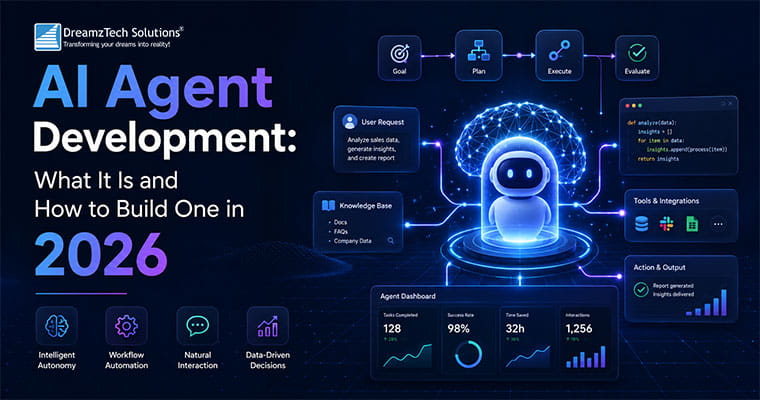
AI agent development is the engineering discipline of building autonomous software systems that reason with a large language model (LLM), plan multi-step actions, invoke external tools and APIs, maintain memory across turns, and complete complex business tasks without step-by-step human guidance. A production AI agent is not a chatbot — it combines an LLM reasoning core with a tool layer, memory subsystem, orchestration logic, and safety guardrails. According to Gartner, over 40% of enterprise applications will include task-specific AI agents by the end of 2026, and Precedence Research projects the AI agents market to reach $294 billion by 2035 at a 43.6% CAGR. Enterprises that partner with a dedicated custom AI agent development team typically ship a first production agent in 12–16 weeks and deliver 30–60% task-throughput uplift within the first year.
What Is AI Agent Development?
AI agent development is the discipline of designing, building, and deploying software systems that can perceive an environment, reason about a goal, plan a sequence of actions, and execute those actions autonomously — looping through observation and adjustment until the objective is met. Unlike a traditional application that follows a fixed execution path, or a chatbot that generates a response to a single input, an AI agent decides what to do next at each step based on what it observes.
The term “agent” comes directly from AI research: an agent is any system that takes actions in an environment to maximize a given objective. What changed in 2023–2025 is that large language models (LLMs) became capable enough to serve as the reasoning core of these agents — replacing brittle rule engines with flexible, general-purpose intelligence that can handle ambiguous inputs, generate tool-call plans on the fly, and recover from partial failures.
The Four Core Properties of an AI Agent
Not every system that uses an LLM is an agent. To qualify as a true AI agent, a system must exhibit four properties:
- Autonomy — It operates without step-by-step human instruction. You give it a goal; it figures out the steps.
- Tool use — It can call external functions: search the web, query a database, write and execute code, send an email, call an API.
- Memory — It retains context across multiple steps (short-term) and across sessions (long-term), so it doesn’t restart from scratch on every interaction.
- Goal-directed planning — It decomposes a high-level objective into sub-tasks, sequences them logically, and adapts the plan when something goes wrong.
Strip out any one of these properties and you have something less than an agent — a capable tool, perhaps, but not an autonomous system.
AI Agents vs. Chatbots: The Definitive Distinction
The most persistent confusion in enterprise AI right now is treating chatbots and AI agents as points on the same spectrum. They are not. They are fundamentally different architectures solving different problems.
A chatbot — even a sophisticated GPT-4-powered one — is a request-response system. A user sends a message; the model generates a reply; the interaction ends. The chatbot has no memory of the conversation tomorrow, no ability to go execute a task in an external system, and no capacity to plan beyond the current token window. It is reactive by design.
An AI agent is a goal-execution system. You assign it an objective — “research our top five competitors and produce a SWOT analysis” — and the agent breaks that down into a plan, searches the web, reads documents, synthesizes findings, writes the report, and delivers it. It may take 40 tool calls and 15 minutes. The user was never involved after the initial assignment. That is the difference that matters to your business.
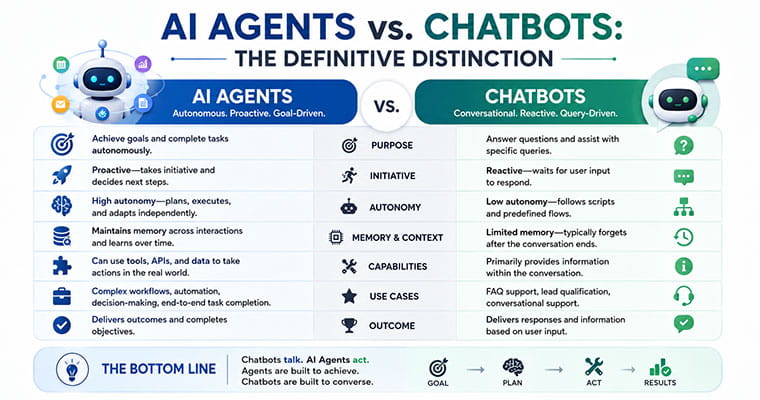
Figure 1: AI Agents vs. Chatbots: The Definitive Distinction
Why AI Agent Development Is the Defining Enterprise Technology Investment of 2026
Agentic AI is not a future trend — it is the current wave. Gartner named agentic AI the number-one strategic technology trend for 2025, and the momentum has only accelerated into 2026. The reason is straightforward: organizations have already extracted most of the easy efficiency gains from RPA and first-generation chatbots. The next order of magnitude in productivity comes from systems that can handle complex, multi-step, judgment-intensive work — and that is exactly what AI agents do.
Market Size and Momentum
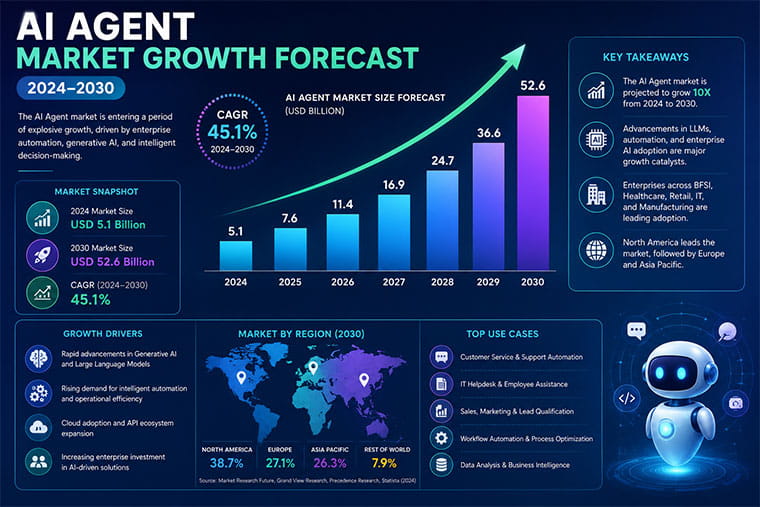
The numbers validate the urgency. Grand View Research values the global AI agents market at $5.1 billion in 2024 and projects it to grow at a 45.1% CAGR through 2030 — making it one of the fastest-growing segments in enterprise software. That growth is not speculative; it is driven by concrete production deployments across financial services, healthcare, logistics, and software development.
Deloitte’s 2025 AI investment survey found that 68% of large enterprises plan to increase AI agent investments by more than 25% over the next 12 months, with autonomous workflow orchestration cited as the primary use case. The enterprises that move first establish durable process advantages — because an agent that has been trained on 18 months of your specific workflows, data, and exceptions is not easily replicated by a competitor starting from scratch today.
What’s Changed: Why Now and Not Three Years Ago
Three structural changes made production-grade AI agent development viable in 2024–2026 that simply did not exist before:
- LLM reasoning quality crossed the threshold. Models like GPT-4o, Claude 3.5 Sonnet, and Gemini 1.5 Pro can reliably follow complex multi-step instructions, use tools without hallucinating function signatures, and recover from failed tool calls — capabilities that were unreliable in GPT-3.5-era models.
- Orchestration frameworks matured. LangChain, LlamaIndex, AutoGen, and CrewAI gave engineering teams production-tested abstractions for agent loops, memory management, and multi-agent coordination — dramatically reducing build time from months to weeks.
- Cloud providers built native agent infrastructure. AWS Bedrock Agents, Azure OpenAI with function calling, and Google Vertex AI Agent Builder provide managed infrastructure for tool execution, guardrails, and observability — eliminating the need to build the plumbing from scratch.
The Architecture of a Production AI Agent: How It Actually Works
Understanding the architecture is non-negotiable for any CTO evaluating an AI agent development project. Vendors who can’t explain the stack clearly are selling you a demo, not a system. Here is how a well-architected production agent is structured.
Layer 1: The Reasoning Engine (LLM Core)
Every AI agent has a large language model at its center. The LLM serves as the reasoning and planning engine — it reads the current state of the world (the agent’s context window), decides what action to take next, and generates the parameters for that action. The choice of model is a significant engineering decision. Frontier models like GPT-4o and Claude 3.5 Sonnet offer the highest reasoning quality but carry per-token cost. Fine-tuned open-weight models like Llama 3 or Mistral can be more cost-effective for narrow, repetitive agent tasks but require more engineering effort to deploy reliably.
Layer 2: The Tool Layer
Tools are what separate an agent from a chatbot. A tool is any function the agent can call to interact with the external world: a web search API, a SQL query runner, a code execution sandbox, a REST API call, a file reader, a calendar event creator. The agent’s LLM core doesn’t execute the tool directly — it generates a structured tool-call specification (function name + arguments), which the orchestration layer executes, then feeds the result back into the agent’s context. Well-designed tool layers are typed, validated, and sandboxed — the agent cannot call a tool with malformed parameters or access systems outside its defined permission set.
Layer 3: Memory and State Management
Memory is the most underengineered component in most early AI agent builds. There are four types of memory an agent can use:
- In-context memory — The current conversation and tool results loaded into the active context window. Fast, but bounded by token limits.
- External short-term memory — A session store (Redis, DynamoDB) that holds the current task state and can be summarized back into context as needed.
- Retrieval-augmented memory (RAG) — A vector database (Pinecone, Weaviate, pgvector) that stores and retrieves relevant documents, past decisions, or domain knowledge on demand.
- Long-term episodic memory — Stored records of past agent runs that can be retrieved to inform future decisions — “last time you ran this report for Q3, you excluded subsidiary X.”
Getting the memory architecture right is the difference between an agent that degrades over a 10-step task and one that completes a 200-step workflow coherently.
Layer 4: The Orchestration Layer
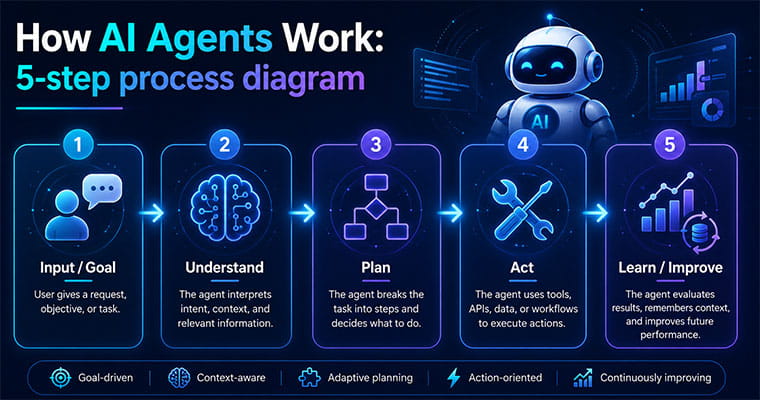
The orchestration layer is the runtime that manages the agent loop: feed context to the LLM → get action → execute tool → observe result → update context → repeat. Modern orchestration frameworks handle this loop, plus critical production concerns like retry logic, error handling, parallelism (running multiple tool calls concurrently), and agent-to-agent communication in multi-agent systems. At DreamzTech, our teams evaluate LangGraph, AutoGen, and CrewAI against client-specific requirements — the right framework depends on whether the use case calls for a single agent, a supervisor-worker hierarchy, or a peer-to-peer agent network.
Layer 5: Guardrails, Observability, and Human-in-the-Loop Controls
No enterprise AI agent goes to production without guardrails. This layer includes: input and output content filters, action confirmation gates for high-stakes operations (“before deleting these 500 records, confirm with a human”), rate limiting to prevent runaway agent loops, full audit logging of every tool call and decision, and real-time monitoring dashboards. Forrester’s 2024 AI governance research found that 74% of enterprises cite lack of observability as their primary barrier to scaling AI agents in production — which means the guardrails layer is not optional, it is the gate to production approval.
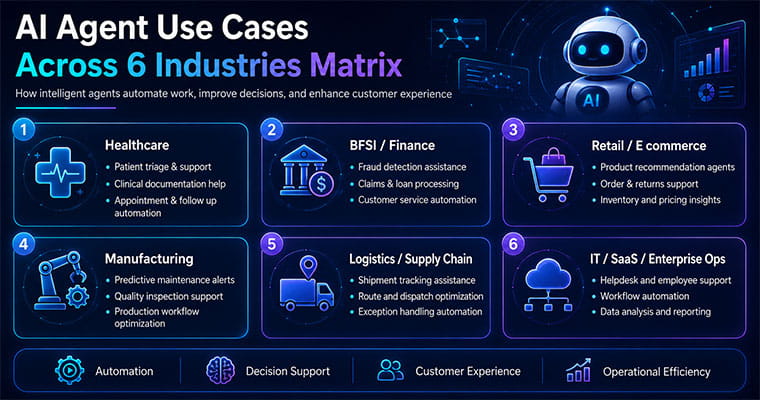
Where AI Agents Create the Most Value: Industry Use Cases
AI agents are general-purpose systems, but the highest ROI deployments in 2025–2026 cluster around specific, high-volume, judgment-intensive processes. Here are the verticals and use cases where production AI agents are delivering measurable results today.
Financial Services: Autonomous Research and Compliance
Investment banks and asset managers are deploying AI agents for equity research synthesis — agents that monitor earnings calls, SEC filings, news feeds, and analyst reports across hundreds of companies simultaneously, surfacing material changes and drafting research notes. Compliance teams use agents to monitor transaction flows against regulatory rule sets, flagging potential violations and auto-generating the supporting documentation for review. The time saving is not incremental — a task that took a junior analyst two days can complete in 20 minutes.
Healthcare and Life Sciences: Clinical and Operational Automation
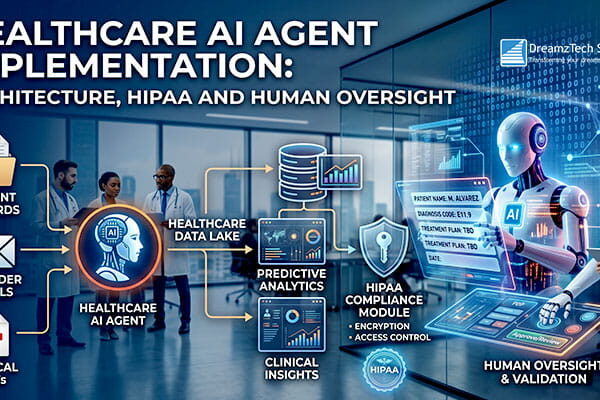
Healthcare organizations are using AI agents to automate prior authorization workflows — a process that currently costs the US healthcare system an estimated $35 billion annually in administrative overhead according to McKinsey. Agents read clinical notes, cross-reference payer policy databases, and submit authorization requests with supporting documentation — reducing a 3-day process to under 2 hours. In pharma, agents accelerate literature review for drug discovery by synthesizing findings across thousands of papers and identifying relevant preclinical studies.
Software Development: The AI Engineering Co-Pilot
Development teams are deploying coding agents that don’t just autocomplete — they handle complete sub-tasks: reading a GitHub issue, writing the code change, running tests, interpreting failures, iterating the fix, and opening a pull request. These are not science experiments; they are production workflows at companies like Cognition (Devin), GitHub (Copilot Workspace), and dozens of enterprises running custom builds. DreamzTech’s own engineering teams use internal AI agents for code review, test generation, and documentation — and we build similar systems for clients through our AI Development Services.
E-Commerce and Retail: Autonomous Merchandising and Support
Retail enterprises are using agents for dynamic pricing — systems that monitor competitor pricing, inventory levels, and demand signals, then adjust prices across thousands of SKUs continuously. Customer support agents handle complex, multi-step service requests (returns requiring exception approval, order modifications spanning multiple fulfillment systems) that pure chatbots cannot touch because they require accessing and updating multiple backend systems in sequence.
Legal and Professional Services: Document Intelligence at Scale
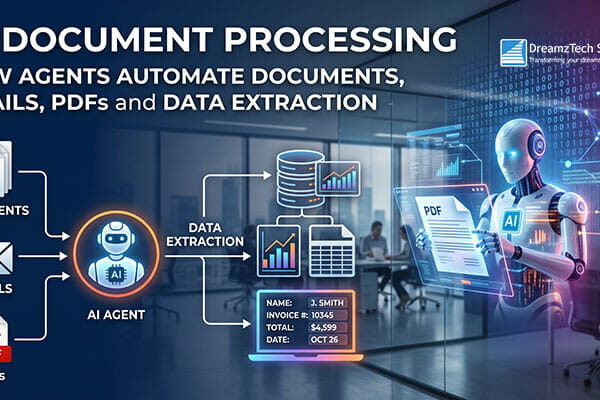
Law firms and corporate legal departments use agents for contract review pipelines — agents that ingest a contract, identify non-standard clauses against a playbook, flag risk, draft redlines, and produce a negotiation summary. What once required 4 hours of associate time takes 12 minutes. Combined with AI document processing capabilities, agents can process entire deal rooms of hundreds of documents in parallel.
IT Operations: Self-Healing Infrastructure
AIOps agents monitor infrastructure metrics, correlate anomalies across distributed systems, diagnose root cause, and execute remediation runbooks autonomously. An agent that detects a memory leak, identifies the offending pod, restarts it, opens an incident ticket with full diagnostic context, and notifies the on-call engineer — without waking anyone up at 3 AM — is not a luxury in 2026. It is a competitive requirement.
The AI Agent Development Evaluation Checklist: What to Demand from Any Vendor
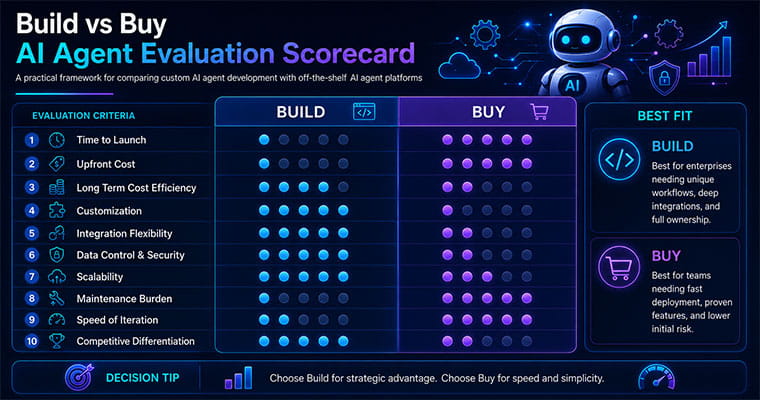
Whether you are evaluating an internal build, a systems integrator, or a platform vendor, use this checklist to separate serious AI agent development capability from polished demo theater. These are the criteria that predict production success.
Architecture and Engineering Depth
- Can they articulate the full five-layer stack? If a vendor can’t explain how memory, tool execution, and orchestration interact, they haven’t built a production system.
- Have they solved the context-window problem? Any agent handling tasks longer than ~20 steps will exceed a single context window. Ask specifically how they manage state across long-running tasks.
- What is their model selection strategy? Frontier-only vendors will destroy your budget. The right answer is a hybrid: frontier models for complex reasoning, fine-tuned smaller models for repetitive sub-tasks.
- Do they have a multi-agent architecture pattern? The most powerful enterprise systems use supervisor agents that delegate to specialist sub-agents. Single-agent architectures hit ceilings quickly on complex workflows.
Security and Governance
- Tool permission model — Every tool the agent can call should require explicit permission grants. There should be no path to an agent accessing a system that wasn’t explicitly configured.
- Prompt injection defense — A well-known attack vector: malicious content in the environment (a web page, a document) contains instructions designed to hijack the agent’s behavior. Ask specifically how they mitigate this.
- PII handling in context — If your agent reads documents containing personal data, that data passes through the LLM’s context window. Understand what is logged, where it goes, and how it is protected.
- Audit trail completeness — Regulatory environments (HIPAA, SOX, GDPR) require complete records of automated decisions. Every tool call, every LLM response, every action taken must be logged and retrievable.
Reliability and Operational Maturity
- Failure mode handling — Ask: “What happens when a tool call fails three times in a row?” The answer should involve graceful degradation, human escalation paths, and no silent failures.
- Cost control mechanisms — Token spend in a poorly designed agent loop can explode. Production systems must have per-task budget limits, token counting instrumentation, and alerts.
- Latency SLAs — Multi-step agents are not instant. Understand what the expected P95 completion time is for your target workflow and whether it fits your user experience requirements.
- Human-in-the-loop design — The best production agents aren’t fully autonomous for every action — they have defined checkpoints where a human must confirm before proceeding. Ask how these are architected.
ROI of AI Agent Development: What the Data Shows
Executives who’ve survived enough AI hype cycles are right to demand concrete ROI before committing to an AI agent development project. The good news is that 2025 produced enough production deployments to generate real benchmark data — and the numbers are compelling.
Productivity and Throughput Gains
McKinsey’s 2025 workplace AI report found that AI agents handling knowledge work tasks delivered 40–70% productivity improvements in structured workflows like research synthesis, report generation, and data analysis — significantly outperforming standalone LLM tools that lack tool-use and autonomy. The difference is that an agent doesn’t just answer a question; it completes the task.
In software development specifically, teams using AI coding agents on well-defined sub-tasks (test writing, documentation, boilerplate generation) reported 55% faster task completion in GitHub’s 2024 developer survey. For enterprises running large engineering organizations, that productivity delta translates directly to faster shipping cycles and reduced headcount growth.
Cost Reduction
The most dramatic cost reduction cases come from high-volume, labor-intensive document and data processing workflows. A financial services client DreamzTech worked with reduced per-document processing costs by 78% after deploying an AI agent pipeline for loan origination document review — the agent reads income statements, extracts key figures, cross-validates against credit bureau data, and produces a structured underwriting summary, replacing manual work that previously took 45 minutes per file.
Customer support agent deployments consistently show 50–65% reductions in cost-per-resolution for Tier 1 and Tier 2 support tickets, with the agent handling full resolution autonomously for approximately 60–70% of requests and escalating the remainder with full context pre-loaded for the human agent.
Time-to-Value and Payback Period
A well-scoped AI agent project targeting a single high-volume workflow can reach production in 8–14 weeks. At that timeline, enterprises with sufficient process volume typically see payback within 4–6 months of go-live. Deloitte’s enterprise AI value study found that organizations with a defined agentic AI roadmap reported 2.3× higher ROI on their overall AI investment portfolio compared to organizations with ad-hoc AI initiatives — because agents multiply the value of other AI assets by connecting them into end-to-end workflows.
Risk-Adjusted Valuation
Not every AI agent project delivers. The failure modes are specific and predictable: agents deployed without adequate guardrails, agents built on brittle tool integrations, and agents scoped to workflows that are actually too ambiguous for current LLM reasoning quality. These are engineering failures, not technology failures — and they are entirely avoidable with rigorous architecture and testing methodology. Gartner reports that 80% of AI projects that fail in production fail due to integration and governance issues, not model quality issues — which is exactly where experienced AI engineering partners earn their fees.

Common Pitfalls in AI Agent Development (and How to Avoid Them)
We’ve reviewed dozens of failed or stalled AI agent projects. The failure patterns are remarkably consistent. Knowing them in advance is worth more than any technology briefing.
Pitfall 1: Scoping the First Agent Too Ambitiously
The most common mistake is starting with a use case that requires the agent to handle highly ambiguous, unstructured inputs across 15 different systems with no clear success criterion. Production AI agent development follows the same rule as all engineering: start with the smallest, highest-value slice of a workflow, prove it works, then expand. An agent that reliably automates one 45-minute task is worth more than a prototype that attempts to automate an entire department and works 40% of the time.
Pitfall 2: Treating Prompt Engineering as a Substitute for Architecture
Some teams believe they can build a production agent by writing a very long system prompt. They cannot. Production agents require real software engineering: state management, error handling, typed tool schemas, test suites, monitoring, and security controls. If a system’s reliability depends primarily on a prompt that a model might not follow perfectly, it is not production-ready. Prompt engineering is a component of AI agent development, not the architecture.
Pitfall 3: Ignoring the Tool Quality Problem
An agent is only as reliable as its tools. If the APIs it calls are slow, inconsistently documented, or return poorly structured data, the agent will hallucinate workarounds or fail silently. Before building the agent layer, audit every tool it will use: response time, error rate, data format consistency, and authentication stability. Tool quality is the most reliable predictor of agent reliability, and it is systematically underestimated in early project scoping.
Pitfall 4: Deploying Without Human-in-the-Loop Gates on High-Stakes Actions
Fully autonomous agents are appropriate for low-stakes, reversible actions. For actions with significant financial, legal, or safety consequences — sending a customer communication, executing a financial transaction, modifying production data — production-grade systems include human confirmation gates. Organizations that skip these gates to demonstrate “true autonomy” inevitably encounter a production incident that sets their entire AI agent program back 12 months. Design your human-in-the-loop architecture before you need it, not after.
Pitfall 5: No Observability, No Reproducibility
If your agent produces a wrong output, can you replay exactly what happened? If not, you cannot debug it, you cannot improve it, and you cannot satisfy a compliance audit. Production AI agents require structured logging of the full agent trajectory — every input, every tool call, every LLM response, every state transition. Building this after the fact is significantly harder than building it in from day one. Leverage platforms like LangSmith, Weights & Biases, or custom observability pipelines, but build it into your architecture from sprint one.
Future Trends in AI Agent Development: What to Prepare for in 2026 and Beyond
The AI agent landscape is moving fast. Here are the structural shifts that senior engineering leaders should be building toward now, not reacting to in 18 months.
Multi-Agent Systems Become the Default Architecture
The limiting factor for single-agent systems is the context window and the breadth of reasoning any one model can sustain across a very long task. The solution is multi-agent: a supervisor agent that decomposes a complex objective and delegates sub-tasks to specialist agents — a research agent, a coding agent, a data analysis agent, a writing agent — each optimized for its domain. AIIM‘s 2025 industry research indicates that 61% of enterprise AI deployments planned for 2026 involve multi-agent architectures, up from 23% in 2024. If you’re building single-agent today, architect for multi-agent extension from day one.
Model Context Protocol (MCP) Standardizes Tool Integration
Anthropic’s Model Context Protocol, now being adopted across the industry, standardizes how AI agents connect to tools and data sources — similar to how USB standardized device connections. This dramatically reduces the integration engineering work required to add new tools to an agent and enables portability across different LLM providers. Enterprises building significant tool libraries for their agents should be watching MCP adoption closely and evaluating when to migrate their tool integrations to the standard.
Edge and On-Premises Agent Deployment
As open-weight models like Llama 3.1 and Mistral Large continue to close the quality gap with frontier models, more enterprises will deploy agents on-premises or in air-gapped environments — eliminating data residency concerns and cloud API latency. For healthcare, defense, and financial services enterprises with strict data sovereignty requirements, on-premises agent deployment will shift from “technically possible” to “routinely deployed” over the next 24 months. DreamzTech’s AI Consulting practice actively helps clients evaluate on-premises vs. cloud agent deployment trade-offs.
Agent-to-Agent Commerce and Interoperability
The most forward-looking development in agentic AI is agents transacting with other agents across organizational boundaries — a procurement agent at one company instructing a supplier’s fulfillment agent directly, with no human intermediary. This is not science fiction; early implementations are running in controlled enterprise environments today. The infrastructure challenge is trust and authorization: how does one organization’s agent authenticate to and authorize another’s? This is an open engineering problem that will define the next wave of B2B process automation.
How DreamzTech Builds AI Agents: Our Approach
DreamzTech is a global AI-led software development company with production AI agent deployments across financial services, healthcare, retail, and enterprise software. Here is how our engineering teams approach an AI agent development engagement — from the first scoping call to production go-live.
Phase 1: Use Case Assessment and ROI Qualification (Weeks 1–2)
We start by auditing candidate workflows against four criteria: volume (is this process run enough times to justify automation?), latency tolerance (can the process wait minutes or does it need millisecond response?), ambiguity level (how much judgment does it require?), and tool availability (do the necessary APIs and data sources exist?). Most organizations have 3–5 high-value workflows that pass all four criteria immediately. We focus there first.
Phase 2: Architecture Design and Stack Selection (Weeks 2–4)
We design the full five-layer architecture specific to your use case, select the orchestration framework and model strategy, define the tool schema and permission model, and design the memory architecture. For organizations running on AWS, we typically leverage AWS Bedrock and our AWS IDP capabilities; for Azure environments, we integrate with Azure OpenAI and our Azure IDP solutions. We document the architecture fully before writing production code.
Phase 3: Build, Test, and Harden (Weeks 4–12)
Our engineering teams build the agent in iterative two-week sprints, with automated evaluation harnesses running against a curated test suite of real-world task examples from day one. We test failure modes explicitly — tool call failures, malformed outputs, adversarial inputs, context overflow scenarios. Security review and penetration testing of the agent’s tool permission model is a required gate before any production deployment. We do not treat observability as a post-launch add-on; our standard agent template includes full LangSmith or custom telemetry instrumentation built in from sprint one.
Phase 4: Staged Rollout and Optimization (Weeks 12–16)
We deploy in shadow mode first — the agent runs in parallel with the existing process, its outputs compared against human-generated results without affecting live operations. Once accuracy and reliability benchmarks are met, we move to supervised production (agent outputs reviewed before being acted upon), then to autonomous production for approved action classes. Post-launch, our team monitors cost-per-task metrics, error rates, and latency SLAs, with continuous model and prompt improvements on a defined cadence.
The Bottom Line: Three Things Every CTO Needs to Know About AI Agent Development in 2026
If you read nothing else in this guide, take these three points into your next board or executive leadership conversation.
1. AI agents are not chatbots with better prompts — they are a fundamentally different architecture. The value they deliver scales with the complexity of the workflows you point them at. If you’re only using them for Q&A interfaces on top of documents, you’re capturing less than 10% of their potential. The real value is autonomous execution of multi-step business processes.
2. The production gap is real, and it is an engineering problem. There are thousands of AI agent demos and prototypes in enterprise environments today that never make it to production — not because the technology doesn’t work, but because the engineering rigor required for production (observability, security, reliability, governance) was never applied. Treat AI agent development as software engineering of the highest order, not as a prompt engineering exercise.
3. The compounding advantage is starting now. An AI agent deployed today accumulates operational data, edge-case handling, and domain-specific tuning that takes months to develop. The organizations that start building production AI agents in 2026 will have systems in 2027 and 2028 that are genuinely difficult for later entrants to replicate. This is not a market where being a fast follower is safe.
Conclusion
AI agent development in 2026 is not a research project — it is a production engineering discipline with a mature stack, proven ROI benchmarks, and an accelerating adoption curve that rewards early movers. The organizations that treat it with the seriousness it deserves — rigorous architecture, serious security controls, staged deployment, and relentless observability — are building operational advantages that will compound for years. The organizations that treat it as a chatbot upgrade will remain exactly where they are.
The technology is ready. The frameworks are mature. The cloud infrastructure is available. The remaining variable is whether your engineering organization has the expertise and methodology to execute — and if not, whether you have the right partner to close that gap quickly. Either way, the time to decide is now, not after the next competitor announcement.
Frequently Asked Questions
1. What is the difference between an AI agent and a chatbot?
A chatbot is a request-response system: a user sends a message and the model generates a reply. An AI agent is a goal-execution system: you assign an objective, and the agent autonomously plans a sequence of actions, calls external tools to execute them, observes results, and iterates until the goal is complete — without requiring human input at each step. Chatbots are reactive; agents are proactive and autonomous. The architectural difference is significant: agents require an orchestration loop, tool execution layer, state management, and planning capability that chatbots do not have.
2. How long does it take to build a production AI agent?
A well-scoped AI agent targeting a single, clearly defined workflow typically takes 8–14 weeks from architecture design to production go-live. This timeline assumes that the necessary APIs and data sources exist and are accessible, that the engineering team has prior experience with agent orchestration frameworks, and that security and compliance reviews run in parallel with development. More complex multi-agent systems or use cases requiring significant data infrastructure work may take 20–30 weeks. Timeline inflation is almost always caused by underestimated integration complexity, not model or orchestration challenges.
3. Which LLM should I use for my AI agent?
The right answer depends on your specific use case. Frontier models like GPT-4o, Claude 3.5 Sonnet, and Gemini 1.5 Pro deliver the highest reasoning quality and are appropriate for complex, judgment-intensive tasks — but carry significant per-token costs at scale. Open-weight models like Llama 3.1 70B and Mistral Large are cost-effective alternatives for narrow, repetitive agent tasks and can be self-hosted for data sovereignty requirements. Best-practice production architectures use a hybrid approach: frontier models for orchestration and complex reasoning, smaller fine-tuned models for repetitive sub-tasks. Model selection should be driven by benchmarking on your actual task distribution, not general capability rankings.
4. What are the main security risks in AI agent deployments?
The four primary security risks are: prompt injection (malicious content in the agent’s environment containing instructions to hijack its behavior), excessive tool permissions (agents with access to systems beyond what their task requires), data leakage through LLM context (sensitive data passing through external API calls), and runaway agent loops (unbounded execution consuming resources or taking unintended actions). Each has known mitigations: input sanitization and output filtering for prompt injection, least-privilege tool permission models, data anonymization and on-premises model deployment for data leakage, and hard execution limits with human-in-the-loop gates for runaway loops. None of these risks make AI agents uniquely dangerous — but they require deliberate engineering to address.
5. What is a multi-agent system and when do I need one?
A multi-agent system uses multiple AI agents working in coordination — typically a supervisor agent that manages task decomposition and delegates sub-tasks to specialist agents optimized for specific domains (research, coding, data analysis, writing). You need a multi-agent architecture when a workflow is too complex or too long for a single agent to handle within a context window, when different parts of a workflow require different model specializations, or when you need parallel processing of independent sub-tasks to reduce latency. As a rule of thumb: if a single-agent implementation of your target workflow requires more than 30–40 sequential tool calls, evaluate a multi-agent design.
6. How do I measure ROI from an AI agent deployment?
The most straightforward ROI metrics for AI agent deployments are: time saved per task (baseline human completion time minus agent completion time, multiplied by volume), cost per task completion (total infrastructure and model costs divided by tasks completed), error rate reduction (comparing agent accuracy on defined outputs against the previous human process baseline), and throughput increase (tasks completed per unit time, before and after). For financial analysis, calculate the fully-loaded cost of the human time being replaced (including management overhead, training, and benefits) and compare against total cost of ownership for the agent system (development, infrastructure, maintenance). Payback periods under 12 months are achievable for high-volume workflows.
7. Can AI agents work with my existing enterprise systems?
Yes — in fact, integration with existing enterprise systems is one of the primary value propositions of AI agents. Agents connect to enterprise systems through tools: REST API wrappers, database query functions, RPA connectors, and messaging integrations. Any system with an accessible API (Salesforce, SAP, ServiceNow, Workday, Jira, Slack, and hundreds of others) can be integrated as a tool. Legacy systems without modern APIs can be accessed through RPA connectors or screen-automation tools. The integration design work is a significant portion of the total agent development effort — typically 30–40% of engineering hours — and it is where experienced teams earn their value.
8. What is the difference between AI agent development and RPA (Robotic Process Automation)?
RPA automates deterministic, rule-based processes with no variation — clicking the same UI elements in the same sequence every time. It breaks when the UI changes and cannot handle unstructured inputs or judgment calls. AI agents handle non-deterministic, judgment-intensive processes — they can read a natural-language email, infer the intent, decide which tool to call, handle exceptions, and adapt to process variations. In practice, AI agents and RPA are increasingly complementary: agents provide the reasoning and decision-making layer, while RPA connectors give agents access to legacy systems that lack APIs. The right architecture often combines both.
9. Does DreamzTech support both cloud and on-premises AI agent deployments?
Yes. DreamzTech designs and deploys AI agent systems on AWS (using Bedrock Agents and Lambda), Azure (using Azure OpenAI and Azure Functions), and Google Cloud (using Vertex AI Agent Builder), as well as on-premises and hybrid configurations using open-weight models like Llama 3.1 for organizations with strict data sovereignty requirements. Cloud deployment is typically faster to launch and easier to scale; on-premises deployment provides maximum data control and eliminates API data-sharing concerns. Our AI consulting team helps clients evaluate the right deployment model based on their data classification, compliance requirements, latency targets, and cost profile before any architecture decisions are finalized.