Custom AI takeoff software development cost depends on the number of trades and quantity classes, drawing quality, training-data readiness, measurement complexity, estimator-review workflow, revision handling, integrations, security, deployment and ownership requirements. A credible estimate requires representative drawings and a defined acceptance test; quoting one universal price before discovery would be misleading.
The most important budgeting decision is not the model alone. It is the scope of the operational system around the model: document intake, preprocessing, quantity review, approvals, exports, monitoring and long-term support.
This guide explains the cost drivers, project stages and questions buyers should resolve before requesting a proposal.
Why there is no responsible universal price
Two projects described as “AI takeoff software” can be entirely different.
One may be a proof of concept that detects three electrical symbols on clean vector PDFs. Another may be a multi-tenant platform that processes mixed scans, measures several trades, compares revisions, supports enterprise SSO and exports approved quantities into an estimating system.
Both use computer vision, but they do not have comparable delivery obligations.
The following factors can change effort by an order of magnitude:
- One trade versus several trades
- Common symbols versus proprietary callouts
- Counts versus complex line and area measurement
- Prepared data versus unlabelled drawing archives
- Basic review versus multi-role approval
- Spreadsheet export versus real-time enterprise integration
- Standard cloud hosting versus controlled private deployment
- Prototype reliability versus production availability
DreamzTech scopes these variables through custom AI takeoff software development discovery rather than using a headline figure that is detached from the drawings and workflow.
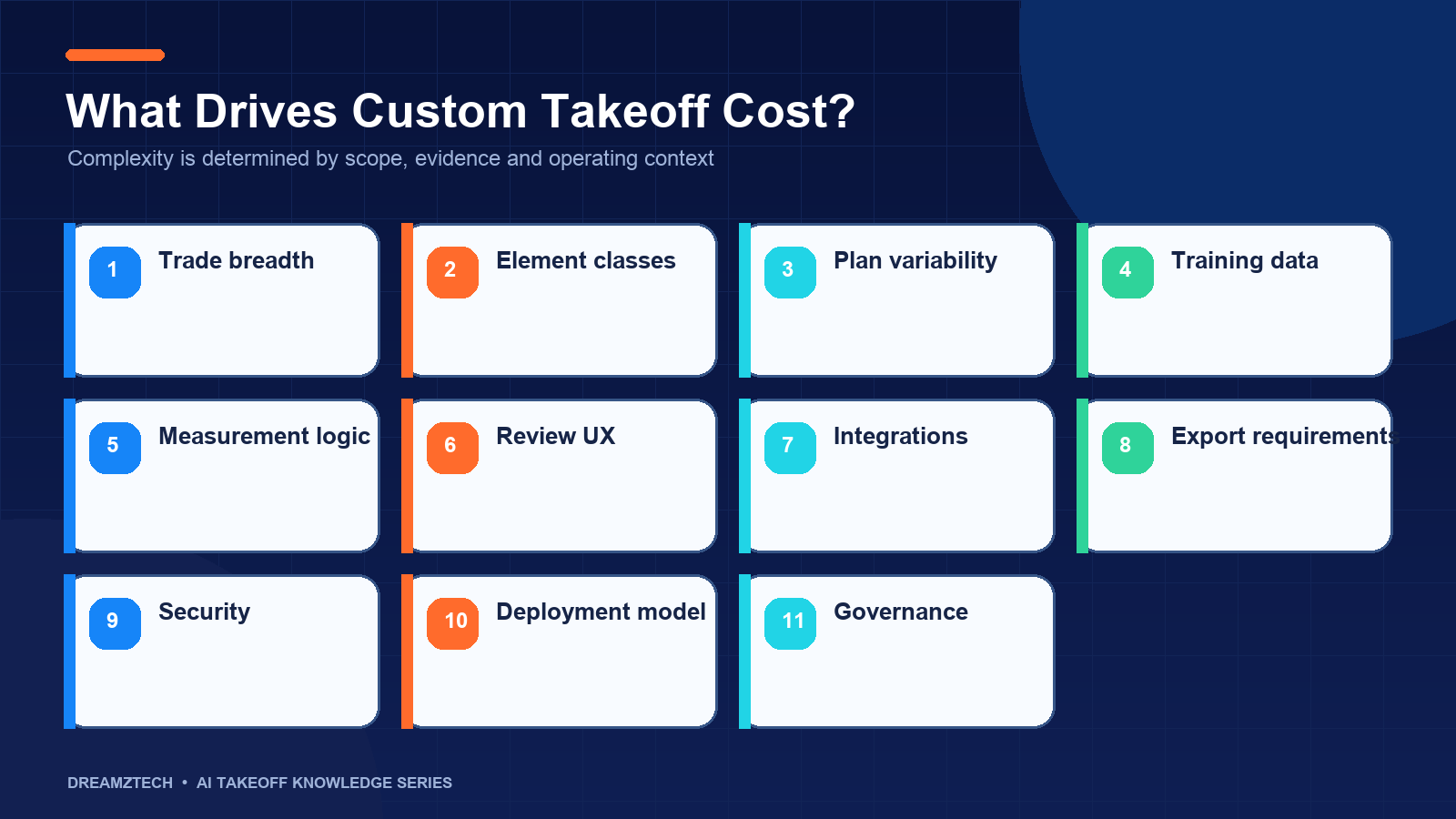
The eleven primary cost drivers
1. Trades in scope
Each trade introduces its own symbol vocabulary, measurement rules, schedules and validation sources.
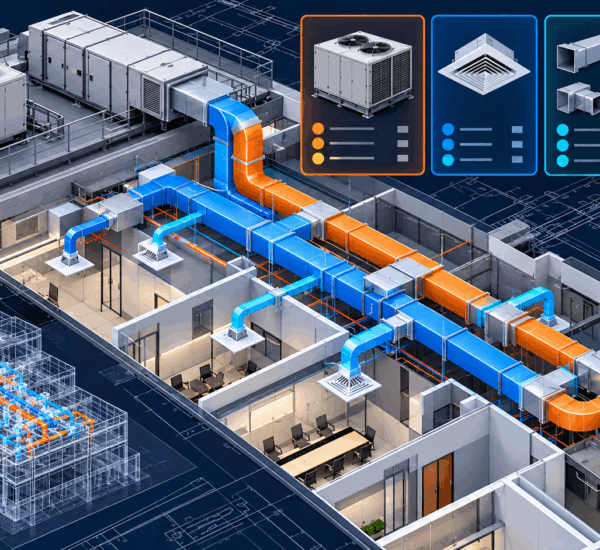
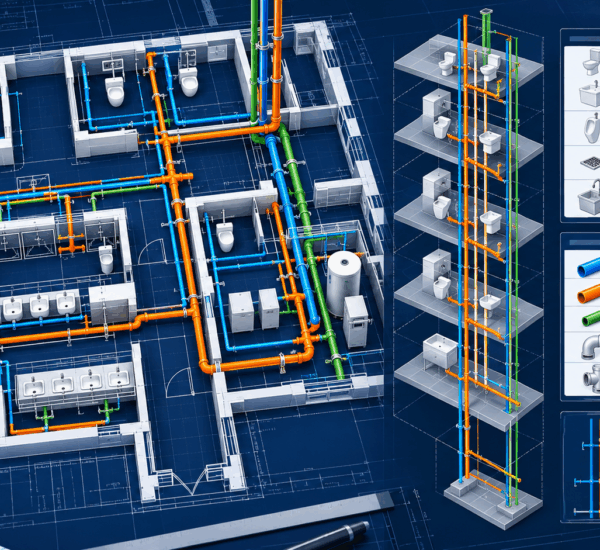
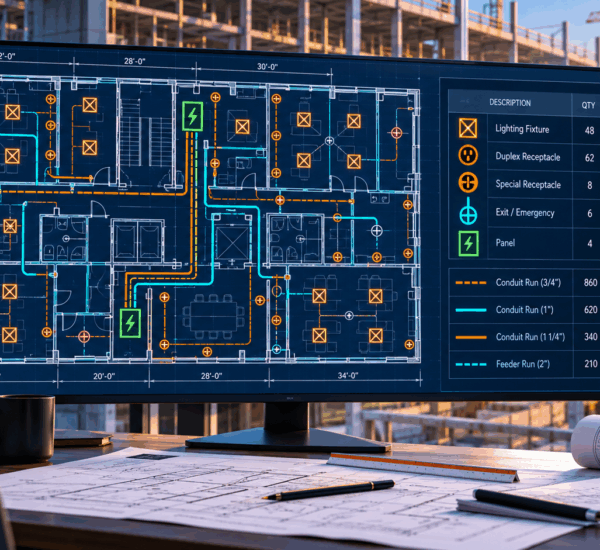
Electrical work may require device classes, fixture schedules, panels and measured routes. Plumbing adds fixtures, pipe systems, risers and vertical scope. HVAC introduces equipment schedules, air devices, duct sizes, fittings and surface-area derivations.
A shared application framework can serve multiple trades, but detection models, class taxonomies and test datasets still need trade-specific work. Start with the trade that creates the clearest recurring value.
2. Number and difficulty of quantity classes
Model scope should be written as an explicit class list. Ten common, visually distinct classes may be easier than three rare classes that look nearly identical.
Difficulty increases when:
- Symbols are very small
- Several classes differ by one mark or letter
- Callouts overlap other linework
- Symbols vary by design firm
- Context determines the classification
- The same object appears differently at different scales
Prioritize classes by business impact, frequency and review cost. Do not fund a long tail of rare classes in the first release unless they are commercially critical.
3. Drawing formats and quality
Vector PDFs, scanned PDFs, CAD files and BIM models require different ingestion paths. Even within PDF, resolution, skew, compression and layer structure change the problem.
If the organization receives many legacy scans, preprocessing and rejection rules become part of the product. If native CAD or BIM is required, file parsing, licensing and model semantics expand scope beyond visual PDF analysis.
The discovery dataset should represent normal quality, not only the best available drawings.
4. Training-data readiness
Custom detection requires examples and labels. Cost depends on whether the organization already has:
- Representative plan sets
- Permission to use them
- A stable class taxonomy
- Manually reviewed quantities
- Item locations or annotations
- Revision metadata
- Estimator availability for ambiguous cases
Historical takeoff spreadsheets are helpful but may not identify where each item appears. Additional annotation may be required to train and validate location-based models.
Data preparation often determines schedule more than model code. Treat it as a planned workstream with acceptance criteria.
5. Detection versus measurement complexity
Counting repeated symbols is different from tracing geometry.
Linear measurement may require scale calibration, path continuity, branch detection and separation by size or system. Area measurement may require closed-region interpretation and exclusion handling. Ductwork may require transformations from plan length and dimensions into surface-area or fabrication quantities.
Directly measured quantities should remain distinguishable from derived quantities produced by business rules.
6. Estimator-review interface
The review application is often as important as the model. A production workflow may need:
- Drawing viewer with overlays
- Class and confidence filters
- Accept, edit, reject and add controls
- Path editing
- Annotations and comments
- Keyboard shortcuts
- Review queues
- Approval states
- Correction history
- Project dashboards
- Export controls
A minimal proof-of-concept viewer and an efficient daily estimator workspace are different products. Prototype the review flow early with real users.
7. Revision and document-control workflow
Revision handling can include sheet registration, issue comparison, change-region detection, affected-quantity identification and re-approval.
Renovation projects may also need new, demolition and existing-to-remain separation. These are not cosmetic features. They influence the data model and audit history.
If revisions create significant manual rework today, include one real addendum in the first feasibility assessment.
8. Output mapping and integrations
Structured CSV or spreadsheet output is usually the lowest-risk first handoff. Scope increases when quantities must map to:
- Material assemblies
- Cost codes
- Estimating databases
- ERP records
- Project-management systems
- Procurement workflows
- Existing customer applications
Integration cost depends on documented APIs, authentication, rate limits, data models, error handling and test environments. A named platform does not guarantee a usable interface.
9. Identity, security and compliance
Enterprise systems may require SSO, role-based access, tenant isolation, encryption, audit logs, data residency, backup controls, vulnerability management and formal retention or deletion.
Security requirements should be defined before architecture is selected. Retrofitting isolation or identity controls after building the workflow is expensive and risky.
10. Deployment and performance
The architecture changes depending on whether the application runs in:
- A managed multi-tenant cloud
- A dedicated customer environment
- The customer’s cloud tenancy
- A private network
- An agreed on-premise deployment
Performance requirements also matter. An internal pilot processing a few projects per week differs from a product serving many users and large plan sets concurrently.
11. Ownership, support and maintenance
The commercial agreement should define ownership of application code, annotations, customer data, trained weights, configuration and third-party components.
After launch, budget for:
- Hosting and storage
- Model inference
- Monitoring
- Security updates
- Integration maintenance
- User support
- Data annotation
- Model evaluation and improvement
- Changes to target-system APIs
Software that is not operated does not remain production-ready.
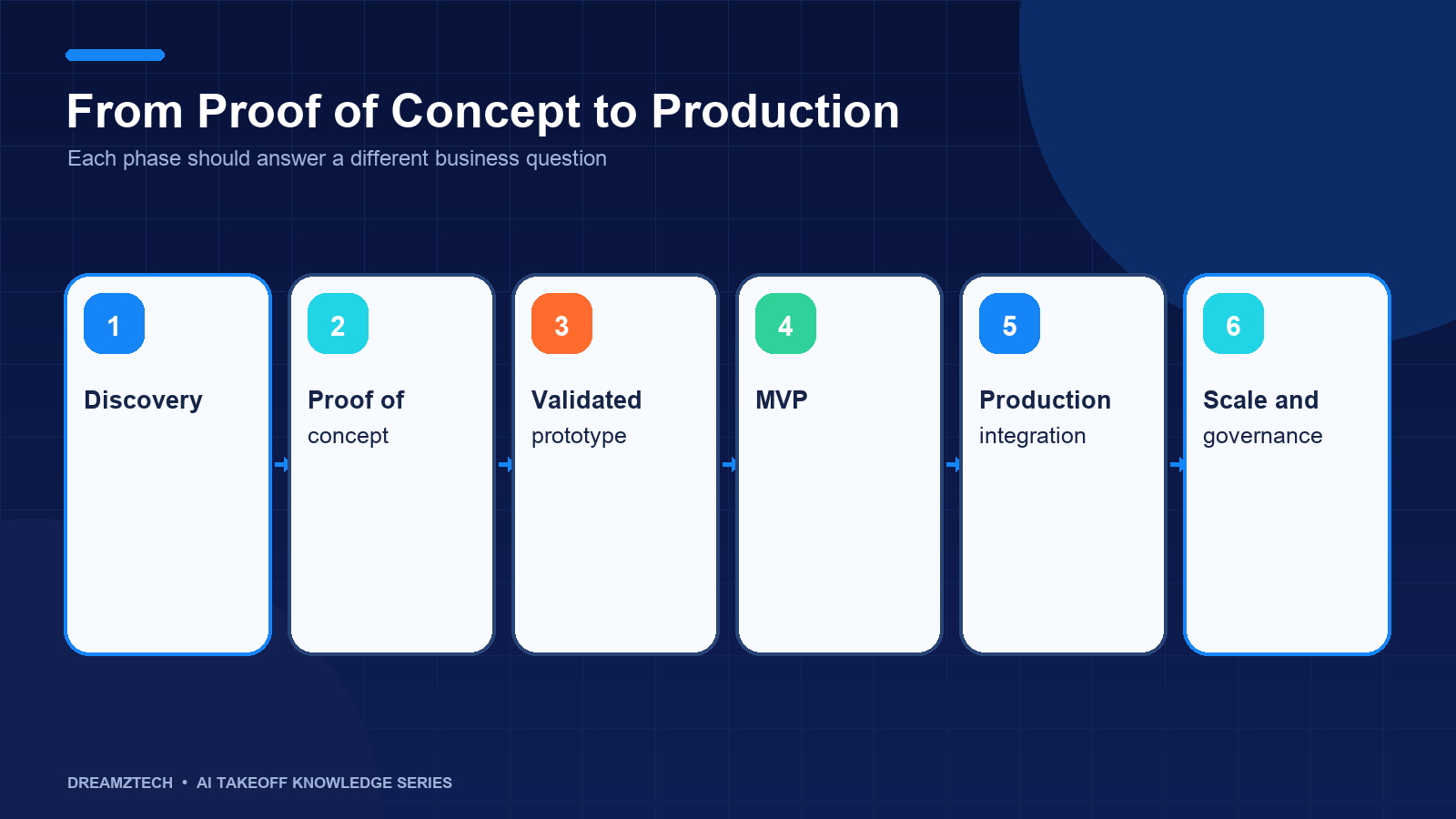
Cost by delivery stage
Rather than requesting one number for an undefined platform, budget in stages.
Stage 1: Discovery and feasibility
Discovery should produce:
- Defined business problem
- Representative drawing corpus
- Class taxonomy
- Current and target workflow
- Architecture options
- Data-readiness assessment
- Integration dependencies
- Security requirements
- Acceptance metrics
- Delivery roadmap
The output is a decision package, not just meeting notes. It should identify whether a product already fits, whether the custom requirement is feasible and what evidence is still missing.
Stage 2: Proof of concept
A proof of concept tests one or two high-risk assumptions. It may answer:
- Can the model distinguish the proprietary symbol classes?
- Can scale be calibrated reliably on the target drawings?
- Can revision differences be isolated?
- Can the target system accept the required output?
It should use a bounded dataset and written success criteria. A proof of concept is not hardened for production users, availability or security.
Stage 3: Minimum viable product
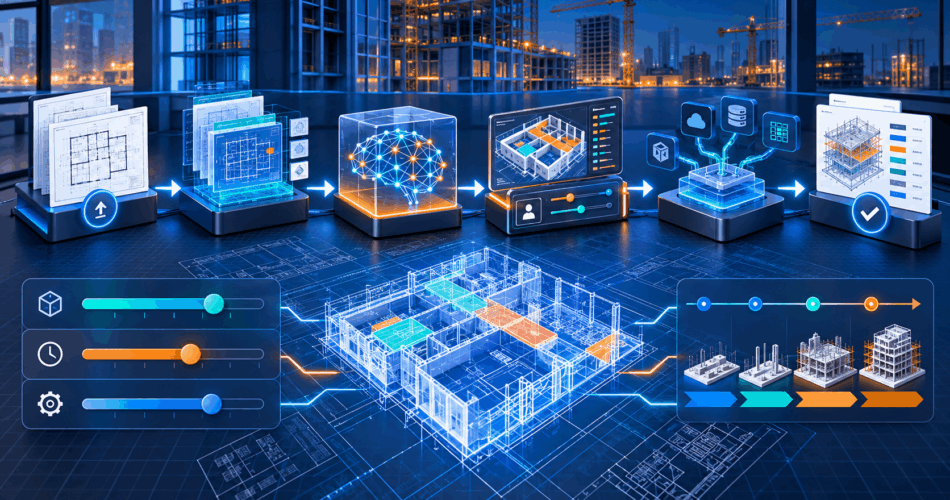
An MVP should complete an operational path for a defined scope:
- Upload supported drawings
- Process agreed classes
- Present evidence to an estimator
- Allow correction and approval
- Export reviewed quantities
- Record basic audit history
The MVP should be usable by a controlled group on real projects. Avoid expanding to every trade before one workflow proves value.
Stage 4: Production platform
Production work can add:
- Enterprise identity and permissions
- Multi-project operations
- Reliable job processing
- Error recovery
- Monitoring and alerts
- Security hardening
- Performance testing
- Integration reconciliation
- Backup and recovery
- Support procedures
- Model governance
These capabilities may not improve a demo screenshot, but they determine whether the system can be trusted in daily operations.
Stage 5: Continuous improvement
Estimator corrections reveal where models and rules need improvement. A controlled cycle collects, reviews and prioritizes this evidence, updates the system and validates changes on held-out drawings.
Continuous improvement should have a budget, owner and release process. It should not mean silently training on every customer drawing.
How timeline is determined
Timeline is driven by dependency order as much as engineering effort.
Common schedule dependencies include:
- Access to drawings and permissions
- Estimator time for taxonomy decisions
- Annotation throughput
- Availability of target-system documentation
- Security review
- Customer infrastructure access
- User acceptance testing
- Procurement or legal review
A technically small integration can block release if credentials or a sandbox are not available. Data annotation can stall if ambiguous examples wait for estimator decisions.
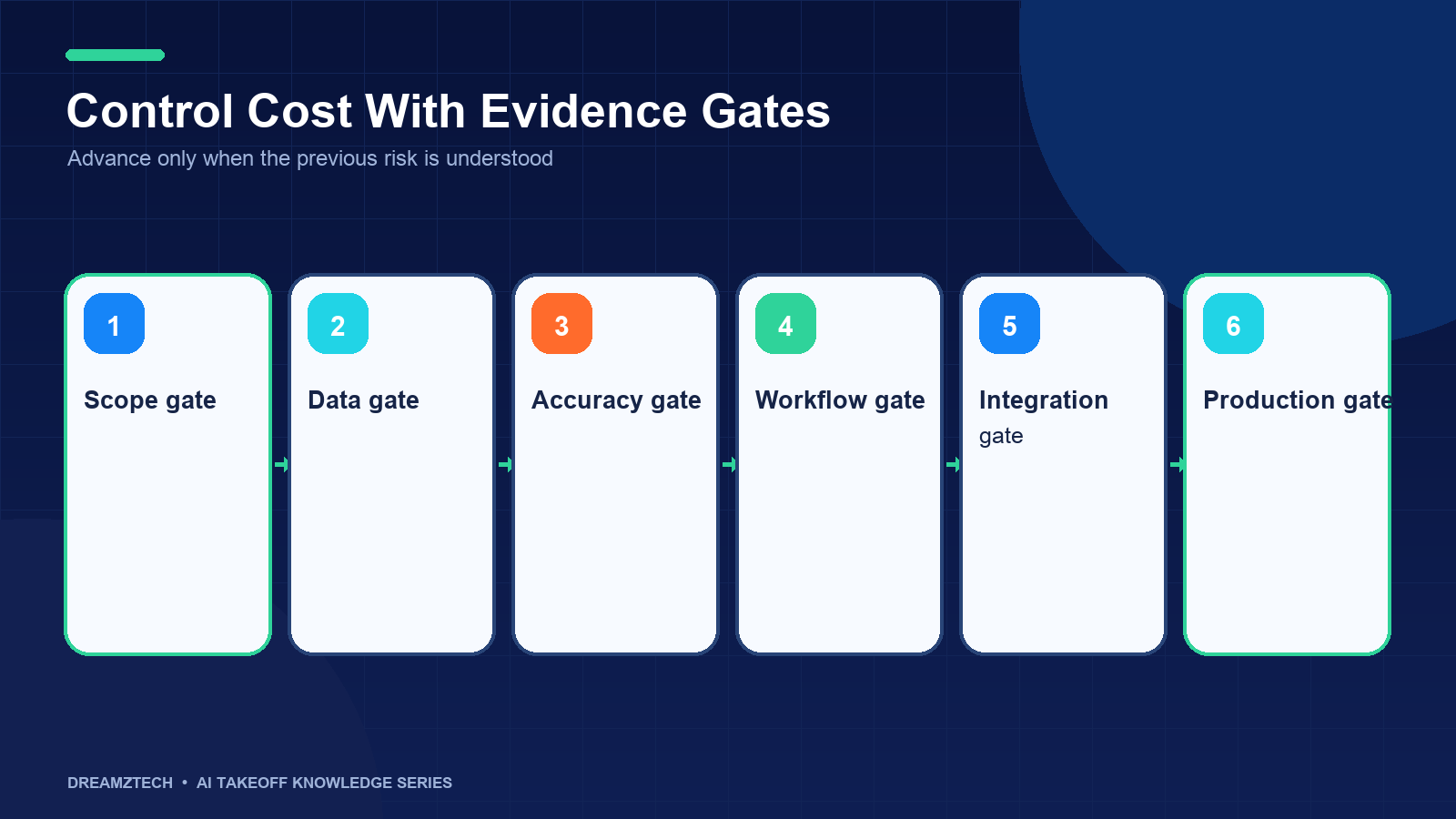
Build the schedule around decision gates:
- Feasibility approved
- Data and classes approved
- Proof-of-concept metrics accepted
- MVP workflow accepted
- Security and integration accepted
- Production release approved
What should be included in a proposal?
A useful proposal should identify:
- Supported inputs and exclusions
- Trades and classes in scope
- Direct and derived quantities
- Training-data assumptions
- Required customer participation
- Review and approval workflow
- Deliverables by phase
- Acceptance criteria
- Integration responsibilities
- Deployment architecture
- Security controls
- Ownership and licensing
- Hosting and third-party costs
- Warranty, support and maintenance
- Change-control process
If the proposal says “AI model development” without describing the operational workflow, it is incomplete.
Acceptance metrics that affect budget
Model acceptance may include precision and recall by class. Measurement acceptance may include error tolerances under defined scale and drawing conditions. Workflow acceptance may include review time and successful export.
Metrics should be segmented by:
- Trade
- Class
- Drawing quality
- Design convention
- Project type
- Measurement type
Do not promise one accuracy threshold for every input. Define unsupported conditions and required estimator review.
How to reduce cost without damaging the product
Begin with one high-value trade
Prove the architecture and review workflow before adding disciplines.
Limit the initial class taxonomy
Choose frequent and commercially important classes. Add rare classes after the main workflow is stable.
Start with structured export
Validate quantity value before building several integrations.
Use existing identity and cloud patterns
Where policy permits, reuse approved enterprise services rather than inventing custom infrastructure.
Separate direct and derived quantities
Do not train models to infer business rules that can be represented transparently in software.
Involve estimators early
Early workflow feedback prevents expensive rework in the review application.
Define rejection conditions
Allow the system to flag an unreadable or unsupported sheet instead of funding brittle attempts to automate every edge case.
Hidden costs buyers should plan for
Estimator participation
Subject-matter expertise is required for classes, annotations, rules and acceptance. Protect this time in the project plan.
Data permission and redaction
Client drawings may have contractual restrictions. Confirm whether they can be used for testing or training.
Integration ownership
The team controlling the target system must participate. External API changes may create future maintenance.
Change management
Estimators need training, workflow guidance and a way to report problems. Adoption cannot be solved only through interface design.
Production operations
Storage, inference, monitoring and support continue after development invoices end.
A budgeting worksheet for discovery
Before asking for a proposal, create a one-page budgeting worksheet. It should describe the smallest business outcome worth funding and the assumptions that can change scope.
Include:
- Target trade and project type
- Prioritized quantity classes
- Monthly or annual plan-set volume
- Drawing formats and typical quality
- Available labelled examples
- Required estimator actions
- Required export or integration
- Expected users and concurrency
- Deployment and security requirements
- Ownership expectations
- Internal subject-matter experts available
- Desired decision date
For each requirement, identify whether it is required for proof of concept, MVP or production. This prevents production controls from being omitted and prevents optional future ideas from inflating the first release.
The worksheet should also identify the cost of the current process. Use verified internal inputs such as estimator hours per project, rework caused by revisions, number of annual bids and effort required to re-key quantities. Do not turn these inputs into guaranteed savings. Use them to establish the threshold a new workflow must meet.
Finally, reserve contingency for data and integration discoveries. The first inspection may reveal inconsistent historical labels, unavailable APIs or security requirements that were not included in the initial request. A decision gate after feasibility allows the organization to revise or stop scope before committing to a larger build.
When custom development is not justified
Do not build custom software when:
- A product already supports the workflow
- The requirement appears on only one project
- There is no representative data
- Estimators cannot participate
- The expected volume is too low to support maintenance
- Ownership is desired but no operating team exists
- The real problem is inconsistent estimating process rather than missing software
A discovery engagement should be allowed to recommend a product or a manual process.
Frequently asked questions
Cost-control gates for the project sponsor
The sponsor should approve spending at evidence-based gates rather than funding the entire roadmap at once.
Gate 1: problem and data readiness
Confirm that the target workflow is recurring, valuable and supported by usable drawings and estimator participation. Stop if the problem can be solved through process standardization or an existing product.
Gate 2: technical feasibility
Review proof-of-concept results for the highest-risk classes or measurements. Confirm that failures are understood and that expected review effort is acceptable.
Gate 3: operational workflow
Require an estimator to complete intake, review, correction, approval and export. Do not approve production engineering based only on model metrics.
Gate 4: enterprise readiness
Confirm identity, security, monitoring, integration and support before broad rollout.
Gate 5: expansion
Add trades, classes or integrations only when usage evidence supports the investment.
At every gate, compare remaining development cost with verified current-process effort and expected operational value. Revisit assumptions when drawing volume, target systems or deployment requirements change.
This approach does not guarantee a return. It limits exposure, creates clear stop conditions and keeps technical ambition connected to estimator adoption and business demand.
Can DreamzTech provide a fixed price for custom AI takeoff software?
A fixed phase may be quoted after drawings, classes, workflow, integrations and acceptance criteria are defined. A full-platform price without those inputs would rely on assumptions.
Is the AI model the most expensive component?
Not always. Data preparation, review UX, integrations, security and production operations can require as much or more effort than model development.
Can we begin with a proof of concept?
Yes, when it tests a clearly defined risk using representative data and written success criteria. It should not be treated as a production release.
Can custom development use an existing takeoff product?
Potentially. A hybrid architecture can use product output and custom mapping or integration if commercial terms and technical interfaces allow it.
Who owns the trained model?
Ownership must be defined contractually. Customer drawings, annotations, trained weights, application code and third-party components may have different rights.
What information is required for an estimate?
Provide representative drawings, quantity classes, current workflow, expected users and volume, target systems, security requirements, deployment preferences and ownership expectations.
Scope the smallest production-worthy release
The right starting point is a bounded workflow with clear business value and verifiable acceptance. That allows the budget to follow evidence instead of ambition.
DreamzTech can assess your drawings, data readiness and estimating process, then propose a phased architecture covering models, estimator review, integrations and deployment. Discuss your custom AI takeoff software development requirements to establish scope before requesting a delivery estimate.