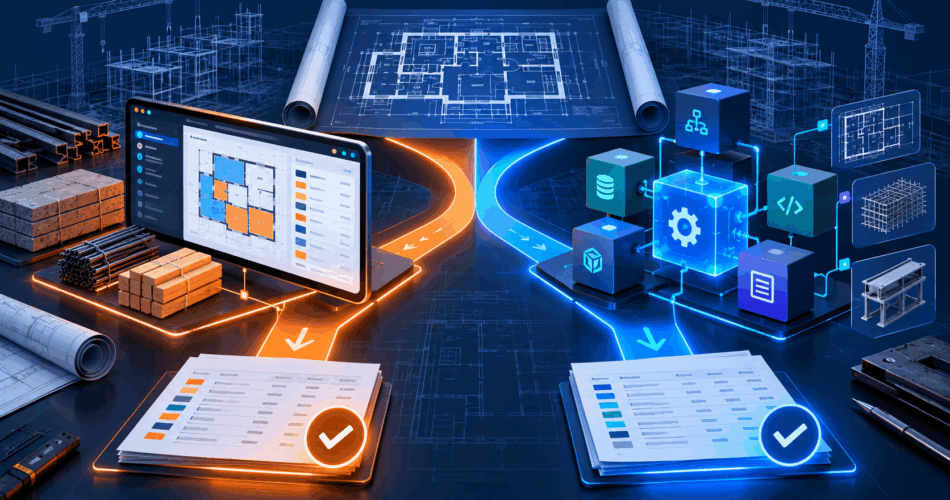
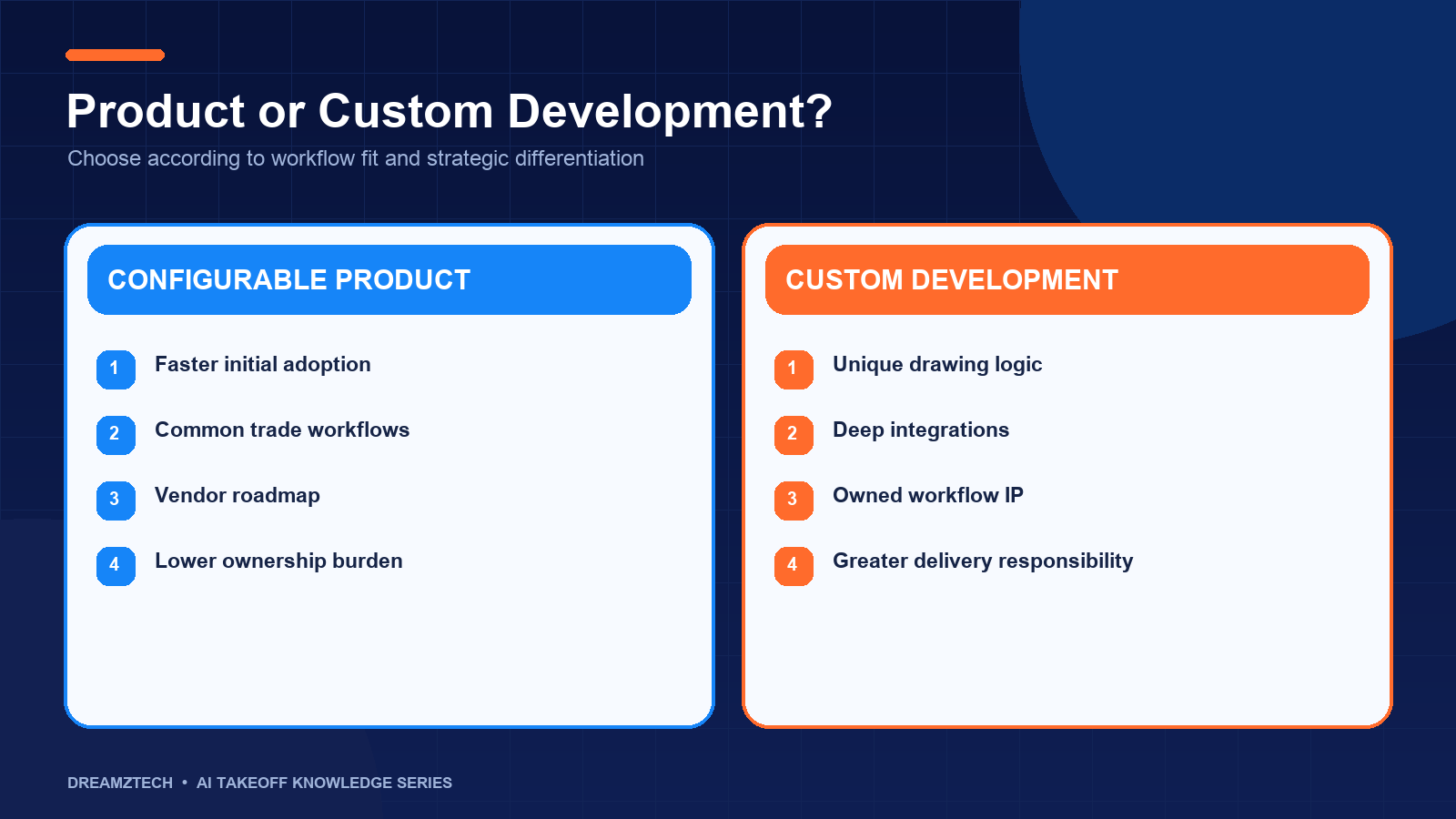
Ready-to-use AI takeoff software is usually the right choice when its supported drawings, trade quantities, review workflow and export options already match how your estimators work. Custom AI takeoff development is appropriate when proprietary symbols, specialized measurement rules, unique approvals, enterprise integrations, deployment requirements or software ownership make adaptation more expensive than building around the workflow.
The decision should not start with “product or custom?” It should start with a representative set of drawings and a specific operational problem. If a product can solve that problem with reasonable configuration, it is normally the faster and lower-risk route. If the product requires estimators to work around core limitations on every project, a custom application may create more durable value.
This guide compares both routes and provides a practical decision framework for construction firms, specialty contractors and software companies.
The short answer
Choose an AI takeoff product when you need a deployable workflow for supported quantity classes and can adapt your process to its established controls. Choose custom AI takeoff software development when the system must be trained on your drawing conventions, embedded into your software, governed by your approval model or engineered for specific integrations and deployment constraints.
Before committing to either route, run a product evaluation using your own plan set. DreamzTech’s AI takeoff software demo is designed to determine whether an available workflow fits, where configuration is required and when a custom build is justified.
What ready-to-use AI takeoff software provides
A productized takeoff application offers a defined set of capabilities that can be demonstrated before purchase. These may include:
- PDF plan-set upload and sheet organization
- Symbol or element detection for supported trades
- Counts, linear measurements and areas
- Plan-scale calibration
- Estimator review and correction controls
- Structured quantity exports
- User, project and permission management
The product team has already made decisions about the user interface, data model, supported classes, hosting model and release process. That reduces the time and cost required to reach first use.
The trade-off is that your business must operate within the product’s boundaries. Configuration can change mappings, categories and some workflow settings, but it cannot automatically create a new architecture or transfer product ownership.
What custom AI takeoff development provides
A custom build starts with your drawings, estimators, business rules and target systems. It may include:
- A project-specific or organization-specific symbol taxonomy
- Custom detection models for proprietary callouts
- Specialized measurement and derivation rules
- A review interface designed around your roles and approvals
- Revision comparison and change-impact workflows
- Assembly, cost-code or bill-of-quantity mappings
- APIs and integrations with existing enterprise systems
- Private-cloud, customer-tenancy or agreed on-premise deployment
- Monitoring, analytics and model-improvement processes
Custom development creates flexibility, but it also creates responsibilities. Training data must be prepared. Acceptance criteria must be defined. Integrations depend on external systems. Models require monitoring. Hosting, support, security and long-term maintenance must be planned.
Custom does not mean automatically better. It means the investment is directed toward requirements that a suitable product cannot meet.
Side-by-side comparison
| Decision area | Ready-to-use product | Custom development |
|---|---|---|
| Starting point | Existing application | Discovery and feasibility |
| Time to first evaluation | Shorter | Longer |
| Symbol coverage | Existing supported classes | Trained or configured for agreed classes |
| Workflow flexibility | Product settings and configuration | Designed around target workflow |
| Integrations | Existing exports or supported interfaces | Engineered to documented target interfaces |
| Deployment | Product hosting options | Agreed cloud, private or enterprise environment |
| Ownership | Licensed use | Contract-defined source code, data and model terms |
| Maintenance | Product vendor roadmap | Customer and development-partner responsibility |
| Upfront investment | Generally lower | Generally higher |
| Best fit | Standardized use case | Differentiated or embedded capability |
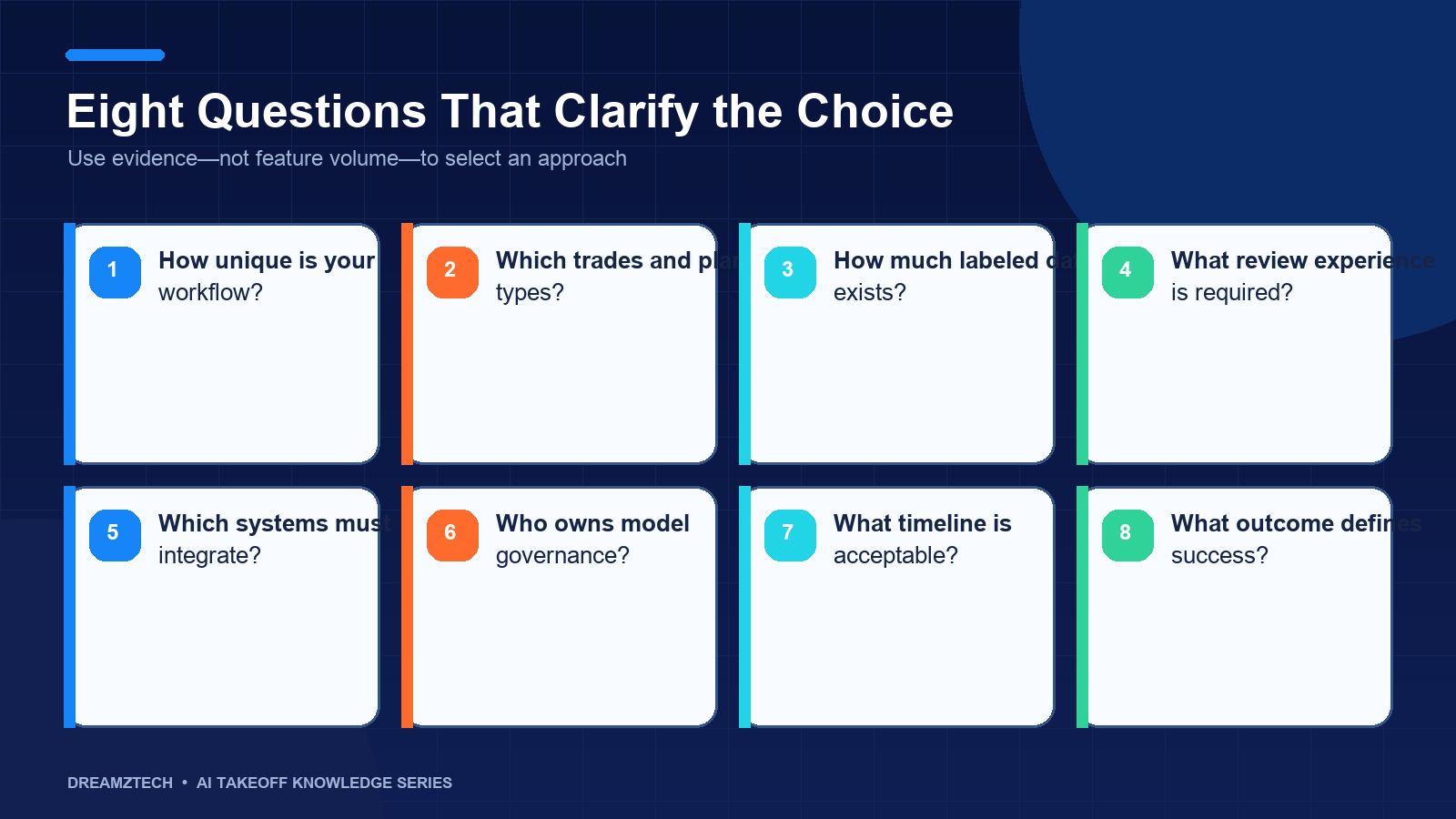
Eight questions that determine the right route
1. Are your drawing conventions standard or proprietary?
Products perform best when their supported classes resemble the symbols and linework in your drawings. If most projects use recognizable conventions, a product evaluation may confirm a fit quickly.
Custom development becomes more relevant when drawings contain proprietary equipment, internal symbols, uncommon callouts or design conventions that are central to the workflow. The requirement should be supported by a representative corpus, not one unusual project.
2. Which quantities must be produced?
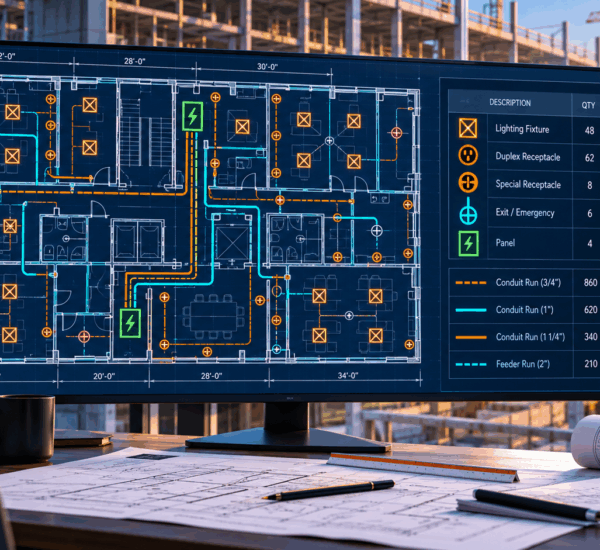
Define the required output at class level. “Electrical takeoff” is too broad. A contractor may need lighting fixtures, receptacles, fire-alarm devices, conduit runs and panel reconciliation. Another may need only device counts.
If the product supports the commercially important classes, configuration may be enough. If missing classes represent a recurring portion of every bid, custom model and interface work may be justified.
3. How specialized are the measurement rules?
Products may support counts, plan lengths and areas. Your estimating process may also require rules for drops, risers, fittings, waste, insulation, hangers, repeated units or fabrication allowances.
Some rules can remain in estimating. Others may need to appear in the review interface with explicit assumptions. Custom development is useful when the derivation is a repeatable competitive process that must be standardized and audited.
4. How should estimators review and approve quantities?
Most teams need accept, edit and reject controls. Enterprise workflows may require:
- Role-based review queues
- Two-stage approval
- Trade-specific reviewers
- Project or client permissions
- Required correction reasons
- Audit timestamps
- Revision re-approval
- Exception escalation
If the product’s review model is compatible, do not rebuild it. If approval logic is essential and cannot be represented, custom workflow engineering becomes a legitimate requirement.
5. Where must approved quantities go?
A spreadsheet export may be sufficient for the first release. Some organizations need quantities mapped to assemblies, cost codes, estimating applications, ERP platforms or project-management systems.
Integration difficulty depends on the target interface, authentication method, data model and ownership of the receiving system. A request to “integrate with our ERP” is not a specification.
Choose a product when its export can be adopted without harmful re-keying. Consider custom development when the takeoff must be embedded in a larger transaction or approval flow and the necessary interfaces are available.
6. What are the deployment and security requirements?
Construction drawings may include confidential client information, controlled facilities or commercially sensitive designs. Buyers should define:
- Data location and residency
- Tenant separation
- Encryption requirements
- Identity provider and SSO
- Role-based access
- Retention and deletion
- Logging and audit evidence
- Restrictions on model training
- Vendor and subcontractor access
A product may already meet these needs. If not, a private environment or customer-controlled deployment may require custom engineering and ongoing operational support.
7. Do you need to own the software or use it?
Licensing a product does not transfer source code or model ownership. If owning, embedding or commercializing the capability is a strategic requirement, those terms must be addressed in a development agreement.
Ownership is not one line. The agreement should distinguish application source code, training annotations, customer drawings, model weights, pretrained components, third-party libraries and deployment scripts.
8. Who will operate and improve the system?
A custom system needs a production owner. Someone must monitor failures, review correction data, approve model changes, manage integrations and respond when drawing conventions shift.
If the organization does not want that operational responsibility, a product is often the better fit even when some manual workarounds remain.
When a product is the better decision
A ready-to-use product is usually preferable when:
- The supported trades and quantities cover the main use case
- Your PDF plan quality is compatible
- Estimators can use the existing review flow
- Structured file output is sufficient
- Product hosting satisfies security requirements
- You need faster evaluation and adoption
- The capability is useful but not a unique software asset
The strongest product-selection process uses a known project, records corrections and measures time to approved output. It does not rely solely on a generic feature list.
When custom development is justified
Custom development becomes more defensible when:
- Proprietary symbols or equipment recur across a large drawing corpus
- Measurement rules encode important internal expertise
- Takeoff must be embedded in an existing platform
- The approval model cannot fit a generic review queue
- Several enterprise systems must exchange traceable quantity data
- Deployment or data-control requirements are non-negotiable
- The organization wants to own or commercialize the capability
- The volume of recurring work can support development and maintenance
One difficult drawing is not enough. The requirement should be repeatable, valuable and supported by data.
A hybrid path is often the most practical
Product and custom development are not always mutually exclusive. A company can use a product for supported trades while engineering specific extensions around it, assuming the product provides suitable exports or interfaces.
Examples include:
- Product detection with a custom assembly-mapping service
- Standard review interface with a custom ERP connector
- Product workflow for common drawings and custom model for proprietary classes
- Product pilot used to define requirements for a later embedded application
The hybrid approach reduces the number of problems that must be solved at once. It also produces real usage evidence before a larger investment.
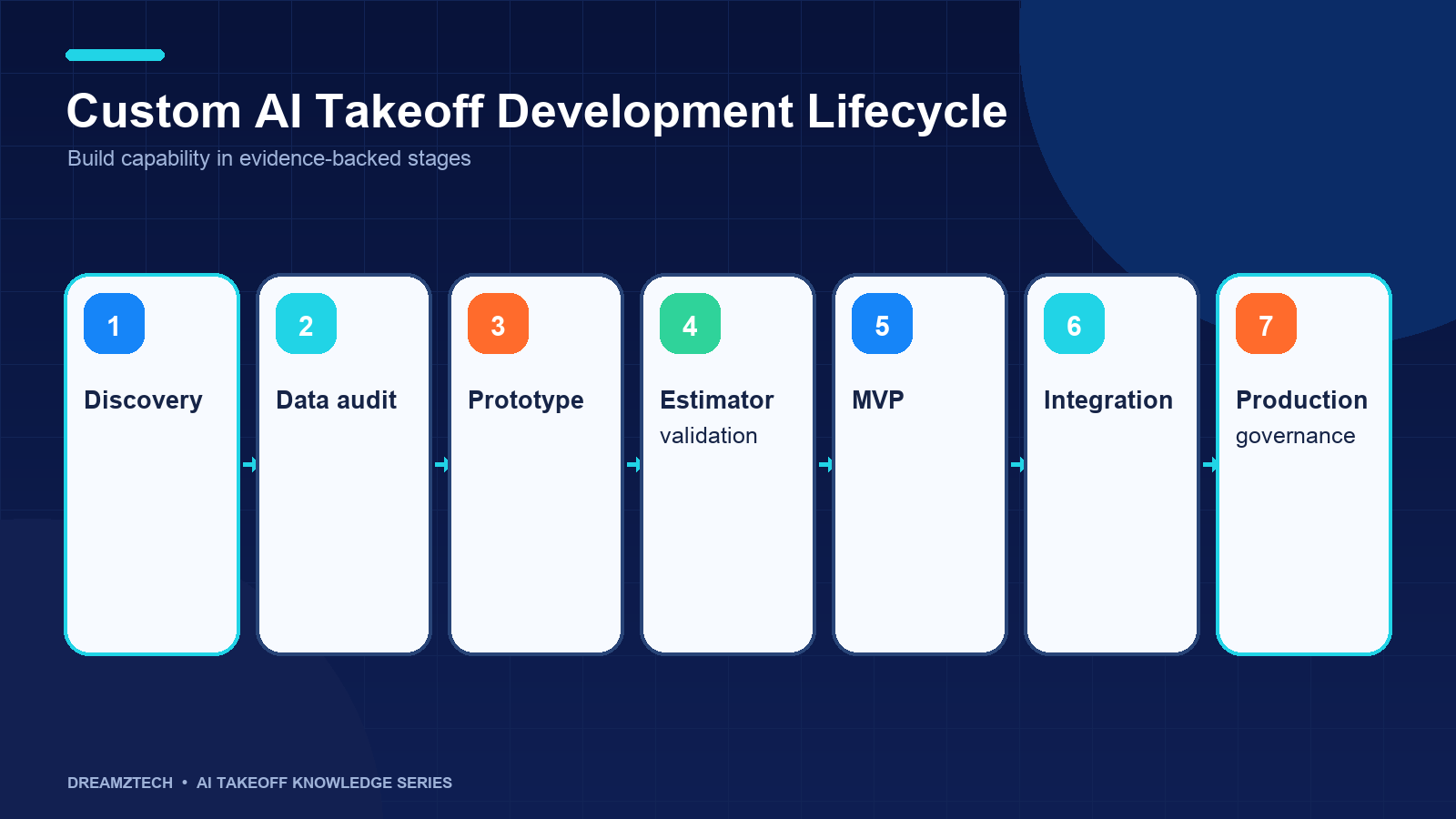
The custom-development lifecycle
Discovery
Document trades, quantities, drawing formats, review steps, system interfaces, deployment constraints and business outcomes.
Feasibility assessment
Test representative drawings, inspect data quality, identify existing model coverage and define what must be configured, trained or engineered.
Proof of concept
Validate the highest-risk technical assumption on a limited dataset. A proof of concept is not a production application and should not be presented as one.
MVP development
Build the smallest operational workflow that includes intake, detection or measurement, review, approval and export for a bounded scope.
Production validation
Test on held-out drawings, document acceptance by class, perform security and performance testing, and confirm integration behavior.
Operation and improvement
Monitor correction patterns, system failures, drawing drift and integration health. Establish ownership for releases and support.
Cost comparison without misleading price ranges
Product pricing is usually shaped by licensing, users, projects, consumption or commercial packaging. Custom-development cost is shaped by engineering scope.
The largest custom cost drivers are:
- Number of trades and quantity classes
- Volume and quality of training data
- Need for annotation
- Counts versus complex geometry
- Review-interface depth
- Revision handling
- Integrations
- Security and deployment
- Performance and concurrency
- Ownership and maintenance terms
A credible estimate requires drawing review and architectural discovery. A price quoted before those inputs are understood is a sales assumption, not a delivery plan.
How to run the decision workshop
Bring the following to a product-versus-custom workshop:
- Two or three representative plan sets
- A completed takeoff for comparison
- List of required quantities by class
- Current review and approval process
- Output examples
- Target systems and interface documentation
- Security and deployment requirements
- Ownership expectations
- Expected project volume
- Business decision and budget owner
Score each requirement as mandatory, valuable or optional. Then mark whether the product supports it, can be configured, requires an external process or requires engineering. This prevents optional features from distorting the decision.
Three decision examples
Example 1: Electrical contractor evaluating device counts
The contractor needs lighting, receptacle and switch counts from vector PDFs. The existing product supports the important classes, provides visible detections and exports reviewed quantities to a spreadsheet. Proprietary symbols occur only occasionally and can be handled through manual review.
Recommended route: adopt the product for supported classes. Building a custom platform would duplicate available capability without solving a recurring strategic problem.
Example 2: Plumbing contractor with proprietary assemblies
The contractor uses consistent internal takeoff rules across a high volume of multifamily projects. Required output combines fixture counts, riser logic, typical-unit exceptions and assembly mappings into an existing estimating database. Generic product exports require extensive rework on every bid.
Recommended route: evaluate the product for base detection, then scope either a hybrid integration or custom workflow. The decision depends on whether the product exposes enough item-level data and whether the proprietary rules create measurable recurring value.
Example 3: Software company adding takeoff to its platform
The company needs a branded, embedded workflow with its own identity model, customer permissions, application data model and commercial roadmap. It expects to sell the capability to its customers and requires defined source-code and model rights.
Recommended route: custom development. The requirement is not simply to use takeoff software; it is to create and operate a takeoff product inside another software offering.
How to avoid overbuilding the custom route
Even when custom development is justified, the first release should not attempt every trade, input and integration. Define one end-to-end workflow that produces value:
- One representative drawing type
- One prioritized trade
- A bounded class list
- One estimator-review path
- One approved output format
- One deployment environment
Additional trades and integrations can be added after the first workflow proves technical and operational fit. This phased approach protects budget and creates real correction data for later decisions.
Frequently asked questions
Procurement questions for either route
Whether selecting a product or custom partner, procurement should request evidence that aligns with the operational decision.
For a product, confirm:
- Current supported capabilities versus roadmap items
- Licensing basis and usage limits
- Hosting, retention and deletion terms
- Support coverage and response expectations
- Export availability and API terms
- Customer-data use in model improvement
- Contract termination and data return
For custom development, confirm:
- Phase deliverables and acceptance gates
- Customer responsibilities for data and review
- Ownership of code, annotations and trained weights
- Third-party component terms
- Security and deployment responsibilities
- Warranty, support and maintenance
- Change-control rates and process
In both cases, ask how unsupported drawings are handled. A controlled rejection or review flag is preferable to a plausible result produced outside the tested operating range.
Also document the exit path. A product buyer should know how approved quantities and audit records can be exported. A custom-development buyer should know how the application will be operated if the original development team changes. These questions may not affect the first demonstration, but they influence long-term cost and risk.
Procurement evidence should complement, not replace, the estimator’s technical evaluation. Commercially attractive terms cannot compensate for incomplete quantity coverage or an inefficient review process.
Is custom AI takeoff development more accurate than a product?
Not automatically. Custom development can target specific drawings and classes, but results still depend on training data, model design and review. Both routes should be tested using representative drawings.
Can a product be customized later?
Products may offer configuration, APIs or commercial extensions. Confirm the actual boundary with the vendor. Configuration is not the same as source-code customization.
How long does a custom takeoff build take?
Timeline depends on discovery, data readiness, model scope, review UX, integrations and deployment. A proof of concept, MVP and production system are different commitments.
Should a contractor build its own model?
Only when the differentiated requirement, data volume and recurring value justify both development and operation. If a product fits, building a duplicate capability creates unnecessary risk.
Can a custom system include estimating?
It can connect approved quantities with assemblies, pricing or labor workflows, but that materially expands scope. Takeoff and estimating responsibilities should remain explicit.
What should be tested first?
Test the highest-value, highest-risk requirement using representative drawings. That is often a proprietary symbol class, scale-dependent measurement or critical system integration.
Choose the smallest solution that solves the real problem
The best decision is not the most technically ambitious one. It is the route that produces trusted quantities, fits estimator review, reaches downstream systems and can be operated responsibly.
Start by evaluating the available workflow. If it fits, adopt it. If recurring gaps remain, turn those gaps into specific custom requirements. DreamzTech can assess drawings, define the architecture and build the detection, measurement, review and integration components needed for a differentiated workflow. Discuss custom AI takeoff software development.