AI Customer Support Agents: Architecture, Use Cases and Implementation is designed for teams moving from AI experimentation to a governed business capability. The useful question is not whether a model can produce an impressive answer. It is whether a system can complete a defined job, use approved data and tools, stop at the right boundary, recover from failure, and leave evidence that people can audit.
This guide takes a customer-service implementation guide covering resolution, not just answer generation. It separates proven engineering patterns from marketing shorthand and gives buyers, product leaders and technical teams a shared way to make decisions.
Quick answer: A reliable AI customer support agent initiative starts with one bounded workflow, explicit success and failure criteria, narrow permissions, representative evaluation cases, human control over consequential actions, and a measured rollout. Model selection matters, but the surrounding software and operating controls usually determine whether the agent survives production.
What readers should take away
- How to evaluate AI customer support agent without confusing a prototype with a production system
- Which architecture and operating controls matter most
- How to define a safe first release and measurable acceptance criteria
- Where DreamzTech services, solutions and implementation evidence can support the next step
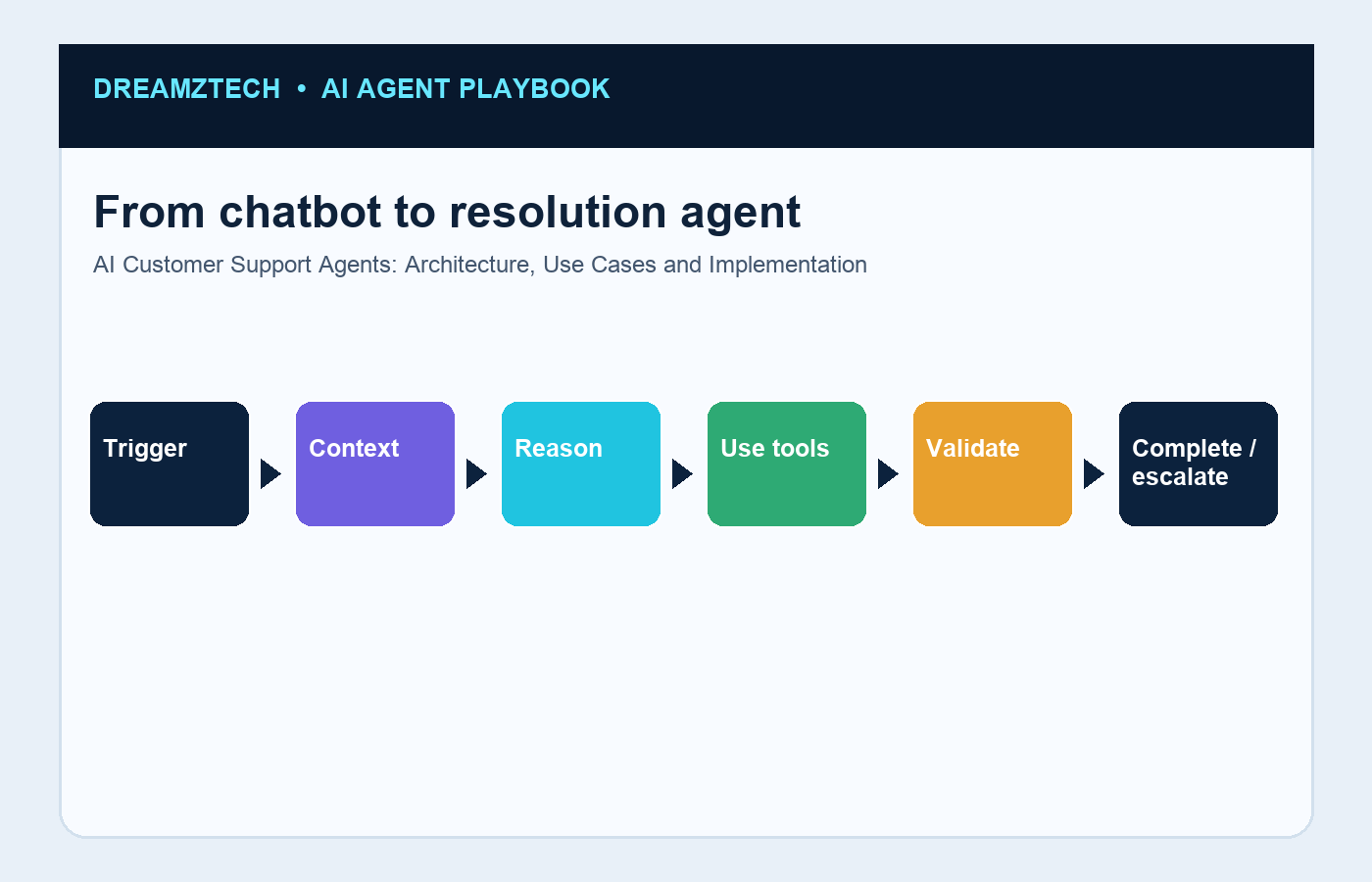
From chatbot to resolution agent
Start by naming the actor, trigger, inputs, systems of record, permitted actions and completion condition. If the team cannot draw the workflow and identify its owner, an agent will inherit that ambiguity. The first design artefact should therefore be an operational boundary, not a prompt.
Support automation creates value when it can resolve a bounded request, not merely generate a reply. Identity verification, account context, approved actions and a clean escalation package are the essential parts of the architecture.
- Define a named owner and measurable completion condition
- Limit tools and data to the minimum required
- Add explicit exception, escalation and recovery paths
- Test with representative and adversarial scenarios
Reference architecture for support agents
Separate deterministic business rules from model judgement. Validation, permissions, monetary limits, routing rules and irreversible actions belong in explicit software controls. The model can interpret messy input and select among allowed tools, but it should not invent its own authority.
Support automation creates value when it can resolve a bounded request, not merely generate a reply. Identity verification, account context, approved actions and a clean escalation package are the essential parts of the architecture.
- Define a named owner and measurable completion condition
- Limit tools and data to the minimum required
- Add explicit exception, escalation and recovery paths
- Test with representative and adversarial scenarios
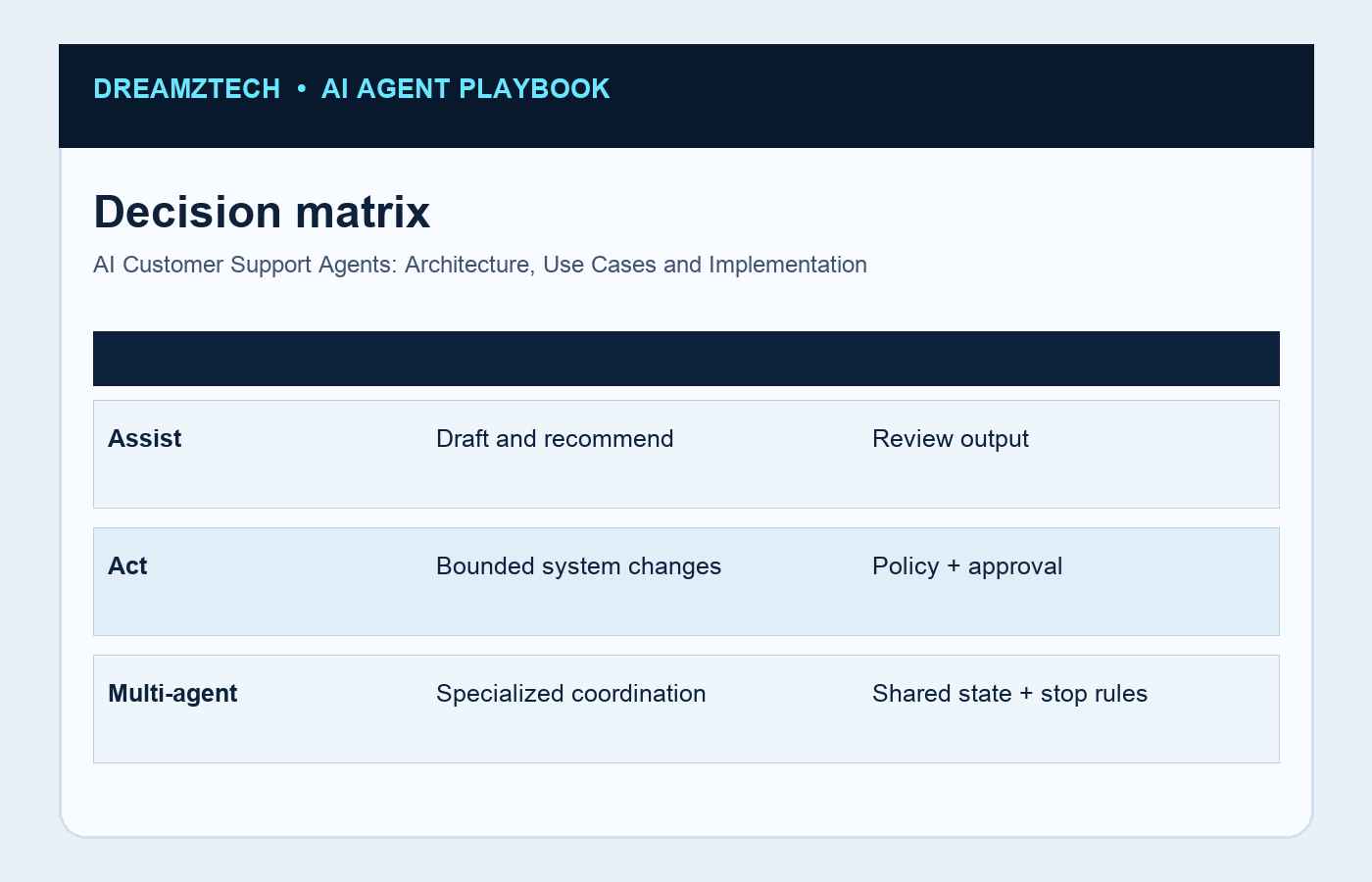
Use cases across channels
Treat every tool as a contract. Define accepted inputs, returned outputs, timeouts, idempotency behaviour, error classes and the credentials required. Narrow tools make an agent easier to test, easier to revoke and much easier to explain during a security review.
Support automation creates value when it can resolve a bounded request, not merely generate a reply. Identity verification, account context, approved actions and a clean escalation package are the essential parts of the architecture.
- Define a named owner and measurable completion condition
- Limit tools and data to the minimum required
- Add explicit exception, escalation and recovery paths
- Test with representative and adversarial scenarios
Knowledge grounding and customer context
Ground the agent in the minimum context needed for the task. Retrieval should respect the requesting user's entitlements, cite the underlying record where practical, and abstain when evidence is incomplete. More context is not automatically better context.
Support automation creates value when it can resolve a bounded request, not merely generate a reply. Identity verification, account context, approved actions and a clean escalation package are the essential parts of the architecture.
- Define a named owner and measurable completion condition
- Limit tools and data to the minimum required
- Add explicit exception, escalation and recovery paths
- Test with representative and adversarial scenarios
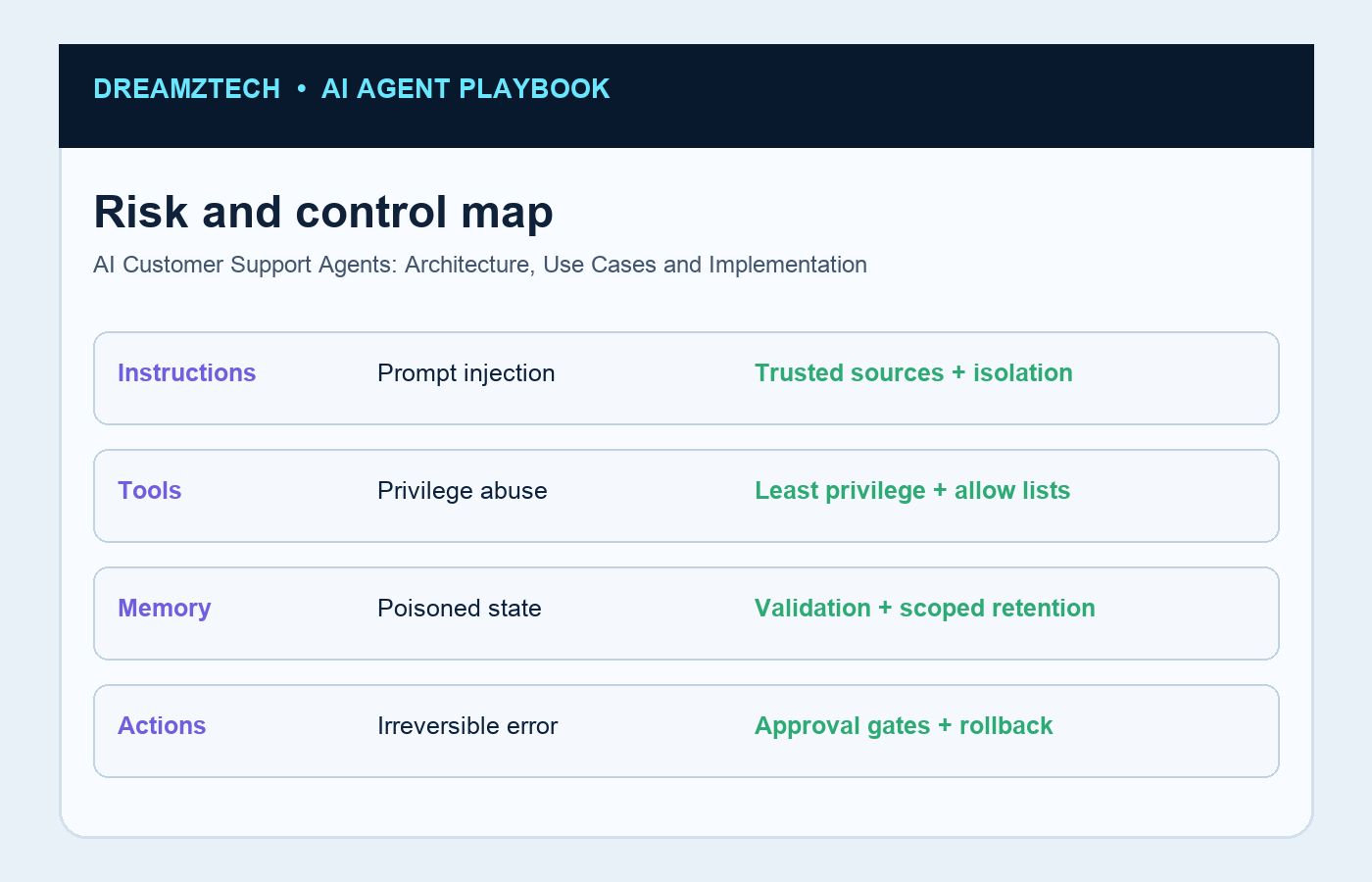
Safe actions and escalation design
Evaluate complete trajectories rather than final prose. A successful run uses the right data, chooses the right tool, handles partial failure, requests approval when required and stops when the job is complete. Scenario suites should include normal cases, edge cases, malicious inputs and dependency outages.
Support automation creates value when it can resolve a bounded request, not merely generate a reply. Identity verification, account context, approved actions and a clean escalation package are the essential parts of the architecture.
- Define a named owner and measurable completion condition
- Limit tools and data to the minimum required
- Add explicit exception, escalation and recovery paths
- Test with representative and adversarial scenarios
Helpdesk, CRM and order integrations
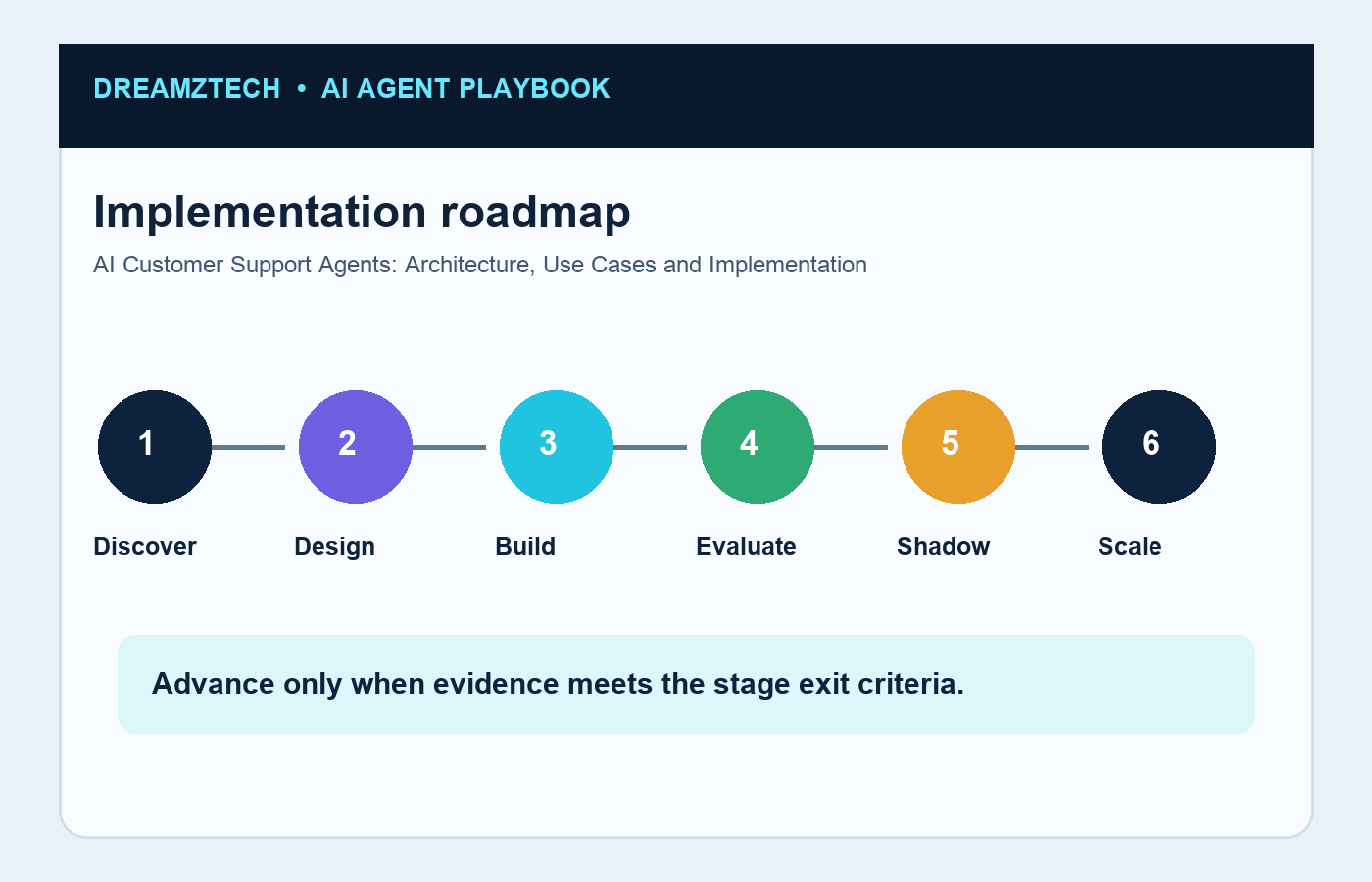
Release in stages: offline evaluation, a sandbox connected to test systems, shadow mode in which the agent proposes without acting, a narrow live slice, and only then broader authority. Each stage needs an owner, exit criteria, a tested disable path and a rollback plan.
Support automation creates value when it can resolve a bounded request, not merely generate a reply. Identity verification, account context, approved actions and a clean escalation package are the essential parts of the architecture.
- Define a named owner and measurable completion condition
- Limit tools and data to the minimum required
- Add explicit exception, escalation and recovery paths
- Test with representative and adversarial scenarios
Quality and service metrics
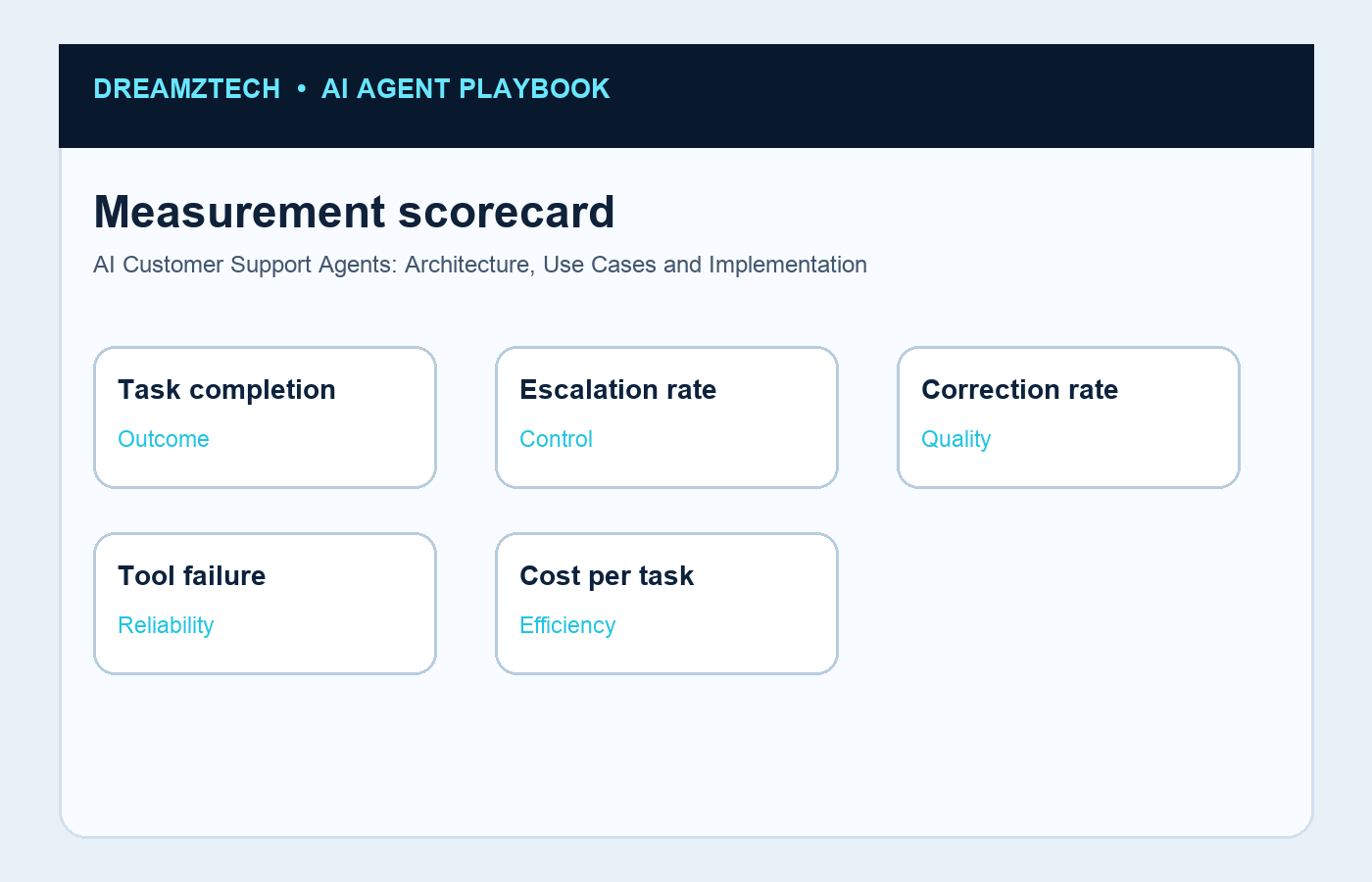
Measure task outcomes, not token activity. Useful metrics include completion rate, escalation rate, correction rate, tool-call failure rate, latency, cost per completed task, policy violations and business impact. Review the failures behind the averages because they reveal where controls or workflow design need attention.
Support automation creates value when it can resolve a bounded request, not merely generate a reply. Identity verification, account context, approved actions and a clean escalation package are the essential parts of the architecture.
- Define a named owner and measurable completion condition
- Limit tools and data to the minimum required
- Add explicit exception, escalation and recovery paths
- Test with representative and adversarial scenarios
Deployment playbook
Ownership continues after launch. Business operations owns the outcome and policy; engineering owns reliability and integration; security owns control requirements; and a named product owner decides what changes. Models, prompts, APIs and source data drift, so evaluation and review must be continuous.
Support automation creates value when it can resolve a bounded request, not merely generate a reply. Identity verification, account context, approved actions and a clean escalation package are the essential parts of the architecture.
- Define a named owner and measurable completion condition
- Limit tools and data to the minimum required
- Add explicit exception, escalation and recovery paths
- Test with representative and adversarial scenarios
Recommended next step
Use this guide to create a one-page scope, then compare it with DreamzTech’s AI agents for customer service automation, AI customer support agent development, enterprise support automation case study. The purpose of these links is to move a reader from education to the most relevant service or proof page without making this article compete with the commercial landing page.
Turn one workflow into a production plan
Select a repeatable ticket category and define the safe resolution boundary.
Frequently asked questions
What is an AI customer support agent?
A useful answer depends on workflow scope, action authority, data sensitivity, integrations and acceptance criteria. Start with a bounded task, narrow permissions, representative tests and a clear human escalation path; expand only when evidence supports it.
How is it different from a chatbot?
A useful answer depends on workflow scope, action authority, data sensitivity, integrations and acceptance criteria. Start with a bounded task, narrow permissions, representative tests and a clear human escalation path; expand only when evidence supports it.
Can it resolve tickets automatically?
A useful answer depends on workflow scope, action authority, data sensitivity, integrations and acceptance criteria. Start with a bounded task, narrow permissions, representative tests and a clear human escalation path; expand only when evidence supports it.
How does it avoid hallucinated answers?
A useful answer depends on workflow scope, action authority, data sensitivity, integrations and acceptance criteria. Start with a bounded task, narrow permissions, representative tests and a clear human escalation path; expand only when evidence supports it.
When should it escalate to a human?
A useful answer depends on workflow scope, action authority, data sensitivity, integrations and acceptance criteria. Start with a bounded task, narrow permissions, representative tests and a clear human escalation path; expand only when evidence supports it.
Editorial note: This article provides general technology and implementation guidance, not legal, medical or compliance advice. Requirements should be validated for the organization, jurisdiction and use case.